
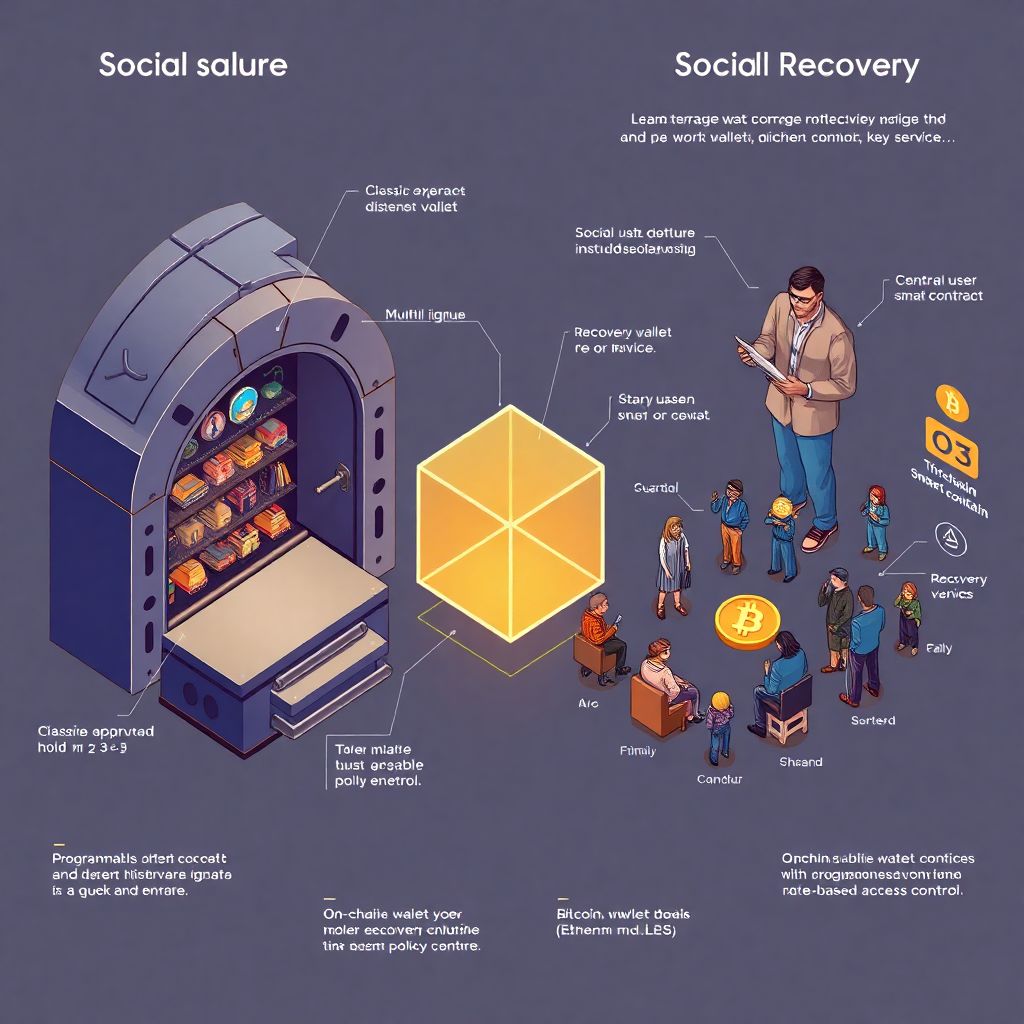
Why Multi‑Sig and Social Recovery Matter More Than Another New Token
If you’re holding serious value on-chain, the real “alpha” isn’t the next memecoin — it’s not getting rugged by your own bad opsec. Multi‑sig wallets and social recovery are basically two different ways to make it statistically harder for you (or anyone else) to screw up in a catastrophic way.
Think of them as layered safety systems: multi‑sig reduces single‑point technical failure; social recovery reduces single‑point human failure. Put together, they’re one of the most realistic paths to secure crypto storage with multisig and social recovery that normal humans can actually use.
Let’s unpack where this all came from, how it works, and how to go beyond the standard “3-of-5 multisig with friends” playbook.
—
Historical background: from single private key to programmable custody
Early Bitcoin was brutally simple: 1 key = 1 address = 1 point of failure. Lose the private key? Funds are gone. Leak the key? Funds are gone. That simplicity was elegant cryptographically, but a disaster operationally.
As value grew, two parallel movements appeared:
– On-chain script primitives: Bitcoin Script added support for `OP_CHECKMULTISIG`, enabling native multi‑signature UTXOs. This is where basic “N-of-M” protection came from.
– Off-chain custodial stacks: Exchanges and custodians hacked together home‑grown multi‑sig, HSMs, and “cold storage” rituals. Great for enterprises, terrible for individual sovereignty.
Ethereum and other smart‑contract platforms took things further. Instead of just locking coins with multiple keys, you could deploy entire smart contract wallets that define custom authorization logic: rate limits, guardians, delayed withdrawals, role‑based access control — all the stuff TradFi security teams already obsess over.
Out of that ecosystem came two key patterns:
1. Multi‑sig as a first‑class object — Gnosis Safe / Safe{Wallet}, BitGo, and other frameworks made multi‑sig usable beyond Bitcoin.
2. Social recovery wallets — driven by people like Vitalik, Argent, and the account abstraction (ERC‑4337) crowd, who realized most people will never manage seed phrases reliably.
Now we’re in an era where “wallet” is basically a programmable policy engine — and multi‑sig plus social recovery are the core primitives of that policy.
—
Basic principles: how multi‑sig and social recovery actually work
Multi‑sig in plain language
Multi‑signature means: “This address only moves funds if at least K out of N pre‑approved signers agree.” That’s the K-of-N threshold model.
Under the hood, two main patterns:
– UTXO / script‑level multisig (Bitcoin, etc.): The locking script literally encodes “require K of these N public keys to sign.”
– Contract‑based multisig (Ethereum, L2s): A smart contract tracks owners and thresholds and validates signatures in its own logic.
Key design knobs:
– N = number of total signers (people/devices/entities).
– K = number of required signatures (threshold).
– Roles = some signers may be limited (e.g., daily spending, whitelisted destinations).
That’s it conceptually — but how you choose K, N, and who holds what matters more than the math.
—
Social recovery in plain language

Social recovery flips the threat model: instead of “never lose this seed,” it assumes you *will* lose it, and designs a way to get back in without handing your friends full control.
Basic pattern:
– There is a primary signer (your device, your key, or your passkey).
– There is a set of guardians (friends, family, other wallets, hardware devices, or even services).
– If you lose the primary key, a majority of guardians can rotate control to a new key after some delay.
Importantly:
– Guardians cannot spend your funds directly.
– They can only help *reset who is allowed* to spend funds.
– Good implementations add time delays, on‑chain signals, and often UI warnings before recovery completes.
So a crypto wallet with social recovery is basically a smart contract wallet whose ownership key can be safely and transparently replaced by a quorum of pre‑chosen guardians.
—
How they compare: where each shines
Very short version:
– Multi‑sig shines at *ongoing* transaction security and governance (DAOs, treasuries, big balances).
– Social recovery shines at *eventual* disaster recovery for individuals and small teams.
Use cases:
– You’re managing a protocol treasury with five co‑founders? Multi‑sig.
– You’re a solo user who doesn’t want to memorize a seed phrase? Social recovery.
– You’re a small fund with a technical team and non‑technical partners? Often: multi‑sig core + social recovery on one or more owner keys.
The interesting stuff happens when you start *combining* both.
—
Examples of real‑world implementations
Plain Bitcoin: script‑level multi‑sig
On Bitcoin, multi‑sig is still mostly done at the script/UTXO level, and it’s very focused on long‑term holding and operational security.
If you’re wondering how to set up a multisig bitcoin wallet, the usual pattern is:
– Choose a wallet implementation that supports multi‑sig (e.g., Sparrow, Specter, BlueWallet multi‑sig setups).
– Generate keys on multiple hardware wallets, ideally from different vendors.
– Combine the public keys into a descriptor or multi‑sig config, then verify on every device that the same config is loaded.
– Require, say, 2-of-3 or 3-of-5 signatures for spending from a vault.
The downside: UX is still rough, and social recovery is mostly DIY — you’re responsible for designing who holds each key and how backups work.
—
Ethereum and L2s: smart contract wallets and “best practice” stacks
On Ethereum, smart contract wallets like Safe{Wallet}, Argent, and others made multi‑sig almost “clickable.” What some people call the best multisig crypto wallet is usually one of these contract wallets because of:
– Built‑in support for multiple owners and thresholds.
– Modules for spending limits, whitelists, 2FA‑like flows.
– Easy integration with dApps and DeFi protocols.
From there, wallet devs layered in social recovery modules: you can have a main owner key and guardian keys, and a recovery process that’s part of the contract logic. On L2s with cheap gas, this becomes practical for everyday users, not just DAOs.
—
Enterprise‑grade stacks
For institutions, enterprise multisig wallet solutions are a whole industry: Fireblocks, BitGo, Copper, Coinbase Custody, and others. Under the hood, these often combine:
– Multi‑party computation (MPC) or HSM‑backed keys.
– Policy engines (who can approve what, from where, within which limits).
– Multi‑sig or threshold signing at both crypto and governance levels.
This is multi‑sig taken to its logical extreme: even insiders cannot move funds without policy‑compliant approvals and device checks. It’s overkill for most retail users — but the *design ideas* can be downscaled and repurposed.
—
Non‑obvious design patterns and unconventional setups

Let’s get into more creative, non‑cookie‑cutter ways to use these primitives.
1. Multi‑sig plus “silent” social recovery of signers
Classic design: 3-of-5 multi‑sig, all keys are equal. Better design: *some* keys are “core,” others are “recovery‑only.”
Example pattern:
– 2 Everyday keys (phone + hardware wallet).
– 2 Guardian keys (held by trusted people or devices).
– 1 Deep‑cold key (stored offline, maybe in a bank box).
Policy:
– Daily ops: 2-of-3 from {phone, hardware, deep‑cold}.
– Recovery of a lost device: require 2-of-3 from {guardian1, guardian2, deep‑cold} to rotate one signer in the multi‑sig.
You basically embed social recovery of multi‑sig signers. The multi‑sig protects day‑to‑day spending; the guardian structure protects against loss of a signer key. No single friend or family member ever touches the funds directly — they just help you repair your signing set.
—
2. Geographic and jurisdictional sharding
Instead of “give one key to three close friends,” consider sharding across jurisdictions and risk domains:
– One key in a hardware wallet in your home country.
– One key in a vault or legal firm in a different jurisdiction.
– One key represented as a key share with a specialized custody service.
– Optional: one “break glass” key held by an offline device in a physically remote safe.
You then choose a threshold that survives:
– Political risk (one jurisdiction fails or becomes hostile).
– Natural disasters (one location destroyed).
– Personal drama (one relationship breaks down).
This looks like overengineering until you remember: your wallet is now your global bank. It makes sense to treat it like a cross‑border, multi‑bank custody network.
—
3. Programmable “guardian of last resort”
Instead of only human guardians, use *systems* as guardians:
– A separate contract wallet that follows a stricter policy than your main wallet.
– A hardware module that only signs if you physically present a device and pass biometric checks.
– A time‑lock smart contract that can join guardians only if certain on‑chain criteria are met (for example, no activity for 18 months).
You can define a tiered model:
– Tier 1: human guardians — fast but require manual coordination.
– Tier 2: device or contract guardians — slower but deterministic, with enforced delays and rate limits.
The system becomes:
– Humans help in normal “lost phone” scenarios.
– Code steps in when you vanish entirely or are incapacitated.
This is a realistic path to inheritance and business continuity without writing down your seed phrase in a lawyer’s drawer.
—
4. Multi‑sig with “burn‑to‑recover” backstop
Here’s a weirder pattern if you’re comfortable with game theory:
– Main wallet: multi‑sig with your normal K-of-N signers.
– Backstop contract: a separate address that can gradually claw funds from the main wallet *only if*:
– No valid transaction from the main wallet appears for X months.
– Y-of-Z guardians sign a special recovery transaction.
– A public on‑chain timelock provides a visible grace period for reversal by the main multi‑sig.
If you lose the main multi‑sig keys, the backstop eventually drains funds to a new, fresh wallet you specify during the recovery. But if anything about the recovery looks like an attack, any surviving signer of the original multi‑sig can override it during the timelock.
This is more complex to implement, but you effectively get a built‑in dead‑man switch that’s still reversible.
—
Practical setups: concrete ideas you can actually use
Here are some patterns you can adapt depending on your risk tolerance and tech comfort.
For a power user with meaningful savings
– Wallet type: smart‑contract wallet on an L2 with native social recovery.
– Ownership:
– Primary: hardware wallet.
– Secondary: password‑manager‑backed key (for emergencies only).
– Guardians:
– One close trusted person with a hardware wallet.
– One separate wallet you control but store in another physical location.
– One long‑term device in deep cold storage (air‑gapped).
Policy ideas:
– Daily transactions: only hardware wallet needed, with small per‑tx limits.
– Large transfers: require dual confirmation (hardware + secondary key).
– Lost hardware wallet: guardians trigger recovery to a new hardware wallet, with a 3–7 day time delay and public notifications.
This gives you personal control, social backup, and time to react to any weird guardian‑based attack.
—
For a small company / DAO
– Wallet type: multi‑sig contract wallet.
– Signers:
– 3 core team hardware wallets (e.g., CEO, CTO, ops).
– 2 long‑term custody keys (cold‑stored devices or institutional co‑signers).
Policy:
– Operational spending: 2-of-3 core team signers.
– Treasury reallocations or protocol‑level moves: 3-of-5 including at least 1 custody key.
– Recovery: a social‑recovery‑style module that allows a defined committee (board, token‑holder vote, or specialized guardians) to add or rotate signers if someone leaves or loses a device.
This is where patterns from enterprise multisig wallet solutions can be simplified and applied in a more decentralized but still structured way.
—
Common misconceptions and traps
“More signers = more security”
Adding more signers increases operational complexity and the attack surface for social engineering. A badly managed 4-of-7 is often less secure in practice than a well‑managed 2-of-3.
Better question: “Have I removed single points of failure *without* making the system so complex that people bypass it?”
—
“Social recovery means my friends can steal my funds”
In a correctly implemented crypto wallet with social recovery, guardians cannot directly spend your coins. They can only assist in rotating the authorized owner key. Plus, you should:
– Use a majority threshold (e.g., 3-of-5 guardians).
– Add a recovery delay (so you can cancel if you still have access).
– Spread guardians across *independent* relationships and risk profiles.
The bigger real risk is choosing guardians who are all close to each other — a family that can be coerced together, or co‑workers in the same company.
—
“Hardware wallet + seed phrase = I’m done”
A single device and a single seed phrase is still single‑point failure:
– House burns down with both the device and the metal backup.
– You get phished and type your seed into a fake interface.
– Legal or physical coercion compels you to reveal the phrase.
Multi‑sig and social recovery don’t magically fix everything, but they give you knobs to:
– Separate knowledge (different people/devices know different things).
– Separate power (no one party can act alone).
– Add time to respond (via timelocks and recovery delays).
—
“Multi‑sig is only for whales and DAOs”
Low‑value accounts don’t need it, but once you’re above “it would really hurt to lose this,” the logic changes. Think of multi‑sig and social recovery like seatbelts and airbags — not about being rich, about avoiding tail‑risk disasters.
Also, with modern UX, some of the best multisig crypto wallet experiences are almost as easy to use as normal wallets, especially on L2s. We’re past the era where multi‑sig meant editing config files by hand.
—
How to think about your own setup (and evolve it over time)
Instead of asking “Which wallet should I use?” start with three questions:
– What am I protecting against? Loss, theft, coercion, partner disputes, legal trouble?
– How many independent entities would need to collude to ruin me? Is that number high enough?
– Can I explain my setup to my future self and my heirs? Complexity you can’t explain is just latency‑delayed loss.
Then:
– Start simple (maybe one contract wallet with modest social recovery).
– Add multi‑sig once your holdings or operational needs justify it.
– Periodically simulate “what if I lost X” scenarios and practice recovery flows with small amounts.
The goal is not perfection; it’s to make catastrophic loss *unlikely and reversible*, given realistic human behavior.
—
Bringing it all together
Multi‑sig wallets and social recovery aren’t rival technologies; they’re complementary tools in the same toolbox. Use multi‑sig to define how funds move in day‑to‑day life; use social recovery to define how control is repaired when things go wrong.
When you combine them thoughtfully — perhaps inspired by, but not limited to, what large custodians do — you move closer to genuinely secure crypto storage with multisig and social recovery that doesn’t rely on you never making a mistake.
And the most “advanced” technique isn’t a fancy cryptographic trick; it’s designing a system that future‑you, your collaborators, and even your heirs can realistically operate when the unexpected happens.