
A practical, no‑nonsense guide to crypto wallet security
Let’s be honest: most people care about crypto wallet security only after something goes wrong. A stolen phone, a lost seed phrase, a “too good to be true” airdrop link — and suddenly the lesson becomes very expensive. This guide is here to help you learn those lessons before they cost you money.
We’ll go through how wallets actually work, what “security best practices” mean in real life, and how to turn your setup into something even a motivated attacker will hate.
—
First principles: what a crypto wallet really is
It doesn’t “store” your coins
Your coins never sit inside an app or a device. They live on the blockchain.
Your wallet is just:
– A set of private keys that prove you own certain addresses
– Software or hardware that lets you sign transactions
So “protecting your wallet” really means “protecting your private keys” — and everything that can indirectly expose them: seed phrase, backups, devices, cloud accounts, screenshots, even your social media habits.
Once you internalize that, wallet security stops being a list of random rules and starts making sense.
—
Different wallet types, different threat models
Hot vs cold: why it matters
You’ll often hear:
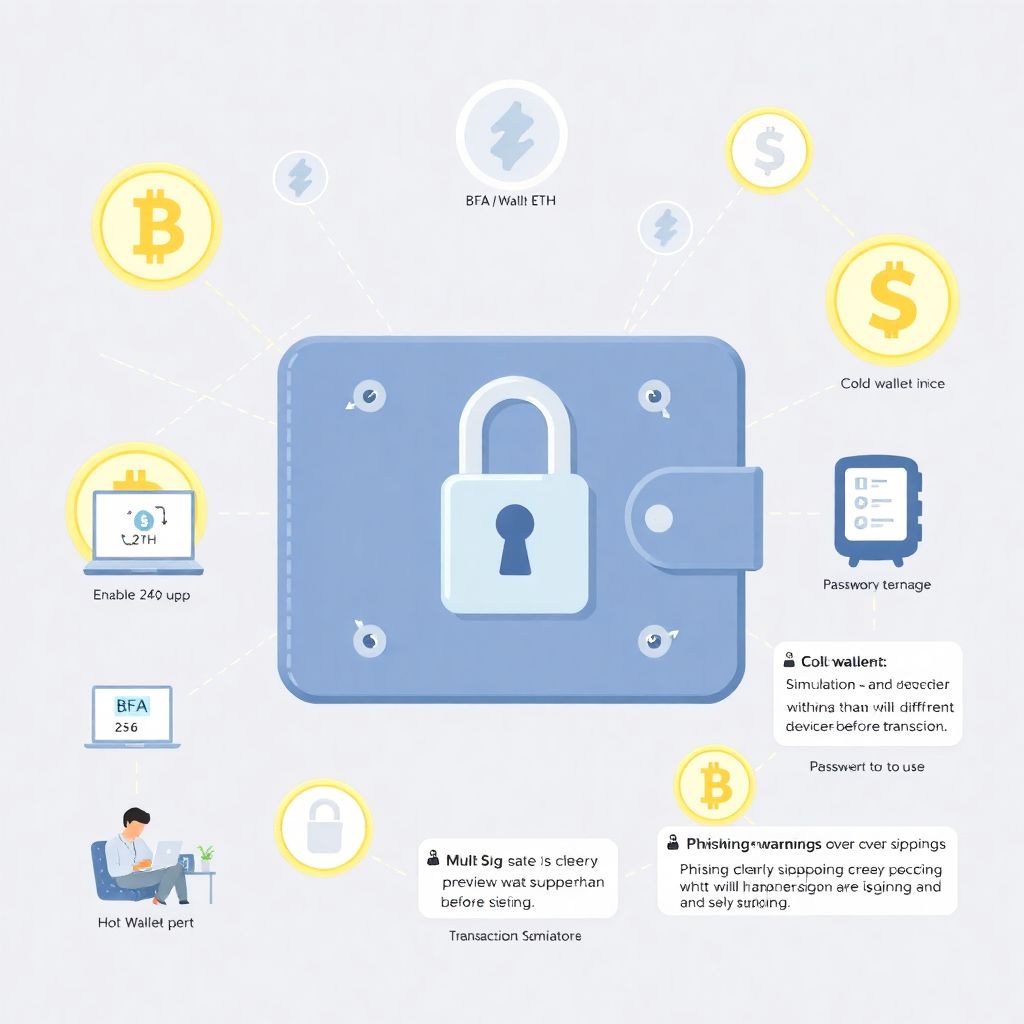
– Hot wallet – Keys touch the internet (browser extension, mobile app, desktop app).
– Cold wallet – Keys stay offline (paper wallets, air‑gapped devices, hardware wallets).
Hot wallets are ideal for daily use but more exposed. Cold wallets are better for long-term storage and larger amounts.
Security experts tend to agree on one simple rule of thumb:
> “Treat hot wallets like cash in your pocket. Treat cold wallets like your savings account.”
So if you’re looking for a safe crypto wallet for long term storage, you’re almost certainly looking at a cold or hardware-based setup.
—
The role of hardware wallets in real security
Why hardware matters (and when it doesn’t)
A hardware crypto wallet for bitcoin and ethereum keeps your private keys in a dedicated, isolated chip that never exposes them directly to your phone or computer. Even if your PC is full of malware, the signing happens inside the device.
This doesn’t make you invincible, but it massively reduces:
– Key theft by regular malware
– Accidental leakage via screenshots or copy-paste
– Browser extension exploits that grab private keys from memory
However, experts also stress a critical point: a hardware wallet is not magic. It won’t save you from:
– Signing a malicious transaction you don’t understand
– Typing your seed phrase into a phishing site
– Social engineering (“support agent” asking for your seed)
A good mental model: hardware protects your keys; you must protect your brain.
—
What “best secure crypto wallet 2025” really means
You’ll see endless rankings claiming to list the best secure crypto wallet 2025. They’re often biased, poorly updated, or focus on shiny UI instead of hard security guarantees.
When security engineers evaluate wallets, they usually look at:
– Open vs closed source – Can experts audit the code?
– Key isolation – Are keys kept in secure hardware or mixed with everything else?
– Recovery options – Is there a sane, safe way to recover if you lose the device?
– Update model – Does the project ship timely security patches?
– Track record – Any major incidents, backdoors, or suspicious funding?
Instead of chasing one “best” wallet, aim for the best setup for your risk level:
– A daily hot wallet with small amounts
– A hardware or multi-sig wallet for serious holdings
– Clear separation between the two
—
How to protect a crypto wallet from hackers in practice
Attackers are lazy, not stupid
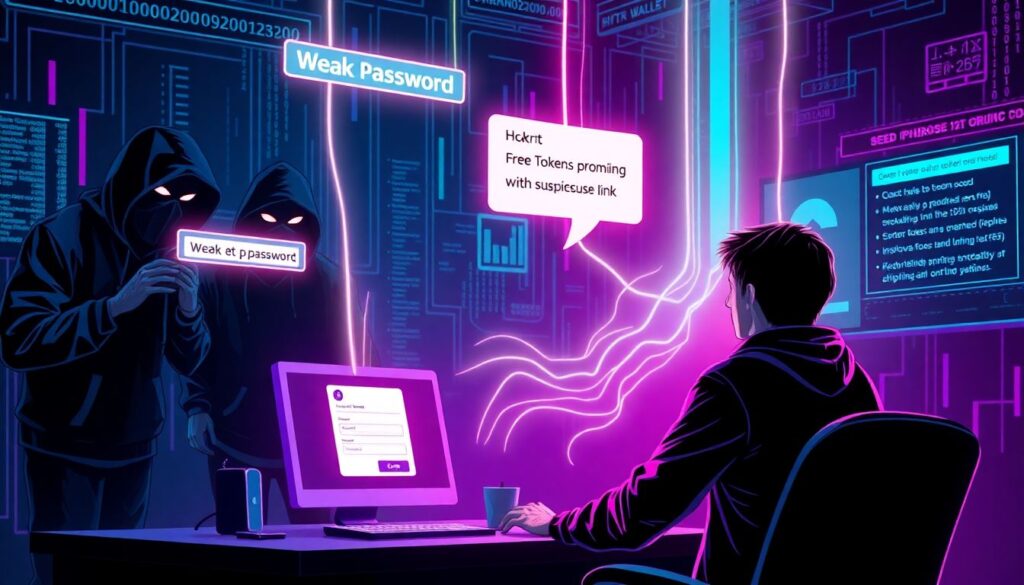
If you’re wondering how to protect crypto wallet from hackers, start by understanding their incentives. They prefer:
– Users with weak or reused passwords
– People who click any link that promises free tokens
– Seed phrases lying in email drafts, notes apps, or cloud photos
Your job is not to be invulnerable. Your job is to be less attractive than 90% of people.
Here are concrete, expert-backed habits that move you into the “too much effort” category:
– Use a password manager and strong, unique passwords for email, exchange, and wallet-related accounts
– Turn on 2FA (preferably app-based, not SMS) everywhere it’s available
– Never store seed phrases in the cloud, screenshots, or messaging apps
– Keep your main trading device relatively “boring”: no random cracked software, shady extensions, or unknown USB sticks
Security professionals call this “raising the cost of attack.” The higher the cost, the fewer attackers will bother.
—
Crypto wallets with advanced security features
What “advanced” should actually mean
When you see a crypto wallet with advanced security features, ignore the marketing adjectives and look for a few practical things:
– Transaction simulation – It shows you what will *actually* happen before you sign (tokens moved, approvals granted, contract interactions).
– Phishing protection – Warnings about known malicious dApps or domains.
– Permission management – Clean interface to see and revoke token approvals you no longer need.
– Hardware support – Smooth integration with multiple hardware wallet brands.
– Multi-account separation – Easy to maintain “clean” and “dirty” accounts for different activities.
The standout feature of modern wallets isn’t just key storage. It’s how well they help you understand what you’re signing.
—
Inspiring real-world stories (and what they teach)
From panic to professional-level setup
Case 1: A small DeFi team lost a mid five-figure sum in their treasury because one founder used a browser wallet on a laptop loaded with torrents and random software.
Instead of quitting, they turned it into a turning point.
They did:
– Migrated the treasury to a multi-sig with hardware wallets only
– Set explicit internal rules: no signing on personal devices, no unreviewed dApps
– Ran internal workshops so even non-technical members understood basic threat models
Two years later, they manage seven figures of protocol funds without a single security incident. Same team, same people — just better habits and clearer processes.
Retail user: zero to robust in one weekend
Case 2: A retail investor lost a small amount by clicking a fake airdrop link on social media. Instead of quitting crypto, they used that as a cheap education.
In a weekend, they:
– Bought a hardware wallet for long-term holdings
– Created a new primary email with strong password + app-based 2FA
– Set up a “burner” browser profile with minimal extensions just for DeFi
– Started using a portfolio tracker instead of connecting their main wallet everywhere
The outcome: no further incidents, more confidence, and a portfolio that actually feels manageable rather than scary.
Both stories share one trait: people used failure as data and systematically upgraded their setup.
—
Step-by-step: leveling up your own security
Phase 1 – Fix the basics (today)
Focus on what gives the biggest improvement per minute spent:
– Secure your main email account (new strong password, password manager, app-based 2FA).
– Clean your device: uninstall random extensions, unknown apps, pirated software.
– Write down your seed phrase on paper (legibly) and move it offline — no photos, no cloud.
– Check your wallet permissions via an approval checker and revoke anything suspicious or unused.
This alone already makes you safer than a huge chunk of users.
—
Phase 2 – Separate roles and reduce blast radius
Next, reduce how much damage a single compromise can do.
Create separation:
– A cold wallet / hardware wallet for serious, long-term holdings
– A hot wallet for daily interactions, trading, and experimentation
– Optionally, an extra “burner” wallet for high-risk dApps
You’ll notice something interesting: once you keep only limited funds in your hot wallet, you immediately feel more relaxed about exploring DeFi or NFTs. Security breeds confidence.
—
Phase 3 – Think like a defender, not a gambler
At this stage, start behaving more like a security engineer:
– Never connect your main wallet to a new dApp without reading at least one independent review.
– Always double-check URLs; bookmark official sites for repeated use.
– Treat any incoming message offering help, support, or free tokens as guilty until proven innocent.
– Get into the habit of reading what the transaction simulator actually shows before signing.
You don’t need to become paranoid. Just a little structured skepticism goes a very long way.
—
Expert recommendations distilled
Here’s how many security professionals would summarize their advice to non-experts:
– Assume compromise is possible, minimize damage when it happens.
– Keep keys offline when you can, especially for long-term holdings.
– Automate good habits — password managers, 2FA, minimal extensions.
– Don’t trust your memory — write down recovery information and store it safely.
– Pause before signing — if you don’t understand a transaction, don’t confirm it.
Or as one security auditor put it:
> “Your best defense is boredom. Make stealing your funds so annoying that attackers move on to someone else.”
—
Successful project security playbooks
What serious teams actually do
Teams that manage real money in crypto (treasuries, DAOs, funds) usually follow patterns you can learn from:
– Use multi-sig wallets so no single person can move large amounts.
– Require hardware wallets for all signers.
– Define strict rules for how much can be kept in hot wallets.
– Regularly rotate keys and review access permissions.
– Run incident simulations: “What if this laptop is stolen? What if this signer disappears?”
You might not run a DAO, but the mindset is portable. For your own funds, you can adapt:
– A “personal multi-sig” setup (e.g., 2-of-3 across devices or services).
– Written rules for yourself about transfer limits from cold to hot wallets.
– Periodic self-audit: what would happen if this phone dies today?
Security isn’t just tools; it’s also policies, even if you’re a team of one.
—
Resources to keep learning (without drowning)
Where to invest your attention
To go deeper without getting lost in noise, prioritize:
– Official documentation of your chosen wallet(s) – often underrated and far clearer than random threads.
– Security sections of reputable exchanges and wallet providers – many have dedicated guides on phishing, 2FA, and recovery.
– Blogs and reports from audit firms and security researchers – they explain real-world exploits in readable terms.
You can also curate your own mini “security curriculum”:
– Follow a couple of security-focused accounts or newsletters instead of 50 loud influencers.
– Once a quarter, block an hour to review your setup: hardware, backups, 2FA, permissions.
– After every incident you read about, ask: *“Could this happen to me? If yes, what’s the smallest change that would prevent it?”*
Over time, you’ll build not just a secure setup, but a security mindset that carries over into the rest of your digital life.
—
Final thoughts: your future self will thank you
Crypto will always attract attackers. That won’t change in 2025 or 2035. What can change is how prepared you are.
You don’t need perfect opsec. You don’t need to memorize every acronym. You just need:
– A clear separation between everyday funds and long-term holdings
– A realistic understanding of how your wallets and keys work
– A handful of consistent habits that make you a very inconvenient target
If you start implementing even a few of the practices from this guide today, you’ll already be moving from “hoping nothing goes wrong” to actively shaping your own security. That shift — from passive to intentional — is where real confidence comes from.