

“`markdown
Why you need a *learning* budget before a trading budget
Most people jump straight into “How much should I put into Bitcoin?” when the better first question is:
“How much can I safely spend to become *competent* with crypto in the next 6–12 months?”
Think of it this way:
If you’re ready to risk $2,000 on the market but hesitate to spend $200 on proper education, your priorities are inverted.
A personal crypto learning budget is a simple system that answers three things:
1. How much money you’ll allocate to education vs. practice.
2. What you’ll spend it on (courses, books, tools, test trades).
3. How you’ll measure whether that money was worth it.
Let’s build that system step by step — with actual numbers and a few non-obvious tricks people rarely talk about.
Step 1. Decide your total “crypto envelope”
Before you break anything into sub-budgets, you need a ceiling.
A practical rule that works for most salaried people:
> Total “crypto envelope” (learning + trading) ≤ 5–10% of your annual disposable income.
Disposable income here means money left after rent, food, insurance, debt payments, and a basic emergency fund (3–6 months of expenses).
Example
– Net salary: $3,000/month
– Essential expenses: $2,200
– Leftover: $800/month → $9,600/year
– 10% of $9,600 ≈ $960/year is your *max* reasonable crypto envelope at the start.
If you’re more risk‑averse, cut that to 5% → about $480/year.
Now we split that envelope into learning and actual trading.
Step 2. Split learning vs. trading money
Here’s a counterintuitive approach that works extremely well for beginners and intermediates:
> **For the first year: 60–70% of your crypto envelope → learning,
> 30–40% → live trading / investing.**
Most people do the opposite and basically “pay tuition to the market” via losses.
Concrete allocation examples
Using the $960/year envelope:
– $600–$650 → education (courses, books, tools, mentorship)
– $300–$360 → live trading experiments
Using the $480/year envelope:
– $300–$330 → education
– $150–$180 → live trading
You can rebalance each quarter. If you see your education spend clearly improves your decisions (fewer dumb mistakes, better entries, smaller drawdowns), you keep the ratio. If not, you cut it and reassess what you’re buying.
Step 3. Break your learning budget into 4 buckets
To make this practical, divide your learning money into four categories:
1. Structured education (courses, programs)
2. Reference material (books, newsletters, research)
3. Tools & data (screeners, analytics, bots)
4. Paid practice & feedback (small real trades, mentorship, communities)
A good starting split for the *learning* part (not the whole envelope):
– 40% → structured education
– 20% → reference material
– 20% → tools & data
– 20% → paid practice & feedback
You’ll tweak this as you go, but it’s an actionable baseline.
Step 4. Choosing structured education without overpaying
A lot of marketing around crypto education is noisy. You’ll see “become a millionaire trader” ads attached to the so‑called best crypto trading courses online. Reality check: most courses are fine for basics, few are worth four figures.
Price bands you can use as a sanity check
– $0–$50: Intro material, basic lectures, often pre-recorded. Good for foundations, bad for depth.
– $50–$300: Solid entry-level or intermediate crypto investing for beginners course with Q&A, assignments, and maybe a community. Good value if you actually complete it.
– $300–$1,000: Niche or intensive programs, live cohorts, instructor feedback, sometimes an online crypto academy with certification and exams. Worth considering only if the instructor’s trading/engineering background is verifiable.
– $1,000+: Usually oversold. You can get 90% of the value below this price point unless you’re paying for 1:1 coaching or a highly specialized institutional-level cryptocurrency investment training program.
Non-standard filter: “Would I pay for this as a *PDF*?”
Before buying any course, ask:
> If this exact content were a 300-page PDF with no videos, would I still think it’s worth the price?
If the answer is “no”, you’re probably about to pay for *production value* rather than *content value*.
Technical detail: ROI filter for courses
You can formalize this to protect your budget.
Let:
– `C` = course cost
– `P` = expected capital you’ll manage in the next 12–24 months
– `Δr` = realistic improvement in annual return due to the course (in decimals, not %)
A course is reasonable if, conservatively:
“`text
C ≤ P × Δr
“`
Example:
– You expect to manage $3,000 in crypto over the next 2 years.
– You assume a *realistic* improvement of 3% in annual returns by removing basic mistakes.
– `P × Δr = $3,000 × 0.03 = $90`
If the course is $400, it must give you far more than “three percent better decisions” to make sense. If it teaches risk management, order types, and position sizing well enough to prevent one 30% portfolio wipeout, it might still be worth it. Use this equation to think rigorously, not blindly.
Step 5. Designing a “paid practice” system with tiny real money
Simulators are fine, but they don’t simulate fear. If you want to learn cryptocurrency trading with real money without blowing yourself up, create a sandbox budget inside your learning budget.
Rule of thumb:
> Paid practice budget = 10–20% of your learning budget
> and each trade ≤ 1–2% of that practice pot.
Example setup
Learning budget: $600/year
Paid practice pot (20%): $120
Maximum per trade: 2% of $120 = $2.40
This looks ridiculous, which is exactly the point:
You practice *process* — entries, exits, journaling, risk management — under real emotional pressure, without meaningful financial damage.
As your skills and capital grow, you can scale:
– At $120 practice pot → $2 per trade
– At $500 practice pot → $10 per trade
– At $2,000 practice pot → $40 per trade
You’re teaching your brain: “We always trade with caps and rules,” which is much more valuable than memorizing random patterns.
Step 6. Turning your budget into a monthly cashflow plan
Yearly numbers are abstract. Let’s translate them into what you actually do each month.
Suppose:
– Total crypto envelope: $960/year
– Learning: $600/year
– Trading: $360/year
Monthly breakdown:
– $50/month → learning
– $30/month → trading
Now further subdivide the $50/month learning chunk:
1. $20 – saved toward one decent course every 4–6 months
2. $10 – books or paid newsletters
3. $10 – tools (on-chain data, screeners, backtesting)
4. $10 – paid practice & feedback (sandbox trades, occasional 1:1 call or group session)
You can literally automate this with two savings sub-accounts:
– “Crypto_Ed” → +$50/month
– “Crypto_Live” → +$30/month
You only deploy money from those accounts according to written rules. This separation alone saves people from a ton of emotional impulse trades.
Step 7. Non-obvious cost savers (and when to pay up)
Here are several underused ways to stretch your learning budget without going fully “free YouTube only”.
1. Piggyback on academic or corporate access
If you or someone close to you has:
– University access to digital libraries
– Corporate access to premium financial data platforms
You can often indirectly tap into:
– Institutional research on blockchain/DeFi
– Risk management and portfolio theory material usable for crypto
This doesn’t replace a dedicated crypto investing for beginners course, but it upgrades your theoretical backbone at zero cost.
2. Rotate subscriptions instead of stacking them
Instead of paying $50–$100/month for 3–4 tools you barely use:
– Run one analytics tool for 3 months
– Cancel, switch to another for the next 3 months
– Keep exporting your data or notes before cancelling
You end up sampling different ecosystems — from scanner platforms to an online crypto academy with certification modules — for the price of a single continuous subscription.
3. Time-box premium content
If you want to join a high-end cryptocurrency investment training program with a strong community:
– Join for 1–3 months, not a full year
– Screen record (where allowed), take obsessive notes, download resources
– Leave, then spend 6+ months executing what you learned
Your *effective* price per useful idea plummets.
Step 8. A concrete 90-day learning budget plan
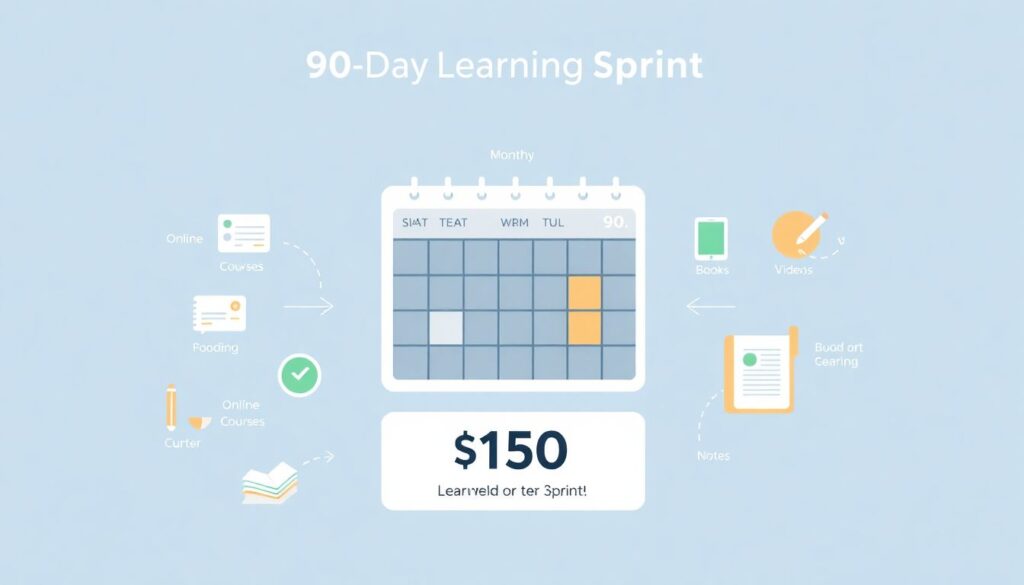
Let’s put everything together in a simple 90-day sprint. Assume you can allocate $150 to learning in 3 months.
1. Month 1: Foundation and structure
– $40–$60: One solid, no-hype beginner/intermediate course from a verified instructor. Look for something positioned like “crypto investing for beginners course” that covers:
– Key crypto assets (L1, L2, DeFi, stablecoins)
– Custody (CEX, DEX, self-custody, hardware wallets)
– Risk management basics
– Simple portfolio structures (e.g., 70/20/10 BTC–ETH–speculative)
– $10–$15: One technical but readable book on trading or market structure.
– $10: Start your sandbox account (live).
Focus: set up secure infrastructure (2FA, password manager, hardware wallet if affordable), learn to move small amounts between wallets and exchanges safely.
2. Month 2: Tools and hands-on practice
– $15–$20: One month of a decent charting / analytics tool.
– $20: Add to sandbox, start placing $1–$3 trades with strict rules.
– $10–$15: Optional — one month of a curated research newsletter or on-chain analytics feed.
Focus: identify one or two setups you want to specialize in (e.g., trend-following on higher timeframes, or simple DCA strategies) rather than chasing everything.
3. Month 3: Feedback loop
– $30–$40: Group Q&A sessions, office hours, or a short cohort where someone actually reviews your approach.
– $10–$20: Top up your sandbox for another set of small trades.
Focus: collect feedback on your trade journal, risk rules, and asset selection. Adjust position sizing and exit rules before you scale capital.
Step 9. Build a simple KPI dashboard for your learning budget
Your learning budget isn’t just an expense line — it’s an investment. To treat it as such, you need KPIs (key performance indicators).
Here are three low-effort metrics that actually matter:
1. Cost per *completed* hour of education
“`text
Cost per completed hour = Total education spend / Hours actually completed
“`
If you buy a 20-hour course for $200 but only finish 4 hours, your cost per completed hour = $50/h.
If you finish all 20 hours, it drops to $10/h.
This metric punishes half-finished purchases and makes you think twice before impulse-buying the next shiny thing.
2. “Mistake prevention” count
Keep a trading journal. Each time you avoid a mistake because of something you learned (e.g., didn’t chase a pump, avoided a scam token, used stop-loss properly), mark it as “Prevented Loss”.
Once a quarter, estimate:
– How much this would have cost you (roughly)
– Which resource helped you avoid it
If you realize “That $80 course saved me from a 30% drawdown on $500 capital,” you already know it paid for itself.
3. Volatility of your PnL vs. market volatility
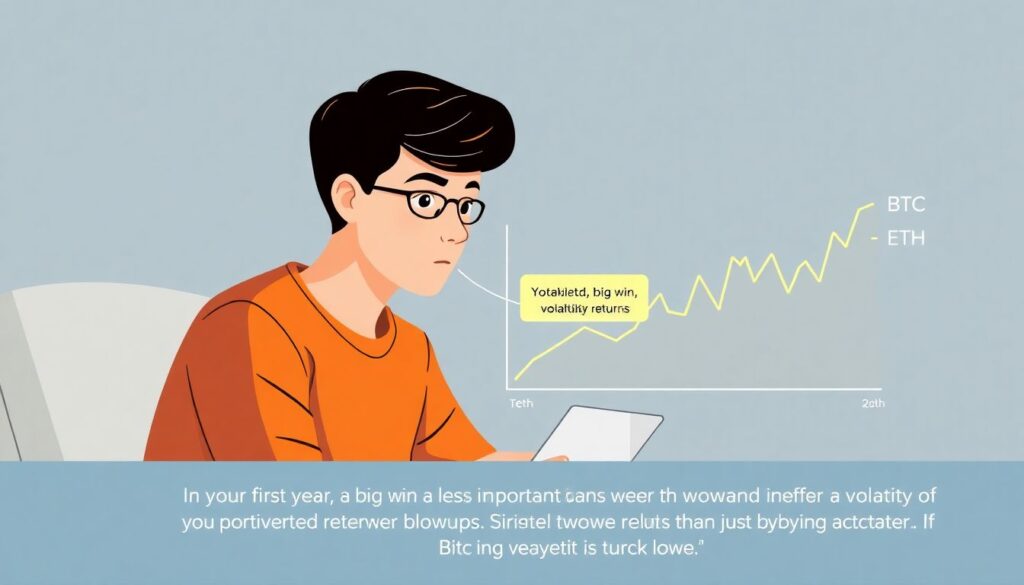
As you grow, compare the standard deviation of your portfolio returns to that of BTC or ETH over the same period. A simple heuristic:
> In your first year, a big win is *less important* than lower volatility and fewer blowups.
If your results are slightly worse than “just buying BTC” but with *much* lower drawdowns and better risk control, your education is working.
Step 10. When to increase (or decrease) your learning budget
Your personal crypto learning budget shouldn’t be static.
Raise it when:
1. Your managed capital increases (e.g., you go from $1,000 to $10,000 invested).
2. You hit a clear skills ceiling (“I don’t understand options/perps/DeFi risks well enough”) that’s directly limiting your returns.
3. You can identify a specific gap that high-quality training can close (e.g., orderflow reading, smart contract risk, on-chain forensics).
Cut or freeze it when:
1. You’re buying resources faster than you can consume them.
2. Your win-rate and risk metrics aren’t improving at all despite multiple paid programs.
3. You catch yourself using an expensive online crypto academy with certification mainly for the *badge* instead of the skills.
Remember: prestige doesn’t trade profitably. Execution does.
A non-standard template you can copy
Here’s a compact, practical template you can adapt. Imagine your monthly numbers; fill them in.
1. Decide your monthly envelope
– “I will allocate $X/month to crypto (learning + trading).”
2. Split it
– “Y% to learning, (100–Y)% to live capital.”
– For the first year, try 60–70% learning.
3. Sub-divide learning
– `40%` courses or structured programs
– `20%` books / newsletters / research
– `20%` tools & data
– `20%` sandbox & feedback
4. Write hard constraints
– No single course > Z% of my annual learning budget.
– No more than N subscriptions at the same time.
– No sandbox trade > 2% of sandbox balance.
5. Review every 90 days
– Complete vs. abandoned resources
– Number of prevented mistakes logged
– Changes in PnL volatility and drawdowns
– Decide: raise, keep, or cut your learning spend.
Final thoughts
A personal crypto learning budget isn’t about being stingy; it’s about being deliberate.
You’re competing against:
– Full-time traders with teams and infrastructure
– Quant funds scraping every exchange
– Bots that never get tired or emotional
You don’t need to match their hardware. But you can absolutely outmaneuver the average retail trader by:
– Spending more *intelligently* on your education
– Using micro-real trades to train your psychology
– Measuring whether your spend actually improves your decisions
Treat your learning budget like your first serious “position” in the crypto market.
Not a meme coin, not a random NFT — but a stake in your own competence. Over a few years, that’s the position with the best risk/reward profile you’ll ever hold.
“`