
Why crypto taxes matter for miners at all

When people talk about “crypto tax for miners”, it often sounds like something only accountants and lawyers care about. In reality, tax rules decide whether your mining hobby is mildly profitable or silently eating your future earnings. Most tax agencies treat mined coins as income the second you receive them, not only when you sell them. That means the block reward that hit your wallet last year might already have created a tax bill, even if you never cashed out to fiat. Understanding this early lets you choose hardware sizes, electricity contracts and payout settings with eyes open, rather than discovering a tax problem years later during an audit or when you try to take out a mortgage.
Historical background: from nerdy experiment to taxable activity
In the early Bitcoin days, hardly anyone thought about a bitcoin mining tax guide, because almost nobody believed those coins would be worth more than a pizza. Hobbyists mined on laptops, and tax offices mostly ignored the phenomenon as a tiny niche. As prices climbed and industrial‑scale farms appeared, regulators woke up: if mining is generating regular economic value, it looks a lot like income. Over the past decade, many countries issued guidelines saying that mining rewards are taxable when received, while later gains or losses when you sell are treated as capital events. The timing of these clarifications explains why older forum threads are full of outdated “don’t worry, it’s anonymous” advice that can be dangerous to follow today.
Basic principles: what the tax office usually cares about
Most beginners expect some kind of special, exotic framework, but the core logic is surprisingly simple: tax authorities try to fit mining into existing categories. First, they ask whether you mine as a business or as a hobby. If you run multiple rigs, reinvest profits and keep detailed records, they may treat you as self‑employed, taxing your rewards as business income but also allowing deductions for electricity, hardware and hosting. Smaller, irregular setups may be treated as “other income” with fewer deductions. Second, the agency defines a cost basis: the fair‑market value of coins when mined. This value becomes your starting point for later capital gains when you sell, swap or spend those coins, so tracking it precisely is critical, even if you never move the coins off your wallet for years.
How to report mining on taxes without losing your mind
A common source of panic is figuring out how to report crypto mining on taxes when payouts happen every few minutes or hours. Tax authorities do not expect absolute perfection, but they do expect a reasonable, consistent method for valuing each reward in fiat. In practice, miners often export CSV files from pools or self‑hosted nodes, then use a crypto mining tax calculator or specialized software to assign a price at each payout timestamp. You then aggregate these values by day, month or year, depending on local rules, to get total income. When coins are later sold, you compare selling price with the earlier income value to compute gains or losses. The process feels tedious at first, but once you set a workflow and stick with it annually, it becomes a repeatable routine rather than a yearly nightmare.
Real‑world examples: hobby rig vs. small mining business
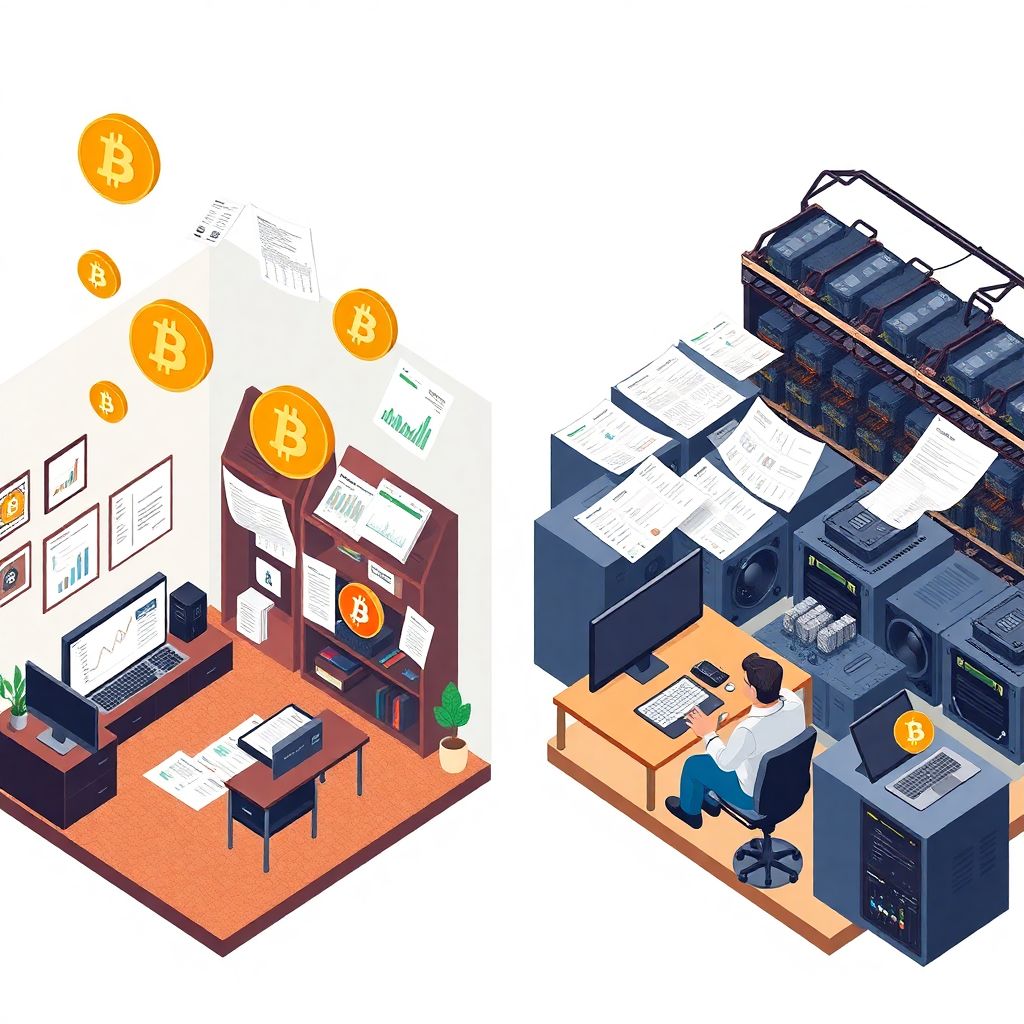
Imagine Alice, who runs a single mid‑range GPU rig in her apartment, mining a variety of altcoins and occasionally converting to stablecoins. Her tax office might treat her as a hobbyist: every payout is income at market value, but her ability to deduct power and hardware could be limited. She mostly needs clear records and a simple tool, maybe the best crypto tax software for miners that integrates with her pool, to avoid manual spreadsheet chaos. Now consider Ben, who operates a warehouse full of ASICs with commercial‑rate electricity. His jurisdiction may classify him as a business, requiring invoices, bookkeeping and possibly VAT considerations. He will care more about depreciation schedules, proper allocation of electricity costs, and cash‑flow planning to ensure mined coins sold at the right time cover both operational costs and expected tax liabilities.
Frequent beginner mistakes and myths that cost money
New miners repeatedly stumble over the same assumptions. One classic error is believing that tax is due only when converting to fiat. In many places, the taxable event is receiving the coins, which means ignoring income for years can create an unpleasant backlog if your wallet history is ever examined. Another mistake is trusting “it’s all anonymous” as a shield; between KYC exchanges, chain analytics and pool records, that confidence is misplaced. Beginners also underestimate the importance of timestamps: without accurate times for each reward, you cannot defend your chosen prices if questioned. Others blindly copy foreign rules from a random bitcoin mining tax guide, not realizing that their own country uses different classifications. Finally, many ignore software entirely and try to reconcile thousands of micro‑transactions by hand instead of using an appropriate crypto mining tax calculator or automation tools.
Tools and habits that keep your mining tax‑ready
While regulations differ, the habits that reduce stress look remarkably similar across regions. First, choose mining pools and wallets that provide exportable histories; screenshots are not enough during a serious tax review. Second, decide early whether you will track income at each payout or use some acceptable aggregation method, and be consistent from year to year. Third, test a couple of platforms and pick the best crypto tax software for miners that supports your specific coins, pools and exchanges, rather than the most heavily advertised brand. Finally, remember that no generic article can replace professional advice: once your operation grows beyond a basic hobby, a local tax professional who understands digital assets is usually cheaper than a major filing error. A disciplined, data‑driven approach turns tax rules from a scary unknown into just another dimension of your mining strategy.