

Why compliance with crypto peers is a real thing (even if you’re “just users”)

When people hear “crypto compliance”, they usually picture big exchanges, banks, or giant funds filling out endless forms. But the tricky part is this: the moment you move meaningful value between wallets, you’re in scope of somebody’s rules, even if you’re just two peers on Telegram. Sanctions, AML, tax reporting, and travel-rule requirements can attach not only to custodial platforms, but also to how you choose counterparties, structure deals, and document intent. Understanding how to stay compliant with cryptocurrency regulations therefore stops being a corporate-only task and becomes a survival skill for founders, traders, DAO contributors, and even “just devs” who occasionally receive tokens. The goal is not to turn everyone into a lawyer, but to build lightweight, repeatable habits that make those interactions defensible if a regulator, bank, or auditor ever asks awkward questions.
Short version: interacting with crypto peers is no longer a “grey zone” you can ignore just because both of you use self-custody; regulators increasingly treat patterns, not platforms.
Key terms without the legalese
Let’s fix vocabulary so we don’t talk past each other. “KYC” (Know Your Customer) in a peer context becomes “know your counterparty”: can you reasonably describe who’s behind that wallet, what they do, and why this transaction makes sense? “AML” (Anti–Money Laundering) is about whether the funds you touch could be proceeds of crime, sanctions violations, or fraud. “Compliance” isn’t only full-blown licensing; it’s your mix of checks, documentation, and governance showing you tried to avoid obvious abuse. When people say crypto aml kyc solutions for exchanges, they usually mean full platforms with screening, ID verification, and monitoring. We’ll steal some of those mechanisms, simplify them, and adapt them to informal peer‑to‑peer settings so you get 80% of the risk reduction without 120% of the bureaucracy.
Think of it as translating bank-grade practices into something a three‑person crypto collective can actually live with.
Visualizing how value flows between peers
Imagine a simple diagram in text:
`Wallet A (you) → Mixer? → DEX → Lending protocol → Wallet B (peer)`. Each arrow is a risk hop: was there a sanctioned address? A hacked bridge? A known scam cluster? Traditional crypto compliance services for businesses model these flows at scale, but as an individual or small team, you can still think in similar terms. Another mental diagram:
`Identity layer → Wallet layer → Transaction purpose → Evidence & notes`. The identity layer can be pseudonymous (GitHub, ENS, long‑standing social handle) as long as it’s stable and has reputation. The transaction purpose connects to a real‑world story: salary, OTC swap, grant, consulting fee. Finally, evidence is what you could show to a bank or tax inspector six months from now: chat logs, draft contract, on‑chain link, invoice. If any of these boxes are blank, compliance risk quietly creeps in.
The “diagram habit” forces you to see each payment as part of a narrative rather than random on‑chain noise.
Borrowing from TradFi, but not copying it blindly
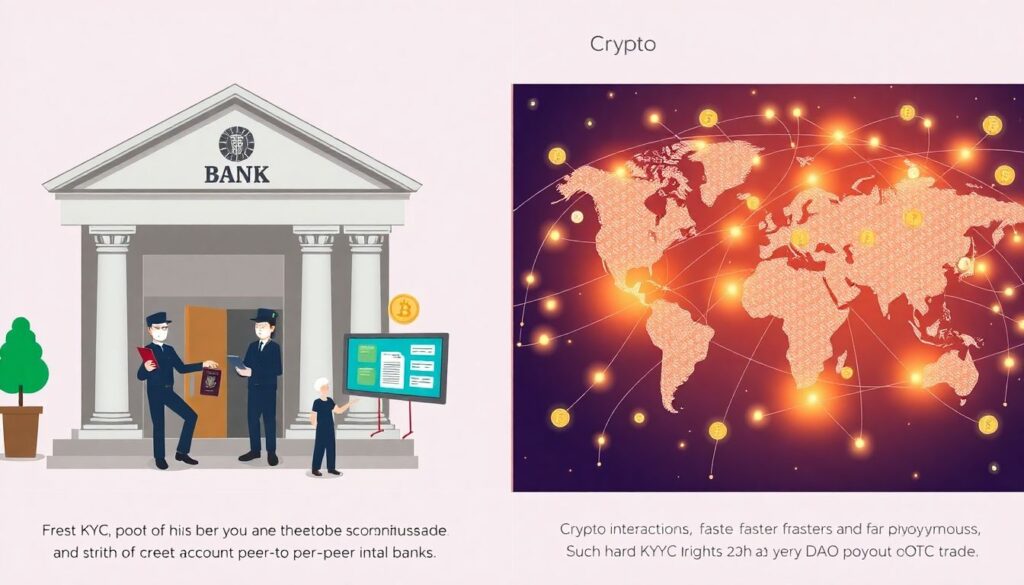
Compared with banks, crypto peer interactions are faster, more global, and far more pseudonymous. Traditional finance relies on hard KYC—passports, proof of address, in‑person checks—and continuous surveillance of account behavior. You likely can’t replicate that for every DAO payout or OTC trade, and you shouldn’t try. Instead, you cherry‑pick: borrow the discipline of documenting purpose and counterparties, but replace paper forms with signed messages, stable online identities, and on‑chain analytics. Where a bank might demand utility bills, you can lean on long‑lived reputational signals (multi‑year GitHub history, LinkedIn, web domain verification) plus wallet screening. Where a corporate treasury buys the best crypto compliance software for companies, a small team can build a modular “compliance stack” out of lighter tools, templates, and automations that still produce an audit trail without killing agility.
So the analogy is: you want “bank‑level story quality”, but you don’t need “bank‑level bureaucracy”.
Unusual but effective practices for peer compliance
Let’s get into the weird stuff that actually works. One underused approach is the “compliance pre‑nup” for repeat interactions: before money moves, both sides agree—informally or in a short doc—on what info they’re comfortable sharing if a bank, platform, or tax office asks. That might include real names under NDA, tax residency, and whether they appear on any sanctions screening. Another unconventional idea is to treat your own wallet history like a public résumé: you deliberately route funds in ways that keep your on‑chain footprint “explainable”—for example, separating risky degen activity from any address you use to receive client or salary funds. Finally, using pseudonymous but persistent identities (ENS, Lens, Farcaster, key‑based email) gives you a social‑graph layer: you’re not just wiring an unknown hex string; you’re dealing with “the same contributor who’s shipped code for 18 months.”
These are light-touch tricks, but together they nudge you toward defensible behavior.
Shared compliance playbooks with your peers
Most people improvise every time, which is why they forget to log things. A better way is to co‑create a tiny playbook with your close crypto peers: 2–4 pages describing how you select counterparties, screen addresses, and store evidence. It can live in a repo or shared drive; update it like code. When you and your counterparties follow the same simple rules—e.g., “we always screen new addresses and keep a screenshot,” “we always tie payments to an issue or proposal link,” “we never route through mixers for business flows”—you gain consistency that looks very good if regulators ever inspect you. This is basically DIY cryptocurrency regulatory compliance consulting within your circle: you talk through scenarios, agree on thresholds (e.g. extra checks above $10k), and codify them. Suddenly “vibes‑based” crypto relationships start to look more like governed commercial relationships, minus heavy contracts.
It’s easier to justify one shared system than a patchwork of ad‑hoc decisions.
Privacy‑preserving verification instead of oversharing
A common fear is: “If I do KYC with every peer, I nuke my privacy.” You don’t have to. A more interesting approach is to use third‑party attestations and zero‑knowledge style tools where possible. For example, a peer can prove “I passed KYC with provider X and am not on sanctions lists” without sharing full documents with you; you just verify a token or signed statement. Some modern crypto aml kyc solutions for exchanges already expose APIs and attestations that you can repurpose informally in peer‑to‑peer contexts. You can also ask for proof‑of‑funds or proof‑of‑solvency: not a bank statement, but a brief on‑chain demonstration that funds came from a clean, liquid source. Combined with address screening, this gives you more confidence without turning every interaction into a full identity strip search.
So “minimal‑necessary data + strong cryptographic proofs” beats “collect every passport scan and hope for the best.”
Using your social and code graph as a risk radar
Traditional AML focuses on transaction graphs; crypto gives you something extra: social and code graphs. Before doing large peer deals, check not just the address but the human context: do they commit to known repos? Are they vouched for by people you trust on X, Discord, or Farcaster? Did a reputable DAO vote to hire them? This isn’t fluffy; it’s an additional filter against fraud and sanctioned fronts. Think of another diagram:
`Wallet ↔ ENS ↔ GitHub ↔ DAO votes ↔ Conference talks`. Each edge you can verify reduces uncertainty. This doesn’t replace basic checks, but it’s a practical way to compensate for the lack of traditional KYC. It also helps you justify, later, why you considered the counterparty low‑risk: you can point to specific links and attestations rather than “seemed legit in chat.”
You’re effectively building a social‑technical confidence score in your head—just document the basis of that score.
Tools, software, and service analogues for small players
You don’t need a bank‑sized budget, but you also shouldn’t rely purely on gut feeling. At the base layer, use at least one solid on‑chain screening tool to check addresses against known hacks, mixers, and sanctions. Above that, there are lighter‑weight versions of crypto compliance services for businesses that offer per‑transaction or low‑volume pricing; they let you upload or tag counterparties and keep notes. Some of the best crypto compliance software for companies now ship “team” or “startup” plans—still overkill for a one‑off user, but realistic for a treasury multisig, prop‑trading partnership, or boutique fund. On top, use automation: connect your wallets to accounting tools, auto‑tag transactions by purpose, and regularly export data for tax and audit. The more automatically your on‑chain life is structured, the less painful compliance becomes when something serious happens.
Think “stack”, not “one perfect tool”: screening + documentation + archiving beats any single shiny dashboard.
When it makes sense to call in outside help
Sometimes the right move is to admit you’re out of your depth. If you’re moving large tickets, dealing with multiple jurisdictions, or touching institutional money, involving cryptocurrency regulatory compliance consulting is reasonable. This doesn’t have to be a Big Four firm; there are boutique shops and solo experts who understand DeFi, DAOs, and NFTs. Use them surgically: to design your baseline policy, map your risk exposure, and sanity‑check that your peer‑interaction workflows aren’t accidentally creating a shadow financial institution in the eyes of regulators. After that, you implement and maintain the day‑to‑day playbooks yourself. This hybrid model keeps costs sane but gives you a defensible story: you didn’t just wing it; you took advice, documented decisions, and adjusted as regulations evolved.
In other words, buy expertise for the “hard parts”, then run the “easy parts” like a disciplined ops process.
Concrete workflows for common peer scenarios
Let’s walk through a simple but realistic example: you’re doing an OTC swap with a DAO treasurer for $50k equivalent. Unconventional but robust flow: (1) exchange stable identifiers—ENS, GitHub, LinkedIn—and confirm they match the public DAO persona; (2) screen the DAO treasury address and the treasurer’s personal address with a blockchain analytics tool; (3) agree on a short, shared memo describing purpose, pricing, and jurisdiction assumptions, signed with both of your keys; (4) test with a small transaction and confirm receipt; (5) execute the main transfer, immediately tagging it in your internal ledger as “OTC swap with X DAO, see memo link.” This takes maybe 30–40 minutes extra but massively improves your ability to explain what happened if a bank later asks why a large chunk of crypto hit your account.
The novelty here isn’t the tools; it’s the deliberate, documented choreography woven into a peer‑to‑peer deal.
Example: paying a cross‑border dev contributor
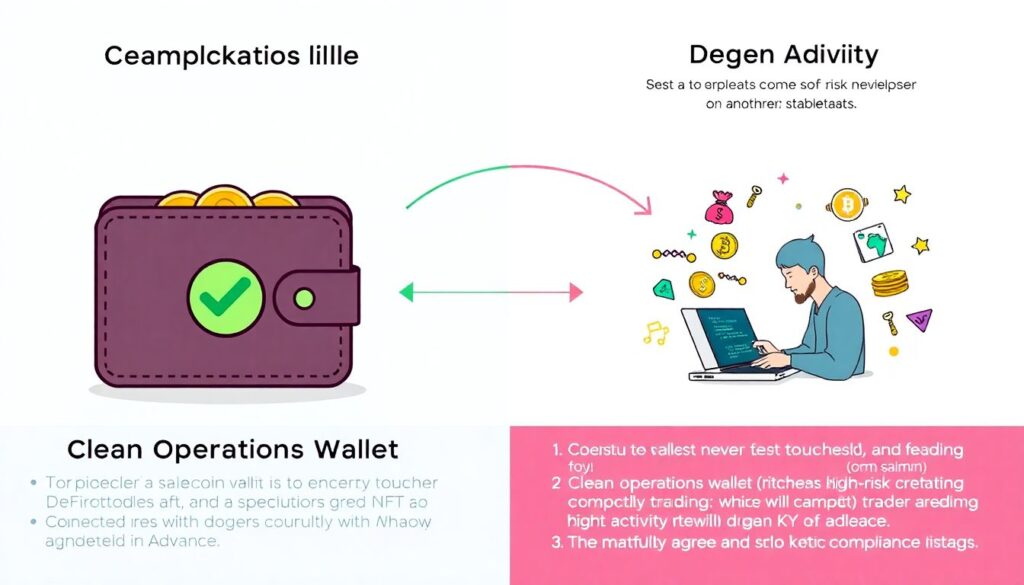
Consider a core dev in another country who prefers stablecoins. Non‑obvious compliance‑friendly path: pay them from a “clean” operations wallet that never touches high‑risk protocols; keep degen activity segregated elsewhere. Before the first payment, mutually decide what minimal KYC each side is comfortable with—maybe a verified LinkedIn plus a signed contract under real names, stored offline. You screen their receiving address, then lock in a consistent payment pattern (same day each month, same memo structure on invoices). Over time, this regularity makes the flow look like salary, which is much easier to justify to tax authorities than random sporadic transfers. If volume grows, you can later plug the same flow into crypto compliance services for businesses or a light‑weight payroll tool without changing the underlying logic.
You’ve essentially designed something that starts casual but can scale into formal rails.
Staying compliant as rules and peers keep changing
The biggest trap is treating compliance as a one‑and‑done checkbox. In crypto, the mix of tools, peers, and regulations mutates constantly. The pragmatic way to stay ahead is to schedule tiny, regular reviews: once a quarter, revisit your peer‑interaction playbook, your wallet architecture, and your screening tools. Ask: did any jurisdiction you touch tighten rules? Did a protocol you rely on get hacked or sanctioned? Are your peers starting to use new chains or bridges that your tools don’t cover yet? Light governance here beats expensive crisis management later. Keep your documentation versioned (Git, Notion history), tag all major decisions with dates, and write down why you accepted certain risks at the time. If regulators ever ask how to stay compliant with cryptocurrency regulations in your situation, you’ll have a narrative: you tracked changes, adapted, and treated peer‑to‑peer interactions with the same seriousness as formal business flows—just with leaner, smarter tools.