
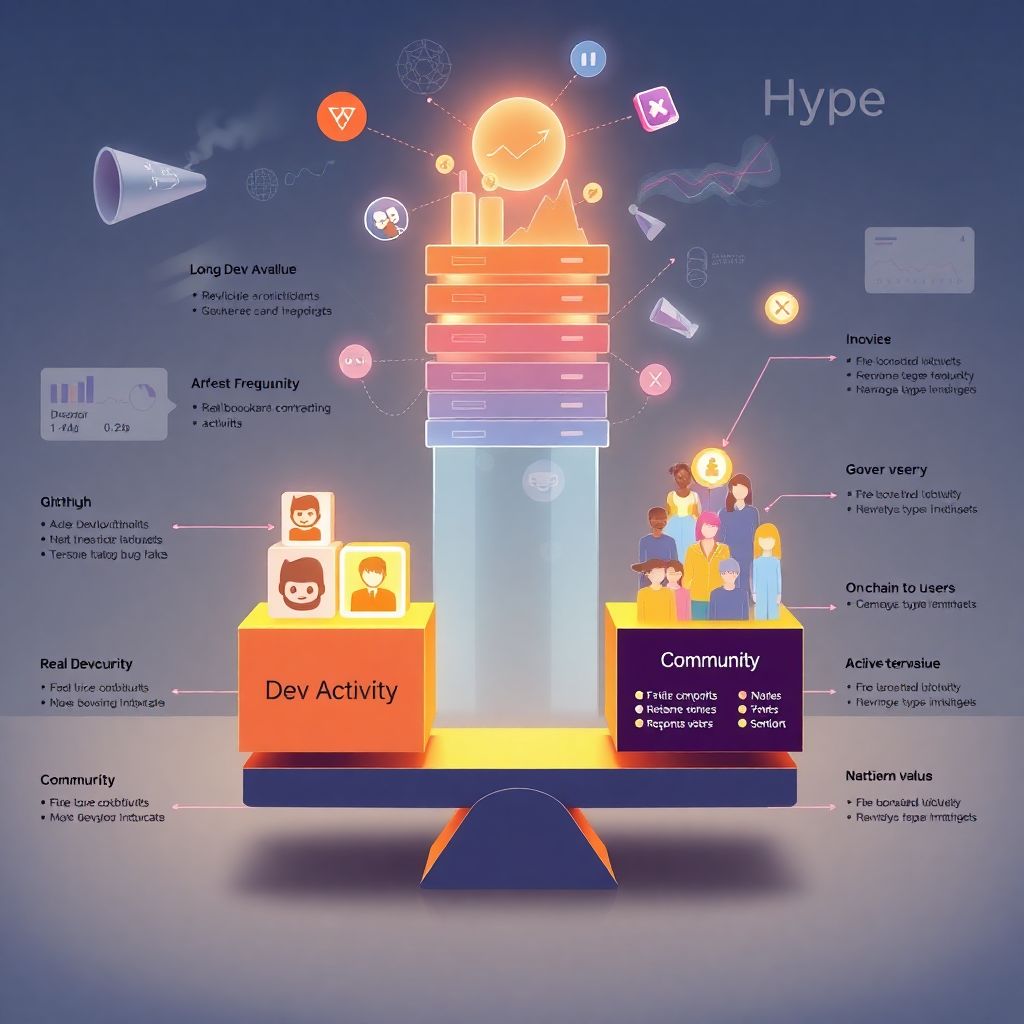
Why dev activity and community matter more than hype
When you’re looking at a new token, it’s tempting to focus on price charts and viral tweets. But if you ask serious investors and analysts, they’ll tell you the same thing: long‑term winners usually have two pillars — strong development activity and a real, engaged community. Price can be faked for a while; liquidity can be rented; but sustained code shipping and genuine grassroots support are much harder to manipulate. In this guide, we’ll walk through how to check both sides in a practical, down‑to‑earth way, using tools that professionals actually rely on, along with expert recommendations and some realistic expectations about risk.
—
Step 1. Understanding what “development activity” really means
A lot of newcomers think dev activity equals “number of commits on GitHub.” That’s a start, but it’s also one of the most misleading single metrics. Serious crypto analysts look at a broader picture: how many independent developers contribute, how often releases are shipped, how transparent the roadmap is, and whether bugs and security issues are handled quickly. Development activity is less about vanity metrics and more about whether the project is iterating, surviving market cycles and adapting to user feedback. As one venture analyst from a crypto fund likes to say: “If the repo is dead for six months, the token is just a bag of hope.”
—
Key metrics experts actually watch in repos
Seasoned researchers don’t scroll GitHub aimlessly; they track a few core signals across time. These numbers alone don’t guarantee success, but they highlight whether a token has an active engine behind it or is coasting on old code and marketing. Remember, a flashy website doesn’t fix a stale protocol, so you want to see a living, breathing codebase with signs of maintenance, refactoring and adaptation to new standards.
– Number of active contributors per month (not just total contributors over the project’s lifetime).
– Frequency of releases, tags, and version bumps, including testnet/mainnet upgrades.
– Speed of response to issues and pull requests, especially critical bug reports or security disclosures.
—
How to assess blockchain project GitHub activity before investing
If you’re not a developer, reading complex smart contract code can feel like trying to read another alphabet. The good news is, you don’t need to understand every line. Start by checking whether the main repository is public, has consistent commits over many months, and shows contributions from multiple people, not just a single founder account. Look at the “Issues” tab to see if bugs are being answered or just piling up unanswered. Topics like “security,” “gas optimization,” and “refactor” show that someone is taking the tech seriously. Professional investors also compare commit patterns to major milestones: if a mainnet launch, bridge integration, or big partnership is announced, but the code repo is quiet in that period, they treat that as a red flag.
—
Using crypto research tools for analyzing token development activity

You don’t need to build your own dashboards from scratch. There are already crypto research tools for analyzing token development activity that aggregate GitHub and GitLab stats, tag repos by project, and even score “developer health” over time. Many funds use these tools daily to filter out “zombie” projects with thin or copy‑pasted code. Some platforms go beyond raw commit counts and include metrics like “code quality,” “open‑source score,” or “bus factor” (how dependent the codebase is on one or two people). While these scores aren’t perfect, they let you compare dozens of tokens side by side without manually digging through every repository.
—
Paid analytics tools and what’s worth paying for
Free data is great, but many sophisticated traders lean on paid analytics tools for tracking crypto community growth and sentiment alongside dev metrics. Subscriptions that cost the equivalent of a few hundred dollars a year can easily pay for themselves if they keep you out of one or two bad trades. Tools with historical data back to previous cycles are especially valuable, because they let you see which teams kept building through bear markets instead of disappearing until the next hype wave. Experts also highlight platforms that automatically detect forked repos or copy‑pasted code, since some projects still try to pass off clones as “innovative protocols.”
—
Community: your early warning system for real demand
Code is important, but adoption and loyalty come from people. A healthy token community can survive short‑term price shocks, coordinate grassroots marketing, and pressure the team to execute. Conversely, a community of pure speculators with no product users tends to vanish as soon as number goes down. Analysts often say: “Dev activity shows you the supply side; community shows you potential demand.” The trick is separating organic enthusiasm from manufactured noise, because follower counts and Telegram member numbers can be easily inflated with bots or airdrop farmers.
—
What professionals look for in a community
Experienced investors don’t care how loud a community shills on social media; they care how it behaves when the market turns against the token. Healthy communities show resilience, constructive criticism, and an understanding of the project’s actual purpose. If all the talk centers on “wen moon” and zero on product feedback, that’s usually a sign the token is mostly a trading chip, not part of a real ecosystem.
– Diversity of channels: Discord, Telegram, X, forums, and sometimes local language groups.
– Ratio of builders to traders: presence of dev chat, governance debates, and user support threads.
– Quality of conversation: questions about integrations, tooling, UX and documentation versus pure price speculation.
—
The best platforms to evaluate crypto project community engagement
You don’t need to join every group personally to get a feel for engagement. Some of the best platforms to evaluate crypto project community engagement track things like follower growth, post interactions, sentiment, and retention. They help you spot projects whose social media is full of botted likes, repetitive comments, or short‑lived engagement spikes around airdrops. Many experts also use on‑chain data platforms that show whether wallet addresses interacting with the protocol are sticking around, or if they just show up for incentives and disappear. Combining social metrics with on‑chain behavior gives you a much clearer picture than raw follower counts ever will.
—
Spotting fake hype versus real traction

It’s not hard to create the illusion of a booming community for a few weeks. Short‑term giveaways, referral contests and aggressive influencer campaigns can pump metrics quickly. The harder part — and what long‑term investors care about — is sustained participation without constant bribery. Look for consistent core contributors posting updates, answering user questions, and organizing events or AMAs month after month. Check if community‑made tools, bots, dashboards, or tutorials exist; those are strong signs of real commitment. Experts also suggest watching how the community handles bad news. If a bug, delay, or price dump happens and the discourse stays mostly rational, that’s a good indicator you’re dealing with adults, not a mob.
—
Combining dev and community data: a practical workflow
Instead of staring at dozens of dashboards and getting analysis paralysis, build a simple repeatable process. Many professionals start with a rough screen based on market cap and liquidity, then quickly scan development and community health before diving deeper into tokenomics. The goal isn’t to find a “perfect” project (there is none), but to eliminate obvious time‑wasters and scams early, so you only spend energy on tokens that at least have a building team and an interested user base.
A common expert workflow looks like this:
1) Quick GitHub and analytics tool check for dev activity over the last 6–12 months.
2) Social and on‑chain activity scan to see if users are real and engaged.
3) Conversation sampling: read a few Discord threads, Telegram chats, and X replies.
4) Only if all of that checks out, dive into tokenomics, governance, and competitive positioning.
—
Crypto due diligence service: when to bring in professionals
If you’re putting serious capital at risk, it can make sense to use a crypto due diligence service for checking token fundamentals and team backgrounds. Those services typically combine legal checks, code reviews, token distribution analysis, and market intelligence. They won’t guarantee returns, but they can highlight hidden risks: previous failed projects by the same founders, questionable vesting schedules, or legal exposure in certain jurisdictions. Some funds also hire independent security auditors to examine smart contracts before touching early‑stage tokens. Even if you can’t afford a full‑scale professional review, reading public audits and looking up the auditor’s reputation is a basic step that many retail investors still skip.
—
Economic aspects: why dev and community show up in price eventually
In the short run, crypto markets are driven by liquidity, leverage, and narratives. Over longer periods, tokens backed by steady shipping and active users tend to show better survival rates. Several industry reports have observed that projects with consistent monthly commits and growing active addresses significantly outperform inactive ones across a full market cycle. Development activity contributes to features, integrations, and security improvements, which can attract developers and partners. A strong community, in turn, creates network effects and “stickiness” that reduce sell pressure. Economically, you can think of both as intangible assets: they don’t show on a balance sheet, but they act as shock absorbers when speculation cools down.
From an expert’s point of view, dev and community metrics are leading indicators. Token price and trading volume are lagging indicators that respond after builders and users start to cluster around a project. That’s why many professional investors are comfortable buying into tokens that are not at all‑time highs, as long as they see a clear upward trend in protocol usage, GitHub activity, and community quality. They treat periods of negative sentiment but persistent building as accumulation opportunities, provided the fundamentals and runway look solid.
—
Statistics and current trends in dev and community growth
Across the broader ecosystem, developer activity has become much more concentrated than it was during previous cycles. Independent analytics reports show that a relatively small group of leading chains and protocols capture the majority of full‑time developers, while hundreds of small tokens have sporadic or one‑off commits. At the same time, daily active users and community metrics often skew toward ecosystems with strong tooling and grants, as builders tend to migrate where support and documentation are better. This “gravity effect” means that evaluating a token in isolation is not enough; you also want to consider whether its underlying chain is gaining or losing mindshare.
Looking ahead, experts expect dev and community data to become increasingly standardized and integrated into exchanges and wallets. Just like traditional finance investors rely on earnings, cash flow and analyst coverage, crypto participants will lean more on on‑chain analytics, open‑source stats and sentiment indices to filter noise. Early signs of this trend are already visible in how major data providers surface metrics like active developers, GitHub commits, and social engagement right alongside price and volume. Over the next 3–5 years, tokens that can’t demonstrate credible activity or real users will likely struggle to attract serious capital.
—
Forecasts: how evaluation methods will evolve
Analysts expect three major shifts in how we evaluate token development and communities. First, machine‑learning‑driven tools will become better at detecting fraud, copied code and botted communities, making it harder for low‑effort teams to fake momentum. Second, regulatory pressure will push some projects to be more transparent about their teams, treasuries and governance processes, giving investors cleaner inputs for due diligence. Third, we’re likely to see more cross‑protocol developer profiles, where you can follow a contributor’s history across chains, repos and DAOs, not just a single project.
From a practical standpoint, this means your toolbox will only get richer. Instead of manually scanning dozens of sources, you’ll be able to pull unified dashboards that combine dev metrics, governance participation, token holder concentration and user behavior into one coherent picture. That should reduce the advantage of large funds over individual investors, at least in terms of raw information access. The edge will then come from interpreting that data well and sticking to a disciplined process, rather than chasing every hot narrative.
—
Impact on the wider crypto industry
As more capital pays attention to development and community fundamentals, projects are being nudged to behave differently. Teams that once prioritized aggressive token launches before their product was ready now face pushback from more educated investors. Instead, we’re seeing more projects delay public token releases until after they’ve shipped core features and established early user communities. This shift places real building and support at the center of value creation, not just clever token engineering or influencer campaigns. Over time, that can help weed out the worst forms of short‑term speculation and strengthen the credibility of the entire industry.
On the community side, higher standards also force projects to invest in genuine user support, documentation, and long‑term engagement, rather than one‑off airdrops. Active, knowledgeable communities become an asset in their own right, helping with product testing, translation, integrations and ecosystem growth. This dynamic pushes crypto projects to think more like open‑source startups than pump‑and‑dump schemes. If this trend continues, the industry could gradually move closer to a world where token valuations reflect, at least partially, the underlying work and network effects — not just casino‑style volatility.
—
Putting it all together: a simple, practical checklist
You don’t need to be a quant or senior engineer to evaluate a token more intelligently than the average retail trader. By combining a few key metrics, some common‑sense observations and expert‑inspired habits, you can massively improve your odds of avoiding hollow projects. Think of it as a quick health check before you commit real capital, not a guarantee of success but a filter that catches obvious problems.
– Dev side: consistent commits over 6–12 months, multiple active contributors, public repos, regular releases, and responsiveness to issues.
– Community side: multi‑channel presence, meaningful conversations, builder and user activity, and stable engagement beyond airdrops.
– Professional help: when stakes are high, consider audits, third‑party analytics, or even specialized due diligence services to validate what you see.
If a token fails on most of these fronts, treating it as a short‑term speculation — or avoiding it altogether — is usually wiser than trying to convince yourself it’s the next big thing. If, on the other hand, you see a team steadily shipping, a thoughtful and resilient community, and fundamentals that line up with your risk tolerance, you’ve at least found a project that deserves a deeper look.