
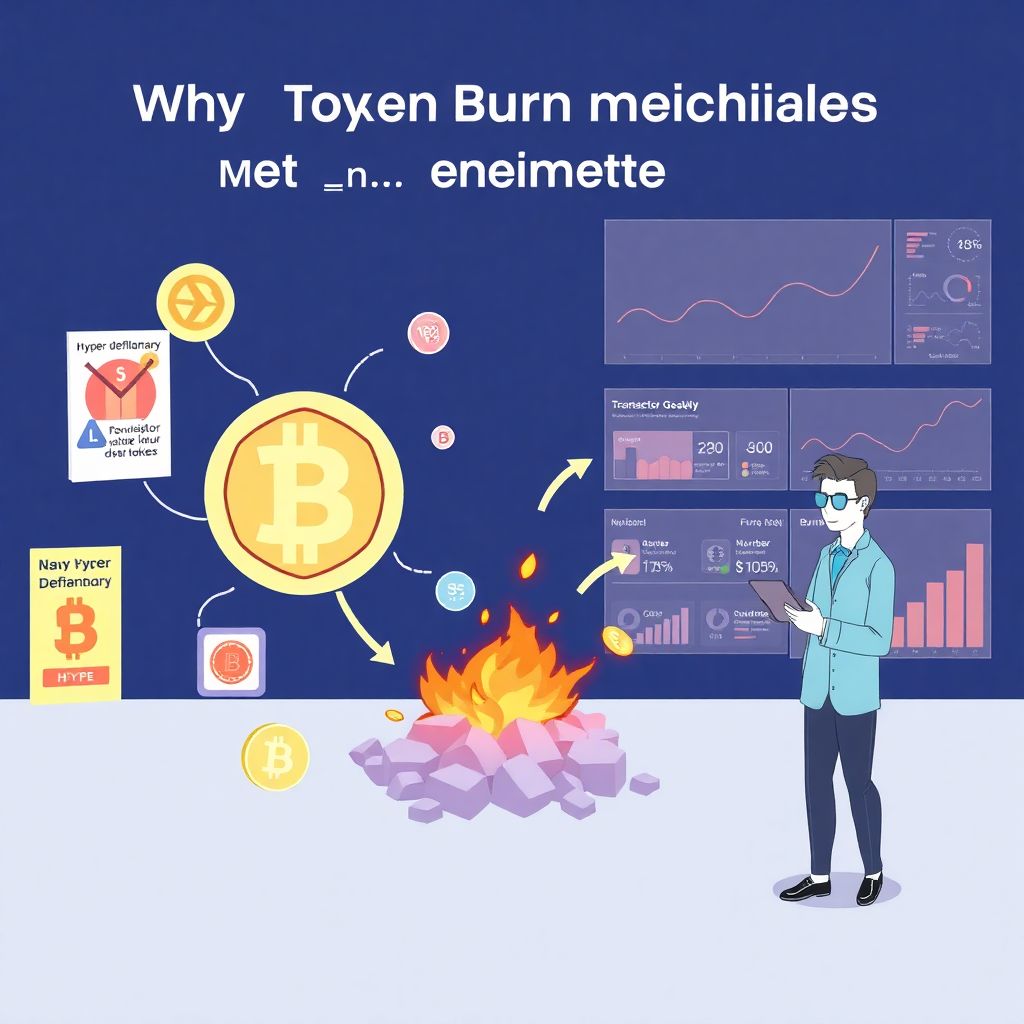
Why token burn mechanics matter more than you think
Token burns sound simple: “We destroy tokens, number go up.”
In reality, the story is way deeper, and if you’re investing in 2025 without understanding how burns really work, you’re flying blind.
This beginner guide to evaluating a token’s burn mechanics in depth will walk you through where burns came from, how they actually work under the hood, and how to read between the lines of flashy marketing claims. Consider it your practical guide to analyzing token burn models before investing, with as little jargon as possible.
—
Historical background: how we got obsessed with burning tokens
From “VIP points” to deflation narratives
Early crypto projects didn’t obsess over burns.
Bitcoin never burns supply on-chain; its scarcity is coded through a capped maximum and halving emissions, not explicit destruction.
The first big wave of burns started with centralized exchanges issuing their own tokens. Binance Coin (BNB) is the classic example: the exchange used part of its profits to buy back BNB and send it to a dead address. This provided a simple story for retail: “We burn profit, you hold, supply goes down.”
That narrative was contagious.
Soon other exchanges, some payment tokens, and later DeFi protocols copied the idea: planned burns, periodic burns, and volatile “event-based” burns became part of every flashy whitepaper.
—
From manual to protocol-level burns
The next step was moving from “the team promises to burn” to “the protocol burns automatically.”
Ethereum’s EIP-1559 upgrade in 2021 was a turning point. A portion of transaction fees started being burned by the protocol itself. No team decision. No marketing event. Just code. This was one of the first widely adopted examples of token burn mechanics explained in a transparent, verifiable way for a large network.
By 2025, protocol-level burns are standard across many chains and DeFi apps. Some do it well, others slap on a burn to look “deflationary” without having a real economic design behind it. Your job as an investor is to tell the difference.
—
Basic principles: what a burn really is (and isn’t)
The core idea
A burn is the permanent removal of tokens from effective circulation.
That usually means sending tokens to:
– An address with no known private key (a burn or “dead” address), or
– A special contract that provably cannot spend or re-emit them.
On paper, lower supply with the same or higher demand should push price up over time. But that’s theory; reality is messier.
—
Effective supply vs. headline supply
One of the first things to grasp when learning how to evaluate crypto tokenomics and burn rate is the difference between total, circulating, and effective supply:
1. Total supply – Maximum minted or mintable tokens.
2. Circulating supply – Tokens not locked or reserved, roughly “available in the market.”
3. Effective supply – Circulating supply minus what is practically off the market (burned, lost, forever locked, or tightly held by non-sellers).
Burns change effective supply.
But if a protocol burns 1% while insiders dump 10%, the “deflationary” label is meaningless. You always compare burn rate against issuance and selling pressure.
—
Burn sources: where do burned tokens come from?
Tokens can be burned via:
– Transaction fees – A portion of every trade or transfer.
– Protocol revenue – Fees from DEXs, lending, gaming, L2 sequencers, etc.
– Buybacks – The team uses treasury or revenue to buy tokens on the market and burn them.
– Penalties or slashing – Misbehaving validators, stakers, or players get tokens destroyed.
Each source has different implications for sustainability and pressure on price. Burns funded by genuine economic activity are far healthier than burns funded by short-lived hype.
—
Practical framework: how to evaluate a burn mechanism step by step
Step-by-step thinking, not vibes
Use this simple checklist whenever you analyze a new “deflationary” coin:
1. Identify the burn trigger.
What exactly causes burns? Transactions, volume, time, protocol profit, governance decisions?
2. Measure the burn intensity.
Is it a fixed percentage, dynamic formula, or “up to X% at the team’s discretion”?
3. Compare burn vs. issuance.
Are new tokens being minted (for rewards, staking, inflation)? Is net supply actually going down, or just slowing its increase?
4. Check transparency.
Can you verify burns on-chain? Is there a clear, auditable burn address or contract? Are there dashboards that match the claims?
5. Assess sustainability.
Can the project realistically fund this burn rate for years? Or is it a short-term marketing blast?
6. Connect to real demand.
Is the token actually used (fees, staking, collateral, access)? Burns without genuine demand are usually noise.
This mental model is the heart of any honest guide to analyzing token burn models before investing. The goal is simple: move from “burn good” to “does this specific burn design make long-term economic sense?”
—
Reading burn math without being a quant
You don’t need PhD-level math.
You just need to understand a few relationships:
– Burn rate per year (in tokens)
– Average issuance / emissions per year
– Expected or historical demand growth
If annual burns destroy 3% of supply but rewards add 5%, the token is still inflating by 2%. A lot of “best deflationary tokens with burn mechanism” on Twitter quietly have net inflation once you add up all emissions.
Ask yourself:
– Is the burn rate variable (depends on volume) or fixed?
– Does high activity increase burns (good) or dilute holders via more rewards (mixed)?
– Does the protocol have levers to adjust burn/issuance if conditions change?
—
Real-world implementation examples
Fee-based protocol burns
DeFi protocols often burn a percentage of protocol revenue. For example:
– A DEX charges trading fees, routes a slice to buy back and burn its native token.
– A lending platform charges interest or liquidation fees, part of which is used to burn tokens.
This design ties burns to real usage: the more people use the protocol, the stronger the deflationary pressure. It’s easier to understand how token burning affects crypto price and market cap in these setups, because there’s a direct line from adoption → revenue → burn → supply.
Short paragraph:
The catch? If revenue drops in a bear market, burns weaken just when holders want them most.
—
Transaction-tax burns
Some tokens add a “tax” to every transfer – for example, 1–5% of each transfer is burned. This was very popular during meme and “reflection token” waves.
Pros:
– Simple story: “Every trade makes supply smaller.”
– Encourages holding instead of trading.
Cons:
– Deters large users and integrators, who hate extra friction.
– Can be bypassed via side contracts or wrapped versions.
– Vulnerable to regulatory scrutiny if too aggressive.
By 2025, many serious projects have moved away from heavy transaction taxes, or limit them to specific in-app actions instead of every wallet transfer.
—
Buyback-and-burn from profit
Centralized exchanges, rollups, and some real-world-asset (RWA) projects use a share of profits to buy back tokens on the open market and then burn them.
Benefits:
– Direct buy pressure plus deflation.
– Easy for investors to track: profit → buyback size → burn amount.
Risks:
– If profit is low, burns shrink.
– If the team can arbitrarily change the buyback policy, you’re trusting management, not just code.
When evaluating these, read the docs and ask: *Is this enshrined in governance or just a “we plan to” statement on a landing page?*
—
Common misconceptions and traps
Myth 1: “Burns guarantee price appreciation”
They don’t.
Price is driven by supply, demand, and market expectations. Burns only directly touch one side of the equation.
If demand is falling faster than supply, even aggressive burns won’t save the chart. Some of the most dramatic collapses in crypto history involved “hyper-deflationary” tokens whose user base vanished.
Short rule of thumb:
If you wouldn’t use or hold a token without burns, burns probably won’t magically fix it.
—
Myth 2: “Large one-time burns are bullish forever”
Team announces a 50% supply burn. Social media explodes. Price spikes, then drifts. Why? Because markets quickly reprice the new supply, and then return to caring about fundamentals.
One-time “shock” burns can have short-lived effects, but sustainable, predictable burn mechanisms aligned with demand usually matter more over a multi-year horizon.
Ask whether a burn is:
– Event-based hype – big, rare, heavily marketed.
– Flow-based design – continuous and structurally linked to protocol activity.
The second style is usually more meaningful for long-term investors.
—
Myth 3: “All deflationary designs are safer”
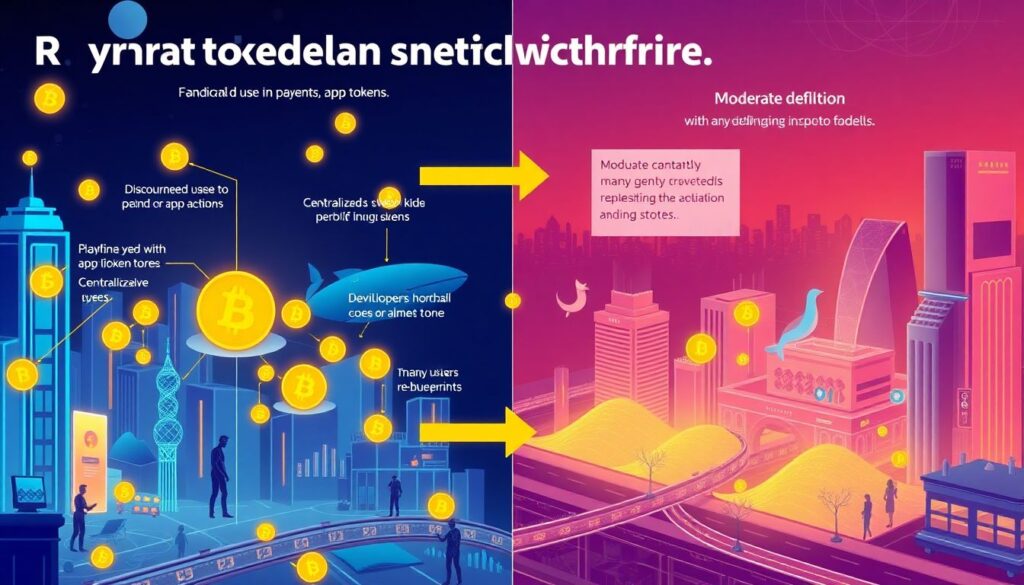
Radical deflation can backfire.
If a token becomes too scarce too quickly, it can:
– Discourage its use in payments or in-app actions.
– Centralize ownership among early whales.
– Force protocols to constantly redesign incentives.
Healthy designs often balance moderate deflation with enough emissions or rewards to bootstrap users and validators. Extremes at either side (hyper-inflation or hyper-deflation) are often unstable.
—
How burns interact with tokenomics as a whole
Burns are one piece of a bigger puzzle
When you evaluate a project, think “system,” not “feature list.”
Burns intersect with:
– Emissions and rewards – staking, liquidity mining, play-to-earn.
– Utility – what you can actually do with the token.
– Governance – who can change burn parameters and how.
– Treasury strategy – how the protocol uses fees and reserves.
A project with modest burns but strong real demand, clear revenue, and responsible emissions can outperform a flashy “super deflationary” token with no actual use case.
—
Putting it together in practice
To actually apply everything above, try this quick analysis when you look at a new token:
1. Read the docs for the burn description.
2. Find the on-chain burn address and verify recent burns.
3. Compare annual burns vs. new tokens issued.
4. Check real usage metrics – daily active users, TVL, fees, transaction count.
5. Look for governance decisions affecting burns (past and possible future).
6. Ask whether the burn is sustainable in both bull and bear conditions.
Over time, you’ll intuitively feel which designs are “cosmetic” and which actually anchor the token’s value.
—
Evaluating burn rate in 2025: what’s changed and what hasn’t
More data, more dashboards, more noise
By 2025, almost every major chain and DeFi protocol has public dashboards showing:
– Tokens burned per day / week / month
– Cumulative burn since launch
– Net issuance vs. net burn
– Impact on projected supply over years
This helps, but it can also drown you in numbers.
Focus on trends: Is net supply growth slowing, stable, or going negative? Are burns correlated with genuine adoption, or just with speculative trading spikes?
When asking how to evaluate crypto tokenomics and burn rate today, you’re really asking: *what parts of all this data actually matter over 2–5 years?* Long-term investors tend to care more about sustained net negative or low inflation alongside growing real usage.
—
Marketing language vs. coded rules
A key shift since the early days: serious investors prefer hard-coded rules and on-chain governance over vague “roadmap burns.” If the burn parameters can be changed at a whim by a small team, treat them as optional, not guaranteed.
You should always separate:
– Guaranteed burns – enforced by protocol logic.
– Discretionary burns – dependent on team decisions or off-chain profits.
Both can work, but the risk profile is very different.
—
Examples of better and worse burn designs (conceptually)
Features of healthier burn mechanisms
While there’s no single formula, designs that age well tend to have:
– Burns funded by real, recurring economic activity.
– Transparent, verifiable on-chain logic.
– Dynamic parameters that can be adjusted through governance if conditions change.
– Net supply that trends toward moderate deflation or low inflation, not wild swings.
These are the projects that are more likely to end up in “best deflationary tokens with burn mechanism” lists for reasons beyond just memes.
—
Warning signs and red flags
Be cautious when you see:
– Huge burns early, with no clear long-term funding for continued burns.
– Opaque burn addresses that you can’t easily track.
– Frequent parameter changes by a small multisig with no community input.
– Overly complex math that can’t be explained in plain language.
– Burns that exist mainly to offset massive emissions or unlocks for insiders.
If, after reading all available docs, you still can’t answer “what actually causes burns?” in one or two simple sentences, that’s a sign to slow down.
—
How token burning affects price and market cap in reality
Short term vs. long term
Short-term:
– Scheduled burns and big announcements can spike price due to anticipation.
– Actual burning during a hyped period can amplify volatility — both up and down.
Long-term:
– Consistent net reduction in supply *can* support a higher price floor if demand is steady or growing.
– Market cap may grow even if supply shrinks, but only if investors see credible future cash flows, utility, or adoption.
When people talk about how token burning affects crypto price and market cap, they often overstate the mechanical effect and understate how much expectations and narrative matter. Burns are a narrative tool as much as they are a technical mechanism.
—
Looking ahead: where burn mechanics are heading after 2025
More dynamic, “programmatic” burns
Expect more protocols to experiment with:
– Adaptive burn rates – burn percentage changes based on market cycles, volatility, or protocol revenue.
– Feedback loops – when price is overheated, reduce rewards and increase burns; when usage is low, do the opposite to attract users.
– Combining burns with lockups – part burned, part time-locked to stabilize circulating supply.
We’ll likely see burn models become more like monetary policy systems than fixed formulas.
—
Regulation and transparency pressure
As regulators pay more attention to token economics, especially around securities-like behavior, projects will feel pressure to:
– Disclose burn policies clearly and consistently.
– Avoid misleading “deflation forever” marketing.
– Demonstrate that burns don’t unfairly benefit insiders.
Investors will demand better explanations of token burn mechanics explained in plain language, not just Solidity snippets.
—
Integration with real-world utility
If 2020–2022 were about DeFi and memes, 2023–2025 have been about infrastructure, RWAs, and more serious apps. Going forward, expect burns tied to:
– Real-world transaction fees (payments, remittances, asset tokenization).
– Usage of L2 and L3 rollups securing real economic activity.
– Hybrid models where a portion of off-chain revenue is verifiably pushed on-chain and burned according to strict rules.
Tokens whose burn mechanisms cleanly connect on-chain logic to off-chain value will likely stand out from pure speculation plays.
—
Final checklist for beginners
When you next look at a new token claiming “deflationary burn mechanics,” run this quick, honest checklist:
1. Can you explain what triggers the burn in one sentence?
2. Can you see where burns go on-chain?
3. Is net supply actually shrinking, or just inflating more slowly?
4. Are burns tied to real protocol usage or revenue?
5. Is the burn policy hard-coded or at the mercy of a small team?
6. Would you still consider the project interesting even if burns didn’t exist?
If you can answer those calmly and still like what you see, you’re no longer guessing. You’re using a real, structured approach to evaluating a token’s burn mechanics — which is exactly where you want to be as an investor in 2025 and beyond.