
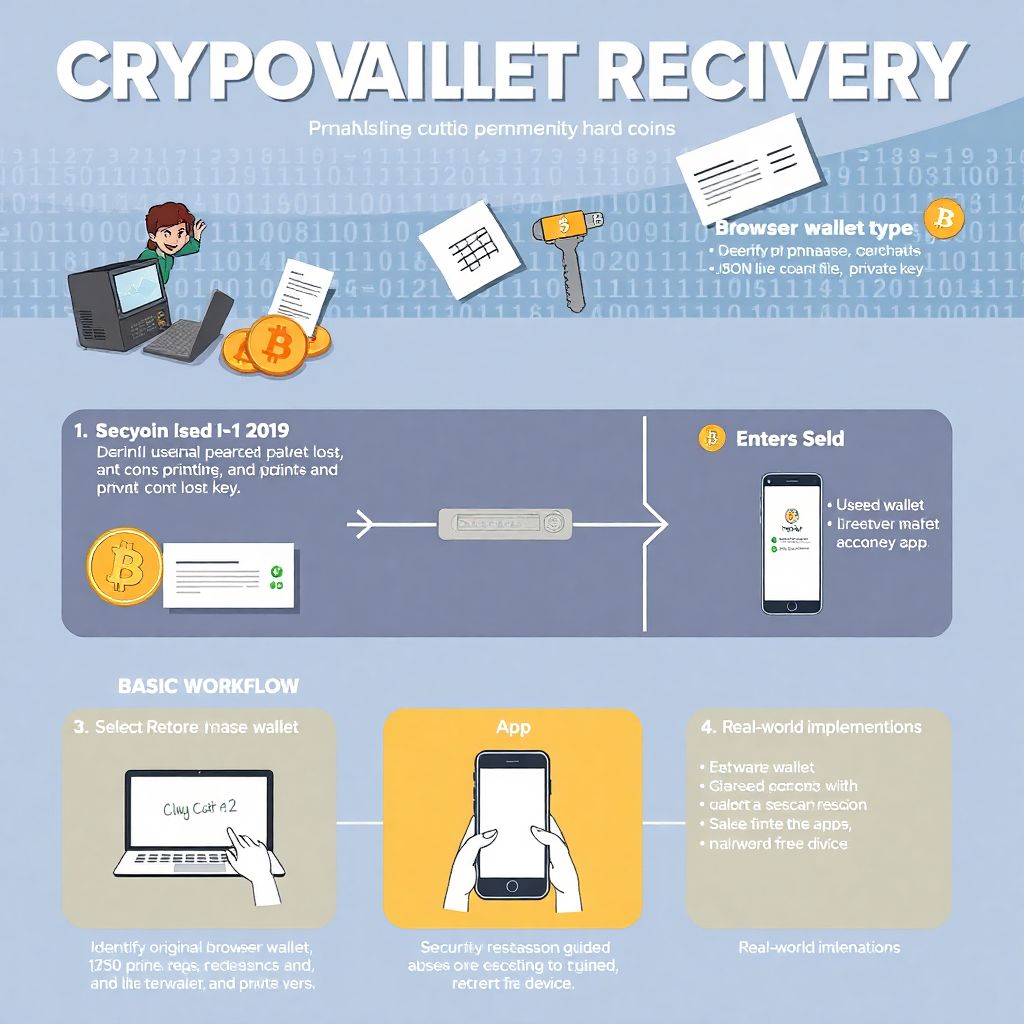
Historical context of crypto wallet recovery
When Bitcoin appeared in 2009, there was no such thing as a crypto wallet recovery service in today’s sense. Early users generated keys with primitive clients, wrote them to text files, or printed them on paper. If you deleted your wallet.dat file or threw away the hard drive, that was it: coins were gone forever. Over time, as more people lost access to funds, demand for structured approaches to how to restore lost crypto wallet access grew. Standards like BIP‑32 and BIP‑39 introduced hierarchical deterministic (HD) wallets and seed phrases, which made backup and restore more predictable but also concentrated all risk into one secret phrase. This evolution gradually shifted the problem from “recovering random files” to “protecting and reconstructing deterministic keys” using standard procedures that any compatible wallet could understand.
Basic principles: keys, seeds and what “recovery” really means
At a low level, a crypto wallet is just a key management tool. Your coins do not live inside the app; they are recorded on a blockchain and controlled by private keys. Crypto wallet private key recovery therefore means re‑deriving or re‑locating the exact key material that can sign transactions for your addresses. For modern HD wallets, this usually means you recover crypto wallet from seed phrase, which is a human‑readable representation of entropy defined by BIP‑39. When you type this phrase into a compatible wallet, it deterministically recreates your whole key tree: accounts, addresses, and sometimes multiple blockchains at once. If you understand that the seed (or private key) is the real asset and everything else—UI, app, device—is replaceable, you can design your backup and restore strategy with much more confidence and less guesswork.
Core workflow: how restoration normally happens
In the typical scenario, how to restore lost crypto wallet access follows a structured flow. First you identify what you actually used: a browser extension wallet, a mobile app, or a hardware device, and whether it was HD (seed phrase based) or single‑key. Next you locate any remnants of your original backup: a 12/18/24‑word seed, a JSON backup file, or an exported private key. Then you choose a compatible wallet implementation, reinstall it (or install it on a new device), and select the “Import” or “Restore” option instead of creating a new wallet. Finally, you feed in the seed phrase or key material and let the wallet rescan the blockchain to find your balances. During this whole process, network safety and device hygiene matter more than speed: performing the restore on an infected, shared, or untrusted machine can silently hand over all your funds to an attacker the moment you regain access.
Examples of real‑world recovery implementations
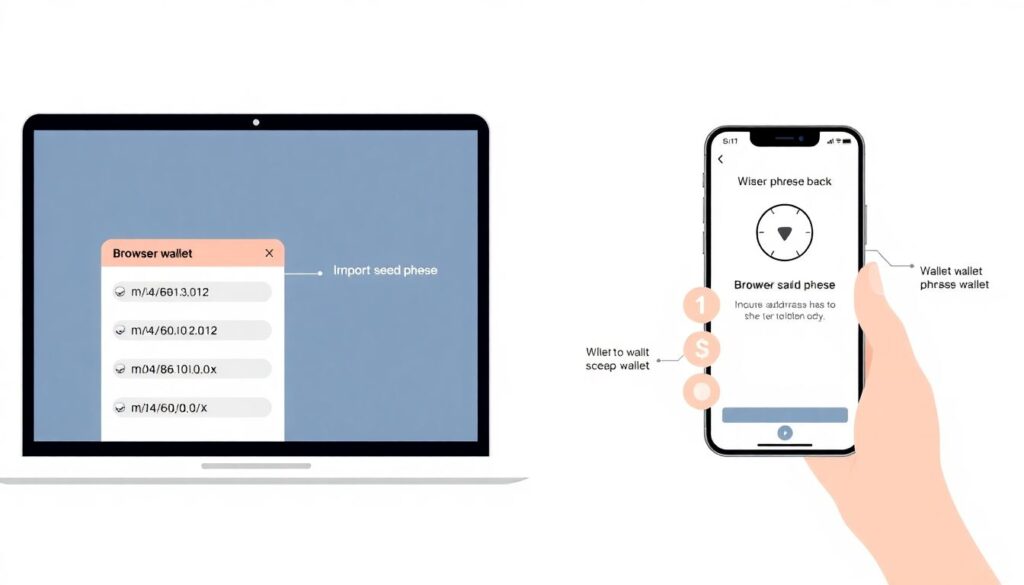
Most mainstream wallets implement comparable mechanisms, but the user experience differs. Browser wallets often let you import using a seed phrase or a raw key; once imported, they derive a standard sequence of addresses using a known derivation path. Mobile wallets usually walk you through a guided recovery flow, validating word count and checksum to reduce errors when you recover crypto wallet from seed phrase. Hardware wallets keep the seed phrase fully offline; you enter the words on the device or via a secure input method, and the device re‑generates keys without exposing them to the host computer. In extreme cases—such as partially corrupted backups or damaged storage media—some users resort to specialized software to brute‑search wallet files, or they consult a vetted crypto wallet recovery service that can analyze drives and wallet formats to reconstruct keys, provided they have lawful access and sufficient forensic data.
Best practices and tools used in recovery
On the tooling side, there is a spectrum from simple consumer apps to low‑level utilities. For non‑technical users, the best crypto wallet recovery tools are usually the official wallet clients themselves, as they have built‑in support for the exact derivation paths and formats initially used. For more complex situations—like mixed derivation paths, multi‑coin setups, or legacy formats—open‑source projects can help enumerate addresses, scan for balances, and repair minor inconsistencies in backups. Advanced users might rely on command‑line utilities to import seeds, test alternative paths, or convert between legacy and modern formats. While brute‑force tools exist, their usefulness is limited: modern seeds are designed to be computationally infeasible to guess without a significant portion of the original phrase or passphrase. The most effective “tool” still remains a well‑documented backup strategy established before catastrophe hits.
Frequent misconceptions and typical beginner mistakes
Newcomers often assume that a wallet app functions like an online bank account with a support hotline. They expect a provider to reset access on demand and underestimate the finality of lost keys. This leads to a slew of errors: storing the only copy of a seed phrase in a photo gallery, on cloud drives, in email drafts, or in unencrypted notes. Another widespread misconception is thinking that uninstalling an app automatically destroys all risk, while cached backups or synced files continue to expose keys to other devices. Many beginners also mix up public addresses and private keys, or think that exporting a “view‑only” address is enough to move funds later. When they try to perform crypto wallet private key recovery, they sometimes paste secrets into random web forms, browser extensions, or unknown mobile apps promoted in ads, effectively gifting control over their funds to scammers who specialize in fake recovery tools and phishing dashboards.
Common rookie errors during the recovery process
When users are already in panic mode and trying to figure out how to restore lost crypto wallet access, they tend to skip verification steps. A classic beginner error is creating a new wallet instead of restoring an old one, then confusing the fresh empty addresses with the original ones. Another is mis‑ordering or mistranscribing words in the seed, especially when handwriting is poor or transliteration issues occur. Some users forget there was an extra passphrase (often called the “25th word”) and assume the seed alone is enough; without that passphrase, the restored wallet will correctly open—but show a zero balance. Others rush into downloading the first thing they see labeled as recovery software, without validating signatures, sources, or reviews, unintentionally installing malware. Blindly trusting anyone who claims to run a crypto wallet recovery service on social networks is another critical mistake: legitimate providers will never ask you to send the full seed phrase in plain text over chat.
Step‑by‑step recovery checklist for non‑experts
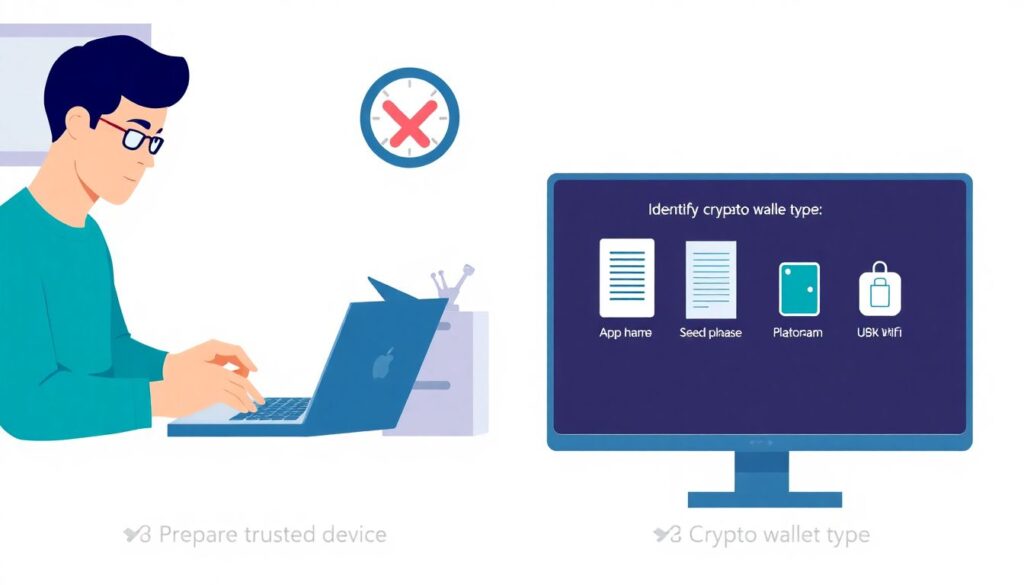
1. Isolate a trusted device. Before you touch any secret data, ensure the system is free of obvious malware, avoid public Wi‑Fi, and update the OS and browser.
2. Identify the original wallet type. Note the app name, platform, and whether it used a seed phrase, separate private keys, or a hardware wallet.
3. Gather all backup materials. Locate written seed phrases, recovery cards, backup files, and any notes about passphrases or PINs; photograph or scan nothing new.
4. Install the official wallet or a proven compatible client. Download from verified sources, check URLs and publisher, and avoid clones or ads that mimic real brands.
5. Use the “Restore” or “Import” function. Enter your seed words carefully in the correct order, or import keys or backup files as guided by the application.
6. Wait for synchronization and verification. Allow the wallet to rescan the blockchain, confirm that known addresses and balances appear, and test a small outbound transaction to verify control.
7. Harden security after success. Once access is restored, rotate to a new wallet if compromise is suspected, move funds, and implement a robust backup scheme with redundant, offline storage.
Clarifying myths about professional recovery help
There is a persistent belief that experts can magically break cryptography and recover any wallet with just a public address or partial seed. In reality, modern cryptosystems are deliberately resistant to brute‑force attacks; without sufficient original material, even the best crypto wallet recovery tools or specialists cannot reconstruct your keys. What professionals can often do is interpret confusing backups, recover partially deleted files from drives, or rebuild configurations for uncommon wallets. Ethical services will clearly explain these limits, use formal contracts, and never guarantee success where the mathematics make it impossible. A legitimate crypto wallet recovery service will generally ask for disk images or wallet files instead of full seeds in chat windows, and will encourage you to consult legal counsel if there are disputes about ownership. If someone claims 100% success rates or offers instant recovery with no data from you, they are almost certainly running a scam operation.
Practical prevention strategies and final remarks
The most effective approach to crypto wallet recovery is not to rely on it in the first place. Establish redundant, geographically separated backups of your seed phrase, using durable media and clear labeling that future‑you can interpret under stress. Test your process by restoring a small wallet from backup before you put significant value into it, verifying that you can actually recover crypto wallet from seed phrase or backup file as planned. Avoid “innovative” storage gimmicks that add complexity without measurable security gains; simplicity, legibility, and redundancy are allies when something goes wrong years later. Keep a concise written guide for yourself or trusted heirs describing where backups reside and which software is needed, without exposing the actual secrets in that document. By combining a clear understanding of the underlying principles with disciplined operational habits, you reduce the odds that a lost phone, failed SSD, or forgotten PIN will ever turn into a permanent loss of funds.