
Why your very first crypto trade feels so scary (and why that’s normal)
Your first digital asset purchase is weirdly emotional. It’s money, technology, and hype all tangled together. One tab shows charts going vertical, another screams about “the next Bitcoin,” and somewhere in the middle you’re just trying to figure out how to buy cryptocurrency for the first time without doing something stupid.
Let’s slow this down.
You don’t need to “ape in,” you don’t need to become a full‑time trader, and you definitely don’t need a PhD to make your first small, controlled trade. What you do need is a clear, practical path from zero to that first real position in a digital asset — plus an understanding of the most common beginner mistakes so you can step over them instead of falling face‑first into them.
Step 1. Get clear on what you’re actually buying
Before opening an app or sending a cent, understand what a “digital asset” is in this context. You’re not buying a stock in a traditional company. You’re buying a token on a blockchain network — something that lives in a distributed database maintained by thousands of computers.
In practice, you’ll mostly see three broad categories:
– Blue‑chip cryptocurrencies (Bitcoin, Ethereum)
– Large, liquid altcoins (e.g., coins in the top 20–50 by market cap)
– Speculative small caps / meme coins in the “lottery ticket” category
For a beginner guide to investing in digital assets, the first key idea is this: not all coins are remotely equal in risk.
New traders often treat them like lottery numbers. The market does not care that a coin is “cheap” at $0.0001 — what matters is supply, demand, and the underlying project. Price per coin is almost meaningless in isolation.
Frequent rookie error #1: Confusing “cheap” with “low risk.”
A coin can cost fractions of a cent and still be far more dangerous than Bitcoin at tens of thousands.
Step 2. Set your constraints: money, time, and risk
If you skip this step, everything else becomes guesswork. Before searching for the best crypto exchange for beginners, define the boundaries:
– How much money are you actually willing to lose if this goes badly?
– How much time can you realistically spend learning and monitoring?
– What’s your emotional tolerance for volatility?
When you think about how to start investing in crypto with little money, it’s not just “what’s the minimum deposit?” It’s also:
Can you shrug off a 30–50% drop without panicking and rage‑selling at the bottom?
Keep this simple:
– Pick a small amount that wouldn’t wreck your budget if it went to zero.
– Treat this first trade as tuition, not a get‑rich‑quick ticket.
Frequent rookie error #2: Starting big to “make it worth it.”
The market punishes overconfidence. Your number‑one goal on your first trade is to survive and learn, not maximize profit.
Step 3. Choose your “sandbox” asset for the first trade
Your first real purchase should be boring on purpose.
You want something:
– Liquid (easy to buy and sell)
– Supported by every major exchange and wallet
– With years of trading history and huge daily volume
For most people, that narrows your “sandbox” candidates to BTC (Bitcoin) and ETH (Ethereum). This isn’t about predicting which will outperform; it’s about using a stable, well‑understood asset to learn mechanics: funding an account, placing orders, withdrawing, storing safely.
New traders often jump to tiny tokens because “that’s where the 100x is.” They end up learning their very first risk lesson the hard way — via a dead coin that no one wants to buy back from them.
Short version: pick one major coin, learn the process end‑to‑end, then consider branching out.
Step 4. Find a reputable, beginner‑friendly exchange
Now we get into logistics. When people search for how to make your first crypto trade step by step, what they usually need is first: “Where do I even go to buy this stuff?”
For a centralized exchange, you’re looking for:
– Strong security history and transparent company info
– Proper identity verification (KYC) and compliance in your region
– Simple interface with clear “Buy/Sell” options
– Reasonable fees and good liquidity in your home currency
Red flags to avoid:
– No clear company behind the website
– Unrealistic yield promises (“guaranteed 20% daily”)
– Poor or no regulatory footprint where you live
– Anonymous team, no audits, no security track record
Don’t just follow a random referral link on social media. Check official websites, read independent reviews, and—crucially—google: “[exchange name] + ‘hacked’ + ‘regulator’ + ‘lawsuit’”.
If a platform spent more money on influencers than on security, that’s information.
Step 5. Create and secure your account properly
This part is boring but non‑negotiable. Exchanges hold a lot of value. That makes your new account a target.
Core actions:
– Use a unique, long password (password manager highly recommended)
– Turn on two‑factor authentication (2FA), preferably with an app (not SMS)
– Store your backup codes somewhere offline and safe
Frequent rookie error #3: Reusing passwords and skipping 2FA.
Attackers love low‑effort targets. Don’t be one.
This setup step takes 10–15 minutes but might save you everything later. The more secure your account is, the more comfortable you’ll feel actually funding and using it.
Step 6. Deposit fiat or stable value first
Next, you need to get money onto the platform so you can trade.
Typical routes:
– Bank transfer
– Card purchase
– Local payment systems / e‑wallets
Each has trade‑offs: cards are fast but often high‑fee; bank transfers are cheaper but slower. Some beginners also move value in with a stablecoin (like USDT or USDC) bought elsewhere, but that’s an extra layer of complexity for a first‑timer.
If fees feel confusing, do a very small test deposit. See how much leaves your bank and how much actually appears in your exchange balance. That information is worth more than reading three more blog posts.
Step 7. Understand the order types before clicking anything
At this point you’ll see charts, green and red numbers, and maybe feel an urge to “just buy.” Resist it for 5 minutes.
There are two order types you actually need on day one:
– Market order – buys (or sells) immediately at the best available price
– Limit order – buys (or sells) only at a specific price you set
For your first small purchase, a market order is acceptable, especially on a major coin with good liquidity. Just understand that:
– You are saying “give me the coin now at approximately the current price.”
– In fast markets, there can be some “slippage” between what you see and what you get.
Frequent rookie error #4: Confusing “amount in USD” with “amount in coin.”
Many people intend to buy, say, $50 of BTC and accidentally type “50 BTC.” The system may stop you, but don’t rely on that. Double‑check which field you’re filling.
Step 8. How to make your first crypto trade step by step
Let’s walk through the actual click‑path. Details vary per platform, but the logic is the same.
1. Log in and confirm your available balance.
Make sure your deposit has cleared and shows in your fiat or stablecoin balance.
2. Navigate to the trading pair.
If you want to buy bitcoin with dollars, you’re looking for a BTC/USD or BTC/USDT pair (or your local currency equivalent).
3. Choose order type: start with a market order.
Select “Market Buy” to prioritize simplicity over clever timing.
4. Enter your purchase size.
Use the “Spend” field in your currency, e.g., $20 or $50. Start low; this is a practice rep.
5. Re‑read every line before confirming.
Asset: correct? Side: “Buy,” not “Sell”? Amount: in dollars, not whole BTC?
6. Execute the trade.
Click “Buy” and wait a moment. You should see your new coin balance appear in your account.
7. Check the trade history.
Look at the price you got, the fee charged, and the final amount received. This is how you build intuition.
You’ve now completed the core mechanical part of how to buy cryptocurrency for the first time. You’re not just “someone thinking about crypto”; you’ve interacted with the market, however small the size.
Step 9. Move from “I bought” to “I control” (wallet basics)
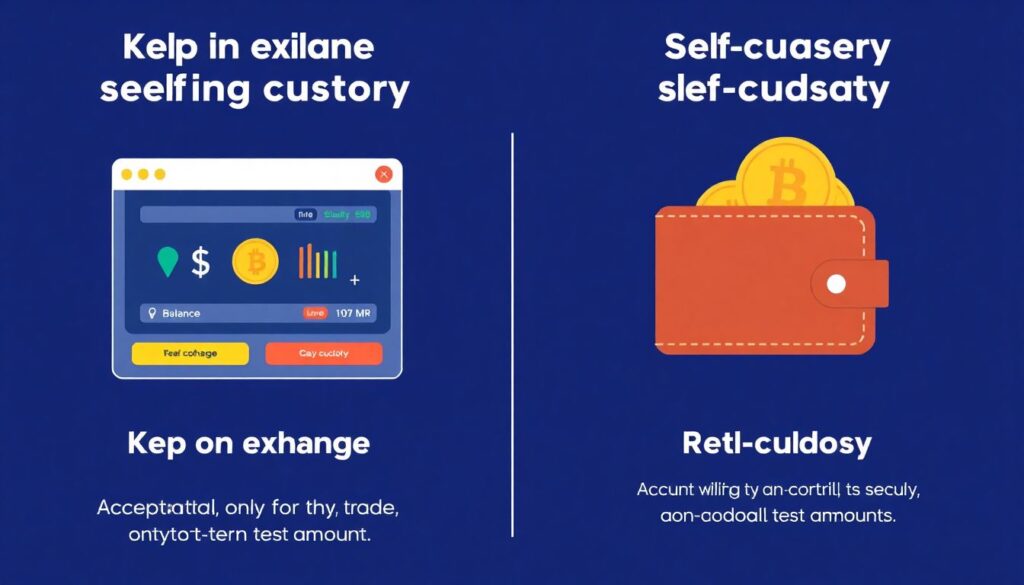
When your asset sits on an exchange, you don’t fully control it. You have a claim on a balance in their system. For many people with tiny test amounts, that’s acceptable short‑term. But it’s crucial to understand what self‑custody is.
Two basic options:
– Keep on exchange – convenient, easy to trade, but counterparty risk
– Withdraw to a wallet – more responsibility, but direct control of your keys
If you choose a personal wallet (software or hardware), you’ll be given a seed phrase (12–24 words). This is the master key to your funds. Lose it and no one can help you; leak it and anyone can help themselves to your coins.
Frequent rookie error #5: Storing the seed phrase in email, cloud notes, or screenshots.
If it’s online and unencrypted, assume at some point someone else might see it.
For your very first tiny purchase, you can experiment both ways: keep a small piece on the exchange, send a small amount to a wallet, and practice sending it back. The experience is worth a lot more than perfection on day one.
Step 10. Newbie mistakes that quietly drain your returns
Beyond catastrophic errors, there are slow, boring ways beginners lose money without noticing.
Common ones:
– Over‑trading: Trying to catch every micro‑move, racking up fees.
– Chasing pumps: Buying after big green candles because of FOMO, then holding the bag when momentum dies.
– Ignoring fees and spreads: Small trades with high fixed fees can eat 5–10% of your capital instantly.
– No exit thinking: Buying “for the long term” but panicking out at the first serious drop.
Another subtle trap: over‑diversifying too early. Holding 15 random tokens with $5 in each is not diversification; it’s clutter. For a realistic beginner guide to investing in digital assets, building a simple, understandable starting point matters more than looking “sophisticated.”
Step 11. How to start investing in crypto with little money (without fooling yourself)
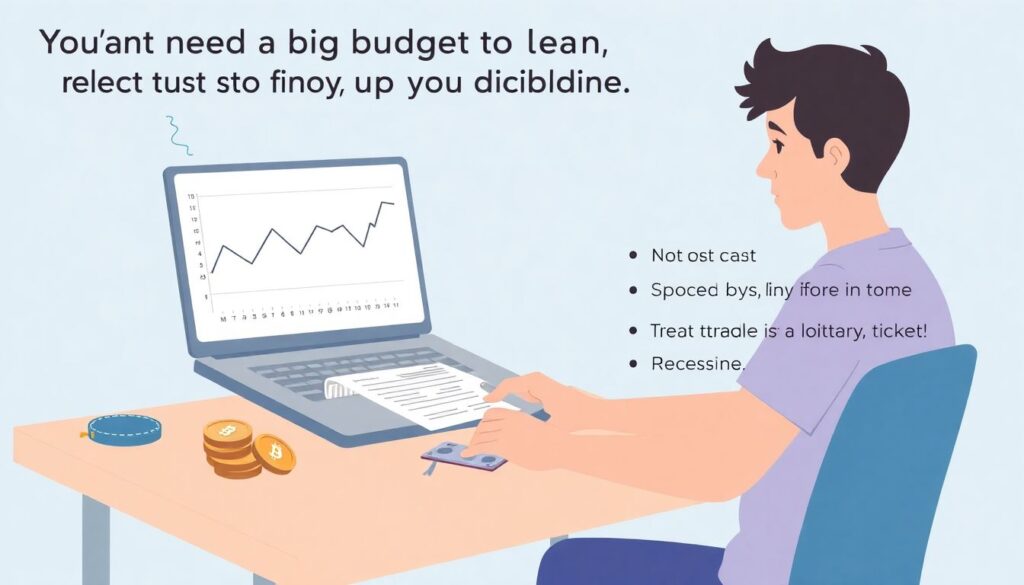
You don’t need a big budget to learn. You do need discipline.
A realistic approach with small capital:
– Start with a tiny, fixed amount (e.g., what you’d spend on a casual night out).
– Split it across time, not across 20 coins. For instance, three or four small buys over a month.
– Treat every transaction as a data point: what were you thinking? How did you feel? What did fees look like?
The advantage of starting small isn’t just financial safety. It’s psychological. You can watch a real position move without the stress that pushes you into terrible decisions.
Over time, if you like the process and understand the risks, you can scale your position size. If you hate the volatility and can’t sleep, you discovered that cheaply.
Step 12. Building your own “playbook” instead of copying strangers

Once you’ve made your first trade and seen it through a few ups and downs, your next edge comes from reflection.
Useful habits:
– Keep a simple log of each trade: why you entered, size, price, what happened next.
– Periodically check: are your decisions mostly emotional or rule‑based?
– Identify which sources of information actually help you, and which just create FOMO.
Remember: people online brag loudly about winners and whisper about losers. Your capital, your risk, your psychology are yours alone. Copying random “strategies” from social media without understanding the rationale is a fast track to confusion.
Step 13. Quick recap: from zero to first trade, the safe way
To pull it all together:
– You defined how much you can afford to lose and accepted volatility.
– You chose a major, liquid asset as your first “sandbox” coin.
– You selected a reputable, beginner‑friendly exchange instead of a random link.
– You created a secure account with proper passwords and 2FA.
– You deposited a small amount, understood fees, and placed a simple market order.
– You checked the executed trade, learned how balances and histories work, and explored wallet options.
– You studied not just your profit/loss, but your own behavior and the common beginner errors.
That’s the real foundation.
Buying your first digital asset is less about nailing a perfect entry and more about building a clean, repeatable process. Once you have that, every later decision — whether to buy more, try different coins, or step back entirely — is made from a place of understanding instead of guesswork.
From here, you’re not a bystander anymore. You’ve moved from theory to practice, carefully. And in a market where most people rush in blind, that alone is a serious edge.