

Crypto trading in 2025 feels very different from the wild days of 2017–2020. Volumes are split between huge centralized platforms and a constantly evolving DeFi ecosystem, and for many newcomers the real puzzle is simple: decentralized vs centralized exchange which is better right now? The honest answer: it depends on what you value more—liquidity, security model, or user experience—and how actively you’re ready to manage your own risk.
Brief history: how we got from Mt. Gox to on‑chain order books
In the early 2010s, centralized exchanges were practically the only gateway to crypto. Mt. Gox, Cryptsy and a few others acted like primitive banks for bitcoin users, and people casually left all their coins on exchange wallets. That ended badly: the Mt. Gox collapse in 2014 and later hacks like Coincheck made it obvious that “not your keys, not your coins” is not just a meme but a survival rule. Yet even with these disasters, centralized venues kept growing because they were easy to use, offered fiat on‑ramps, and had deeper liquidity than the still‑nascent decentralized experiments, which at that time were clunky prototypes with thin order books and painful UX.
The first meaningful decentralized exchanges appeared around 2017–2018, mostly on Ethereum, with early protocols like EtherDelta and then Uniswap redefining how on‑chain trading could work. Still, gas fees, slow confirmation times, and confusing interfaces kept most people on big custodial platforms. Things changed dramatically after “DeFi summer” in 2020, and then again with the collapse of FTX in 2022. That scandal destroyed the myth that big brand equals absolute safety and pushed a critical mass of users toward self‑custody and on‑chain trading. By 2025, major DEXs on L2 rollups and alternative chains are matching or even exceeding mid‑tier CEX volumes, and regulators are finally moving from denial to attempts at integrating these systems into legal frameworks.
Basic principles: what really separates CEX and DEX in 2025
At a high level, centralized exchanges (CEXs) act like traditional brokerages. They hold user funds, run internal order books on their own servers, and give you a web or mobile interface to trade. You trust the company: its security team, its internal controls, and its solvency. Funds move on‑chain only when you deposit or withdraw; everything in between is just database updates. Decentralized exchanges (DEXs), on the other hand, are essentially smart contracts or on‑chain programs. You connect a wallet, sign transactions, and trade directly via blockchain logic. No one can arbitrarily freeze your funds inside the protocol, but bugs in that same code can do just as much damage. The practical trade‑off is clear: CEXs offer speed, fiat access, and customer support; DEXs offer self‑custody, transparency, and composability with the rest of DeFi.
In 2025, this line is blurred by hybrids. Some major platforms run both a CEX and a DEX under one umbrella, with shared branding but different risk models and interfaces. Layer‑2 networks and high‑performance chains enable near‑CEX speed for on‑chain trades, while centralized platforms integrate on‑chain proof‑of‑reserves and even partial on‑chain settlement. New users still mostly start with CEXs, but many quickly open a non‑custodial wallet once they realize how much of DeFi is unavailable through a typical account. When you’re deciding how to choose between dex and cex for crypto trading today, you’re really deciding how much control you want over your keys, how much friction you tolerate in UX, and whether the features you need exist in one environment or the other.
Liquidity in 2025: deep order books vs. smart liquidity routing

Liquidity used to be the trump card of centralized platforms. Big order books, institutional market makers, and deep pairs for BTC, ETH, and majors meant tight spreads and minimal slippage for most trades. That’s still largely true at the top end: if you want to move eight figures of BTC against USD or a regulated stablecoin in one shot, the best centralized crypto exchange for beginners and pros alike will often be a large, licensed CEX with serious market‑making partners. They can aggregate institutional flow, provide derivatives, and offer cross‑margin and leverage in ways that pure on‑chain systems are only starting to replicate, especially in regulatory‑constrained jurisdictions.
On the DeFi side, automated market makers (AMMs) learned a lot since the first versions of Uniswap. Concentrated liquidity, dynamic fees, and active management strategies allow modern DEXs to achieve astonishing capital efficiency. Cross‑chain and cross‑rollup aggregators in 2025 can route a single swap across many pools and even multiple chains behind the scenes, showing the user just one price and one click. For long‑tail assets and niche ecosystems, the best decentralized crypto exchange for trading altcoins is usually not a single venue but a set of DEXs plus an aggregator that stitches them together. The catch: while retail‑sized trades face tiny slippage, whales often have to split orders, time the market, or accept worse execution than on big centralized books for very large transactions.
Security models: custody risk vs smart contract risk
When people ask for a centralized vs decentralized crypto exchange security comparison in 2025, they often expect a simple winner. In reality, each model offloads a different type of risk to you. With CEXs, your biggest threats are custodial risk and operational failure: an insider theft, a poorly managed hot wallet, an accounting scam, or even regulatory seizure of funds. Technology has improved—hardware security modules, multi‑party computation wallets, strict withdrawal whitelists—but fundamental trust in the operator is still required. Some large platforms publish real‑time proof‑of‑reserves and proof‑of‑liabilities using Merkle trees or zk‑proofs, yet these are only as honest as the surrounding business practices and audits.
DEXs transfer power—and responsibility—directly to you. There’s no custodial risk in the traditional sense, because the protocol cannot withdraw your funds without your signed permission. However, smart contract exploits, governance attacks, oracle manipulation, and user mistakes (signing a malicious transaction, falling for a phishing site, mismanaging seed phrases) are very real. In 2025, formal verification, bug bounties, and on‑chain insurance funds are more common, and blue‑chip DeFi protocols have built multiyear security track records. Still, new or obscure DEXs and experimental features remain risky. From a practical standpoint, a top‑tier regulated CEX and a battle‑tested DEX both provide “good enough” security for many users, but in totally different ways. Your decision hinges on whether you trust your own operational discipline more than a company’s internal controls.
User experience: onboarding, support, and the “oops factor”
User experience is where centralized venues continue to shine. Account creation with email, app‑store downloads, familiar KYC flows, and simple fiat deposits via card or bank transfer are standard. If a beginner loses access to a device, support can help restore the account through identity checks. Mobile apps show clear balances in local currency, tax reports are exportable, and margin or staking products are integrated in a few taps. The best centralized crypto exchange for beginners in 2025 usually combines strong localization, clear fee structures, and guardrails that block obviously absurd leverage or sketchy tokens. That hand‑holding matters when someone’s first crypto trade is the difference between never coming back or staying for years.
On DEXs, the UX gap has narrowed but not disappeared. Wallet creation is easier thanks to social recovery, account abstraction, and seedless custodial‑noncustodial hybrids—but you still have to understand that losing recovery methods means losing funds forever. Connecting a wallet to a DEX is now often just one tap, but the mental overhead remains: gas fees in native tokens, chain selection, signature prompts that look scary, and scam tokens that mimic real ones. On the plus side, once you’re comfortable, the flow feels smooth: swap, provide liquidity, borrow, lend, and farm yields without ever giving up custody. For power users, that’s addictive freedom; for casual traders, it can be overwhelming, especially in moments of high volatility when gas spikes and every click matters.
Modern examples: what CEXs and DEXs look like in practice
In the centralized camp, 2025 is dominated by a handful of global players plus strong regional exchanges tailored to local regulation. Major platforms invest heavily in compliance, market surveillance, and interoperability with traditional finance. Features like spot and perpetuals, options, copy‑trading, crypto credit cards, and integrated tax tools are common. Some even offer tokenized stocks and on‑chain money‑market products under regulated wrappers. For active traders, advanced charting, complex order types, and deep API access make CEXs feel like mature financial hubs rather than experimental tech toys. The downside is that listing policies and withdrawal rules are at the mercy of both the company and its regulators, and some coins or privacy features simply never make it onto these venues.
On the decentralized side, the picture is more diverse. You have established AMMs on Ethereum mainnet and L2s, order‑book‑based DEXs on high‑throughput chains, and app‑chains built entirely around trading. Perpetual DEXs with on‑chain or hybrid matching are now serious competitors to CEX derivatives desks, especially for crypto‑native traders who prefer composable margin and collateral. Cross‑chain messaging lets you trade assets from multiple ecosystems through a single interface, even if under the hood there are bridges, wrapped assets, and complex routing. The best decentralized crypto exchange for trading altcoins in 2025 is often the one that integrates all this complexity in a way that feels simple: you pick a token pair, see a price, and confirm, while the app quietly handles bridges, gas, and route optimization.
How to actually choose: matching tools to your goals
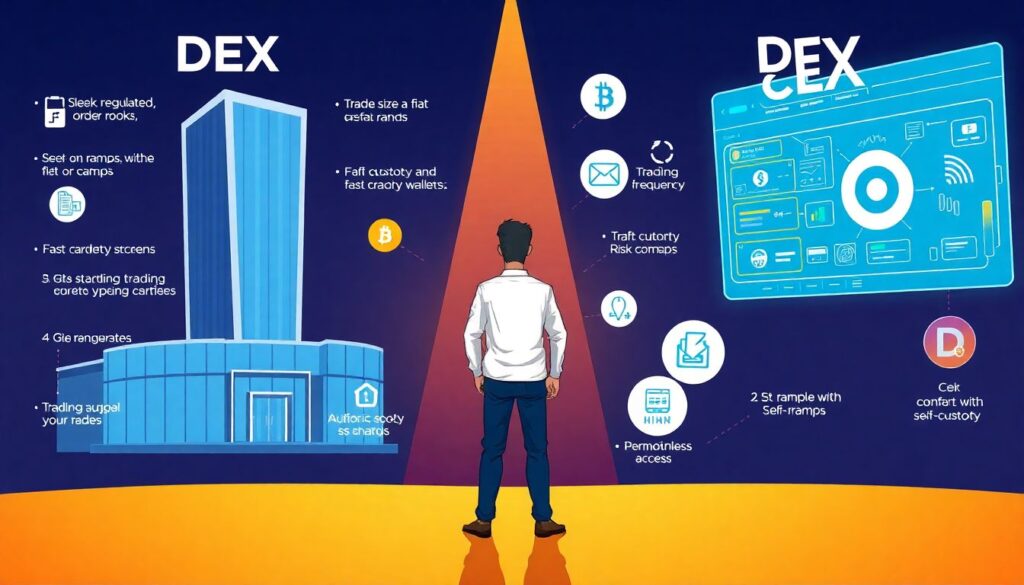
When you strip away ideology, how to choose between dex and cex for crypto trading boils down to a few practical questions: what size are your trades, how often do you trade, do you need fiat ramps, what’s your risk tolerance, and how comfortable are you with self‑custody? If your goal is occasional buying of BTC and ETH with a debit card and you want someone you can email if something goes wrong, a reputable regulated CEX is the obvious first stop. If you’re yield‑farming, chasing niche DeFi strategies, or trading long‑tail tokens that never get listed on mainstream platforms, DEXs are practically unavoidable. Most serious participants in 2025 use both, not out of confusion but by design.
A simple way to think about this is to separate “core holdings” from “experimental capital.” Many people keep a portion of their portfolio on a trusted CEX to benefit from ease of use, straightforward tax reporting, and fast fiat access, while storing long‑term holdings in self‑custodied wallets that interact with DeFi only when needed. Active traders might hedge positions on a CEX while farming yields or providing liquidity on a DEX. The more you diversify your platforms and custody setups, the more work you take on, but the less exposed you are to any single point of failure—whether that’s a centralized blow‑up or a major protocol exploit.
– Use a CEX if:
– You need fiat on‑ and off‑ramps in your local currency.
– You’re a beginner who values support and clear interfaces over maximum control.
– You trade large sizes in majors and want minimal slippage and robust derivatives.
– Use a DEX if:
– You prioritize self‑custody and transparency over customer support.
– You want access to DeFi, long‑tail tokens, and on‑chain yield opportunities.
– You’re comfortable managing wallets, backups, and transaction risks.
Common myths and misconceptions in 2025
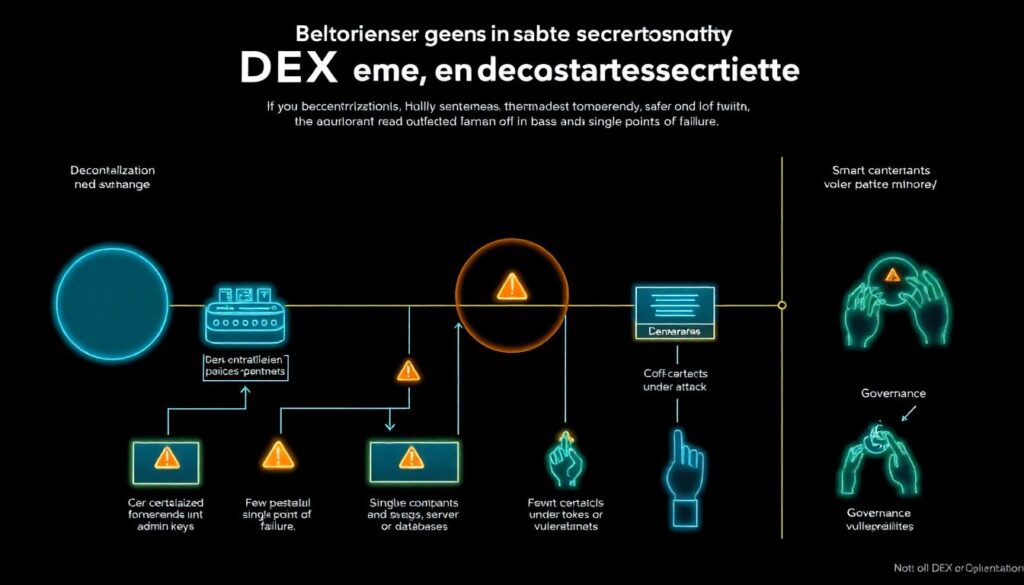
One widespread misconception is that “DEXs are automatically safer because they’re decentralized.” In reality, decentralization is a spectrum, and some “DEXs” rely on centralized frontends, admin keys, or off‑chain components that introduce single points of failure. Smart contract exploits and governance attacks have cost users billions over the years. Conversely, believing that “regulated CEXs can’t fail anymore” is equally naive—while risk management has improved post‑FTX, human error, fraud, or aggressive risk‑taking haven’t magically disappeared. A thoughtful user treats both environments with skepticism, checks audits and licenses, and never risks more than they can afford to lose in any single venue.
Another myth is that on‑chain trading is only for degens and that “real investors” stay on compliant centralized platforms. In 2025, a lot of institutional players quietly interact with DeFi, either directly or through whitelabeled interfaces, because that’s where the most innovative liquidity and collateral models live. At the same time, it’s wrong to assume that everyone must “go fully on‑chain” to be a serious crypto user. For many people, the right answer to decentralized vs centralized exchange which is better is actually “a balanced mix, adjusted to your skills and goals.” Centralization brings service quality and legal recourse; decentralization brings censorship resistance and open access. You don’t have to pick a side forever—you can calibrate as your knowledge and portfolio grow.
– Watch out for these red flags, regardless of CEX or DEX:
– Opaque ownership or governance, with no clear information about who’s in charge.
– Unrealistic yields or bonuses that depend on inviting endless new users.
– Poor communication around incidents, downtime, or security disclosures.
Trends shaping the CEX–DEX landscape beyond 2025
Looking ahead, the most interesting trend is convergence rather than polarization. CEXs are adopting more on‑chain tech—custody backed by on‑chain proofs, tokenized real‑world assets, and settlement rails built on public networks. DEXs, in turn, are becoming more compliant, with optional KYC pools, geofencing, and integrations with regulated stablecoins and identity frameworks. The line between “a crypto exchange” and “a DeFi front‑end tied into traditional finance” is getting blurry. As scaling solutions mature, on‑chain trading becomes cheap and fast enough that UX is no longer dominated by gas costs but by design choices and user education.
For individual traders, this means that the old binary debate—CEX good, DEX bad, or vice versa—is slowly losing relevance. The smarter question is: which combination of tools gives you the liquidity, security posture, and user experience you need at this moment? By 2025, both sides have learned from a decade of crashes, hacks, bull runs, and regulatory clashes. Centralized platforms can no longer ignore transparency, and decentralized protocols can no longer ignore usability and risk management. If you stay curious, test with small amounts first, and diversify your approaches, you can benefit from both worlds instead of being trapped in a false either‑or choice.
Комментарии