
Why decentralized identifiers suddenly matter
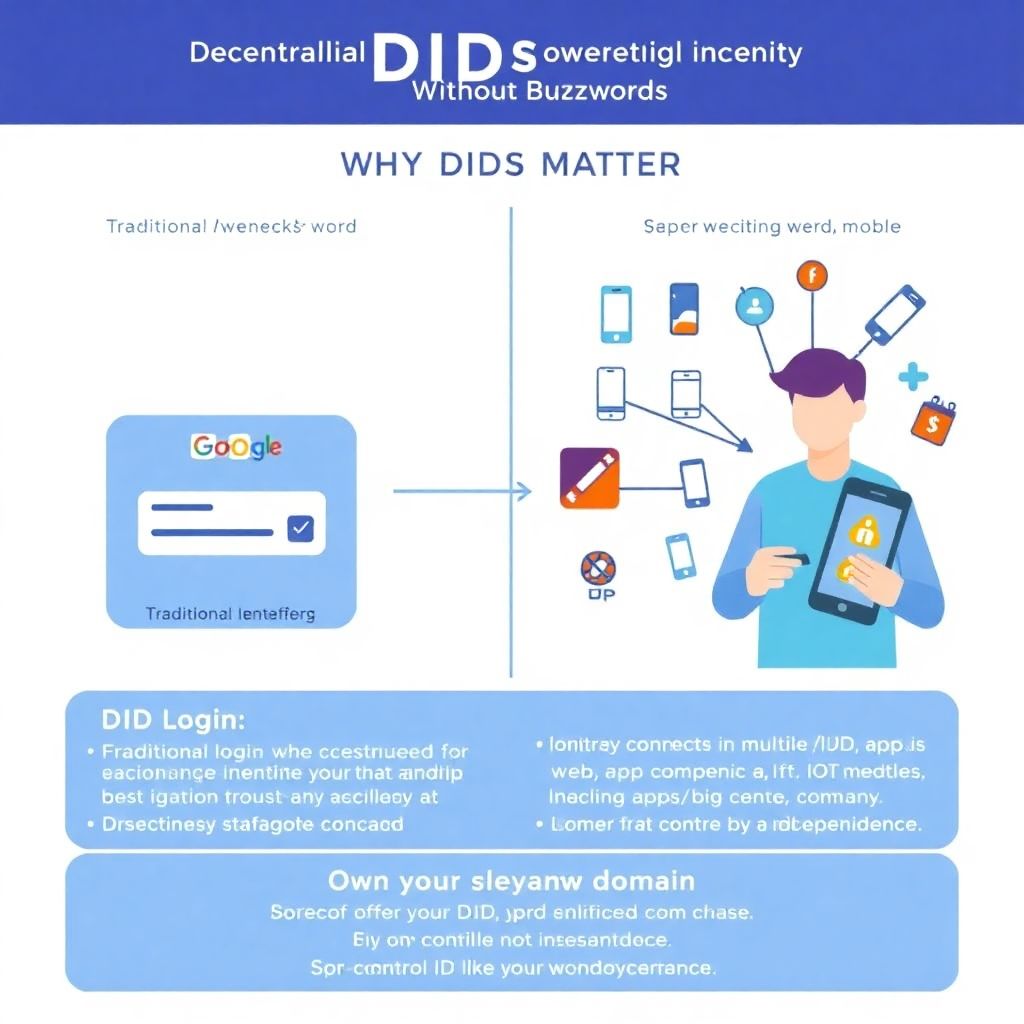
Most people first meet DIDs when a website asks them to “sign in with wallet,” and everything looks a bit mysterious. Think of this guide as “decentralized identifiers explained without the buzzwords.” Instead of relying on logins owned by Google or Facebook, a DID lets you control a cryptographic ID that no single company can revoke or monetize at will. It’s like owning your email domain instead of renting a Gmail account, but tuned for cryptography, privacy and machine‑readable trust relationships across many apps and services.
Key terminology without the jargon
A Decentralized Identifier (DID) is a globally unique string, like `did:example:123abc`, that points to a DID document. That document holds public keys, service endpoints and metadata that describe how to talk to you securely. The DID method is the “recipe” for creating and resolving that DID on a specific network (blockchain, sidechain, distributed database or even a simple web server). A verifiable credential (VC) is a signed digital statement about you, like a tamper‑proof certificate that your phone or wallet can present on demand.
Text diagram: what a DID actually looks like
[Diagram: A horizontal flow. Left: “User wallet” holding private keys. Middle: “DID document” showing public keys and endpoints. Right: “Verifier app or website.” Arrows: Wallet → DID document registry (read only). App → DID document registry (resolve DID). Wallet ↔ App (signs and verifies messages using keys from DID document). No passwords, just signatures tied to the DID.] This structure separates your identifier from any particular app, so you can swap platforms without losing your core digital identity.
How DIDs differ from usernames, emails and OAuth
Traditional logins depend on centralized identity providers: if a company blocks or loses your account, you lose access everywhere it’s used. In contrast, a DID is created and controlled by keys you own, often in a local wallet or secure enclave. Compared with OAuth (“Sign in with X”), there is no single mega‑provider mediating access; instead, relying parties read your DID document from a neutral registry. It’s closer to using your own set of keys for many doors than carrying hundreds of separate badges, each issued by a different landlord.
Centralized ID vs DIDs: mental picture
[Diagram: Left column titled “Centralized identity.” Icons: User → Big Platform → App. Arrows show the platform standing between user and app, approving logins. Right column titled “Decentralized identity.” Icons: User wallet → App, with a side arrow from app to decentralized registry. There is no central gatekeeper; instead, the app checks cryptographic proofs against the registry.] This visual way of thinking helps clarify how to use decentralized identifiers for identity management in ecosystems where trust can’t rely on a single corporation or state authority alone.
Core benefits of decentralized identifiers
The first obvious advantage is portability: migrate between services without rebuilding your reputation every time. Then comes resilience: there’s no master switch that a platform admin can flip to erase your identifier. Privacy gains are subtle but big: DIDs support selective disclosure, so you can reveal only necessary attributes instead of oversharing. Finally, DIDs integrate well with automation, enabling machines, IoT devices or micro‑services to authenticate each other without storing passwords in brittle configuration files or insecure environment variables.
Self‑sovereign identity in practice
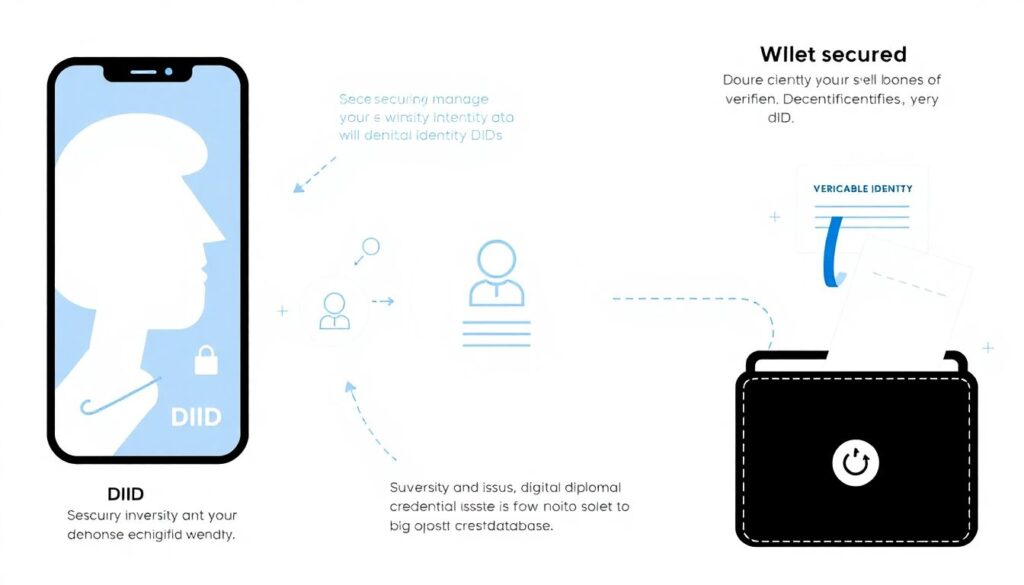
You’ll often see DIDs mentioned alongside self sovereign identity solutions using DIDs. “Self‑sovereign” means your identity data lives primarily under your control, usually in a wallet, not in an opaque platform database. For example, a university issues you a verifiable credential for your diploma. Your DID anchors that credential. Later, a recruiter’s portal asks for proof of education; your wallet shares a minimal claim like “has valid Master’s degree,” signed by the university, without disclosing student ID, grades or full transcript, yet verifiably tied to your DID.
Where DIDs are already used
Several sectors experiment with decentralized identifiers today. In finance, DIDs underpin reusable KYC proofs, reducing repeated onboarding checks across multiple exchanges or neobanks. In healthcare, they can link patient records from different providers without centralizing all data into one massive honeypot. Supply chains use DIDs for companies, products and even shipping containers, proving provenance and custody in cross‑border logistics. Even gaming studios test DIDs to let players carry achievements and identities from one universe to another, without locking everything to a single publisher.
Beginner‑friendly mental models
To keep things intuitive, imagine three “layers.” First, keys: like door keys, but cryptographic; lose them and you lose control, so backups and recovery are crucial. Second, identifiers: DIDs derived from those keys or linked to them, which others can reference. Third, claims: verifiable credentials attached to your DID, equivalent to signed documents or badges. All DID tools basically manage these three layers—creating keys, binding them to identifiers, then exchanging claims between issuers, holders and verifiers in predictable, machine‑verifiable ways.
Choosing DID methods without getting lost
Beginner confusion often starts with the question: “Which DID method should I use?” Some methods, like `did:ion` or `did:btcr`, rely on public blockchains; others, like `did:web`, map a DID to a specific HTTPS domain. For experiments, `did:web` can be convenient because you just host a JSON file at a known URL. For censorship‑resistance or long‑term anchoring, blockchain‑based methods look more attractive, but they involve extra operational costs and governance trade‑offs that are worth considering before you commit.
Deciding criteria: your threat model
Assess three angles: who could block you, who must trust the system and how long it must last. If you operate in a stable corporate IT environment, a DID method tied to your company domain may be enough. If you design activist tools or censorship‑resistant publishing, distributed ledgers matter more, even if fees or latency are higher. There’s no universal best DID method; instead, decide based on the weakest party you want to protect and how much complexity they can reasonably handle in their daily workflows.
Wallets, platforms and “identity as a service”

Managing keys and credentials manually is risky, so most users rely on dedicated apps. Some of the best DID wallets and identity platforms focus on mobile wallets that backup keys using secure device hardware plus encrypted cloud recovery. Others target enterprises with admin dashboards for employee and customer DIDs. Above them sit decentralized identity as a service providers, who expose APIs for issuing, storing and verifying credentials without forcing every developer to learn the finer points of DID resolution, cryptographic suites and revocation registries.
How a DID login works step by step
[Diagram: 1) User opens “Login with DID” page. 2) Site shows QR code or deep link. 3) Wallet scans it, sees a challenge. 4) User approves; wallet signs the challenge with DID keys. 5) Site resolves DID document, fetches public key, verifies signature, then maps DID to a local account.] This flow demonstrates decentralized identifiers explained in action: no password stored, no secret shared with the server, just a challenge‑response protocol grounded in the cryptographic material referenced by the DID.
Unconventional ways to use DIDs
Beyond human identities, DIDs can represent micro‑services, AI agents or even single configuration files. For instance, you might assign a DID to a machine‑learning model deployed on‑premise; each time a cloud service wants predictions, it authenticates against that model’s DID and checks a verifiable credential proving audit status or version. Similarly, a data pipeline could treat each dataset slice as an entity with its own DID, tracking provenance and transformations as credentials, making complex analytics more transparent and debuggable.
Experimental social and creative applications
Consider a writers’ collective building a shared universe of stories. Each fictional character receives a DID; every time an author publishes a new piece, they issue a credential describing canonical events involving that character. Fan tools can then verify continuity by checking those credentials, even if stories span multiple platforms. This sounds niche, but it showcases how DIDs can coordinate contributions in messy, multi‑author ecosystems where there’s no central database but you still want machine‑checkable consistency over time.
Security basics: keys, backups and recovery
The strongest DID system collapses if you lose your keys. For everyday users, seed phrases are fragile; people forget them or store them poorly. An alternative is social recovery: split a recovery secret between trusted friends or devices using Shamir’s Secret Sharing, so no single party can hijack your ID. For organizations, hardware security modules, threshold signatures and detailed audit trails become essential. The right answer blends usability and risk appetite; whatever you choose, decide recovery procedures before launching anything into production.
Privacy pitfalls and how to avoid them
Although DIDs promise better privacy, naïve design can still leak patterns. Reusing the same DID for every website lets trackers build cross‑site profiles. A safer approach is to generate pairwise DIDs, one per relationship or app, while linking them privately in your wallet. Another trap is dumping too much personal data into on‑chain DID documents; it’s almost impossible to erase. Instead, keep DID documents minimal, and put sensitive attributes only inside revocable, off‑chain verifiable credentials under your direct control.
Getting started: from zero to working prototype
If you’re a developer, begin with a test wallet and a simple verifier demo. Many open‑source frameworks offer command‑line tools to create a DID, issue a mock credential and verify it. Build a tiny app that replaces password login with a signed challenge and a DID resolver library. Gradually add support for verifiable credentials, revocation checks and selective disclosure. Non‑developers can still experiment by using wallet apps that let you hold educational or event credentials, then present them to compatible check‑in portals.
Roadmap for deeper exploration
After your first prototype, drill into specs like DID Core, Verifiable Credentials Data Model and emerging protocols for interoperable credential exchange. Participate in small pilots—employee badges, alumni access, or conference passes—to understand real‑world friction points. Over time, these experiments reveal how to use decentralized identifiers for identity management at scale, which governance models actually work, and where regulation either supports or conflicts with strong user control. With each iteration, refine both tech choices and human processes around consent and accountability.
Closing thoughts: design for humans, not just cryptography
DIDs are powerful, but they succeed only if ordinary people can live with them comfortably. Design flows where losing a phone is annoying, not catastrophic. Offer clear mental models: “this is your passport,” “this is your house key,” “this is your anonymous mask.” Combine the rigor of cryptography with familiar metaphors and recovery options. Used thoughtfully, decentralized identifiers can become quiet infrastructure, not a buzzword—showing up simply as smoother logins, portable reputations and trustworthy data that doesn’t depend on a single gatekeeper to exist.