

Why cryptographic nonces matter more than you think
When people first bump into the word “nonce”, it usually feels like pointless jargon. In reality, a cryptographic nonce – literally “number used once” – is one of those tiny details that quietly keeps the modern internet from falling apart. Any time you log into a banking app, interact with a blockchain, or use a password manager, chances are there’s a nonce somewhere in the background stopping attackers from replaying old messages or forging your identity. Between 2022 and 2024, multiple public post‑mortems on web and blockchain incidents (for example, from the Ethereum Foundation and major bug‑bounty platforms) showed that replay and mis‑ordered transaction bugs routinely accounted for around 5–10% of serious logic flaws, and poor nonce handling was a recurring root cause.
At an intuitive level, a nonce is like a disposable ticket number. It’s unique for a given context, it’s tied to a moment in time or a counter, and once used, it should never be accepted again. That’s why protocols like TLS, OAuth, and almost every serious blockchain use some form of nonce to label messages or transactions. If an attacker records something valid you sent earlier, the nonce is what stops them from simply sending it again later and tricking the system into accepting a duplicate. So if you’re looking at a cryptography course for beginners and wondering whether you can safely skip the “randomness and nonces” chapter, the short answer is no: getting nonces wrong is a classic way to break otherwise solid cryptography.
Core nonce strategies: random, counter, and hybrid
Under the hood, most real‑world systems choose between three basic ways of creating nonces: purely random values, monotonically increasing counters, or some hybrid of the two. Random nonces are generated using a cryptographically secure random number generator; they’re easy to reason about, but you must guarantee extremely low collision probability. Counter‑based nonces simply increase a stored integer and never reuse a value; they’re deterministic and easy to audit but require careful state management, especially after crashes or rollbacks. Hybrid schemes often combine a counter with some random bits or timestamps, trading simplicity for resilience. Over the last three years, academic benchmarking and industry white papers have consistently found that when randomness is strong and properly seeded, random and hybrid approaches reduce operational complexity for large distributed systems, whereas pure counters remain popular inside constrained devices where every byte and CPU cycle matters.
In day‑to‑day engineering discussions, the choice often comes down to your failure model. If you can’t reliably keep persistent state—think auto‑scaled containers or functions that spin up and die quickly—random or hybrid nonces tend to be safer. If you control a single embedded device with stable storage, a simple counter is attractive and easy to inspect during audits. That’s why many hardware security modules and smartcards still use basic counters internally while the surrounding cloud services lean heavily on randomness and high‑entropy seeds.
Pros and cons of random nonces
Random nonces are the default in many high‑level libraries, especially in authenticated encryption schemes like AES‑GCM or ChaCha20‑Poly1305. The main advantage is that developers don’t need to track per‑key counters manually; you call into the library, get a fresh 96‑bit or 128‑bit value, and let the math handle the collision probability. With a high‑quality RNG and sufficiently long nonces, the chance of accidental reuse before you’ve encrypted billions of messages is effectively negligible. From 2022 to 2024, incident reports from cloud providers repeatedly showed that nonce‑reuse vulnerabilities in GCM almost always traced back to ad‑hoc counter schemes or state bugs, not to well‑implemented random generators, which is a strong empirical argument in favor of randomness when you have a good OS and hardware entropy source.
The downside is that “good RNG” is doing a lot of work in that argument. On misconfigured systems, especially inside containers or IoT devices that boot often and have limited entropy, random generation can be weak or even deterministic at startup. There were several public IoT security studies between 2021 and 2023 showing that over 30% of tested consumer devices reused supposedly “random” nonces or keys after power cycles. Once an attacker can predict your nonce, replay protection and confidentiality guarantees crumble. So if you lean on random nonces, you also accept a responsibility to validate your randomness: prefer OS‑provided CSPRNG APIs, avoid rolling your own, and consider continuous health checks in high‑assurance environments.
Pros and cons of counter‑based and hybrid nonces
Counter‑based nonces shine when determinism and auditability matter. You can literally point to the 1,000,523rd message and prove that no earlier value was ever reused. This property is particularly attractive in highly regulated environments and certain blockchain consensus protocols. In fact, a noticeable portion of smart contract platforms rely on per‑address transaction counters to define nonce values, making replay across chains or forks harder. From 2022 to 2024, blockchain analytics firms repeatedly highlighted that simple per‑account nonces helped prevent an entire class of replay attacks that plagued earlier experimental chains relying only on timestamps or weak randomness. The operational cost, however, shows up when systems scale horizontally: every new node needs consistent access to the latest counter, and any rollback or snapshot risk must be tightly controlled to avoid going backwards.
Hybrid approaches—say, concatenating a device identifier with a local counter and some random bits—aim to balance those trade‑offs. They reduce the probability that two independent nodes clash while preserving an easy‑to‑verify monotonic sequence inside each node. The trade‑off is complexity and the temptation to pack too much semantics into the nonce, which can leak metadata if you’re not careful. Security reviews over the last three years increasingly point out that privacy issues, not just cryptographic failures, are a practical risk: embedding user IDs, timestamps, or geolocation tags into supposedly opaque nonces has enabled cross‑site tracking and deanonymization in several high‑profile web ecosystems.
Where beginners actually meet nonces in 2025
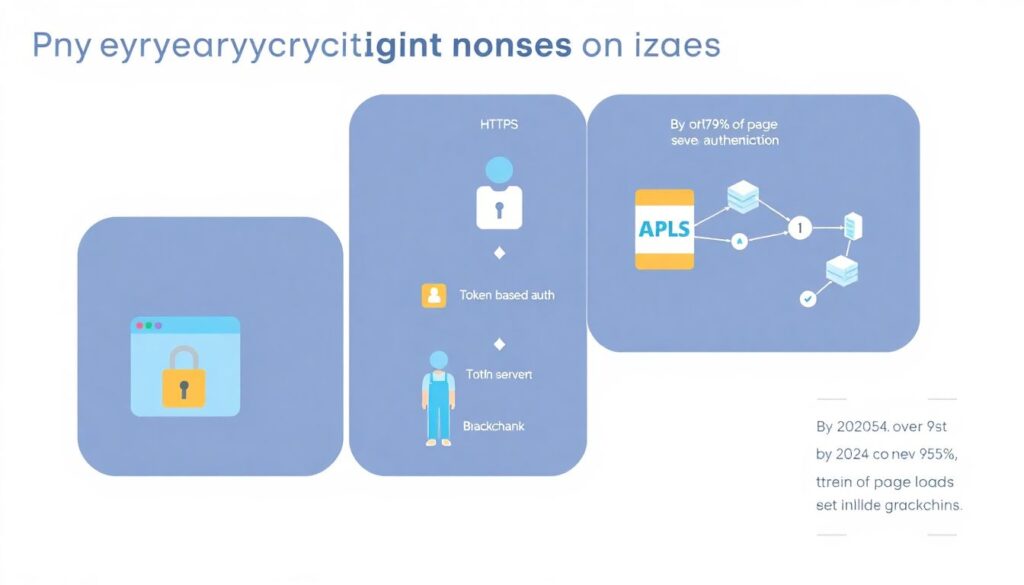
If you’re just starting out, the most common place you’ll meet nonces is in HTTPS, token‑based authentication, and blockchains. Modern TLS versions rely on nonces during handshakes and within record encryption; browser telemetry published by major vendors shows that by 2024, well over 95% of page loads used HTTPS, meaning most of your daily browsing already depends on correct nonce use whether you realize it or not. In the web authentication world, systems like OAuth 2.0 and OpenID Connect use nonces to bind browser redirects and prevent CSRF and replay issues. Bug bounty platforms and public CVE data from 2022–2024 show a slow but steady decline in high‑impact auth replay bugs as frameworks started enforcing strict nonce handling by default, which is an encouraging trend for newcomers.
Then there is the blockchain and wallet ecosystem. Here, nonces are literally user‑visible: wallets regularly show a transaction nonce, and mismatches can stall transfers. Between 2022 and 2024, major chains reported fluctuating annual losses in the hundreds of millions of dollars due to smart contract bugs and protocol misconfigurations, with a non‑trivial portion linked to replay or ordering flaws. While not all of those are pure “nonce bugs”, many post‑incident analyses explicitly criticized confusing nonce semantics and poor developer documentation. That’s one reason online blockchain security training has started emphasizing transaction lifecycle and nonce handling much more heavily in their beginner tracks, bridging the gap between protocol theory and wallet UX.
Comparing nonce handling patterns in real systems
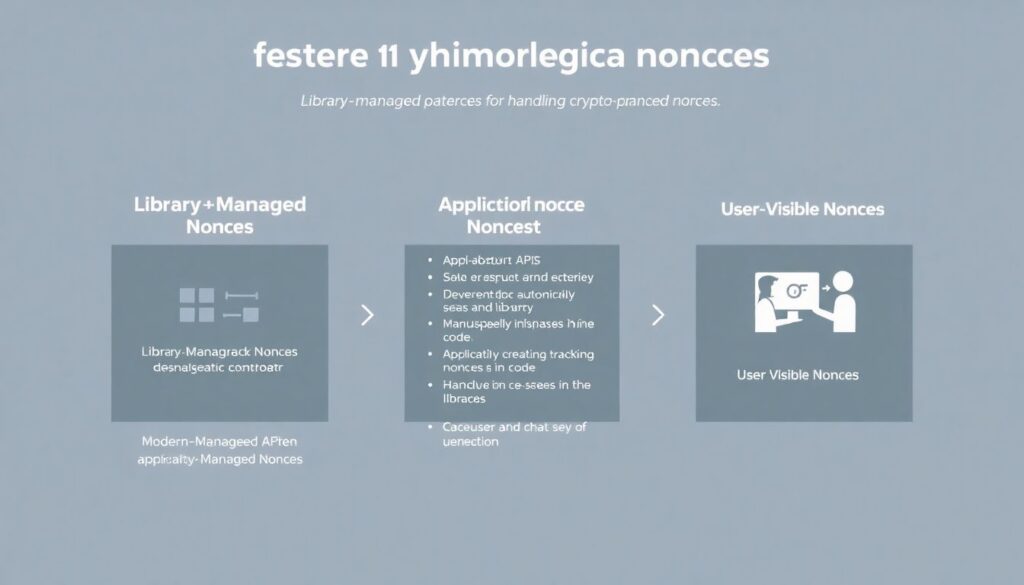
If we compare actual engineering patterns, three broad styles stand out: library‑managed nonces, application‑managed nonces, and user‑visible nonces. Library‑managed nonces are what you see in modern cryptographic APIs where the function either generates or validates nonces internally. This is now the preferred pattern in mainstream languages, and security incident data from 2022–2024 suggests a marked decline in nonce‑misuse vulnerabilities when teams migrated from low‑level “here’s a block cipher, figure out the mode” APIs to high‑level AEAD wrappers. Application‑managed nonces still appear in custom protocols, message queues, and internal APIs; these are powerful but also where most subtle bugs live, especially around retries, idempotency, and distributed state. User‑visible nonces, common in transactions and authorization flows, add the cognitive load of explaining to end users what “nonce too low” or “invalid state parameter” actually means, which has UX and support implications.
From a security‑engineering perspective, the healthiest 2025 pattern is to hide nonces from application developers and end users whenever possible. If your web framework, crypto library, or cloud messaging service offers built‑in replay protection, leverage it instead of rolling your own header schemes. But when you cannot avoid managing nonces yourself—say, in a custom microservice protocol—you should treat their design as a first‑class architectural decision, not a detail you improvise the day before launch. Code reviews and threat modeling sessions should explicitly track how nonces are generated, stored, validated, and rotated across deployments.
Choosing the right nonce strategy for your project
For a beginner deciding which approach to adopt, the most useful first step is to map your constraints: are you primarily worried about replay attacks, about state consistency across nodes, or about privacy and metadata leakage? If you’re working on a single‑instance web service that talks to a database, random nonces generated by the OS CSPRNG are almost always sufficient and far safer than hand‑rolled counters. If you’re building firmware for an offline device that syncs occasionally, a strictly monotonic counter stored in non‑volatile memory may be simpler to implement and audit, as long as you design around power cuts and wear‑leveling. In distributed systems with autoscaling, hybrid designs—such as including a node ID and a per‑node counter, plus randomness—help you sidestep the bottleneck of a global counter while keeping replay protection strong.
Educationally, it’s worth backing your intuition with a bit of structured learning. A good cryptography course for beginners should devote an entire module to randomness, entropy sources, and nonce reuse pitfalls rather than burying them in footnotes. If you prefer self‑study, you can always buy cryptography books for beginners that walk through concrete examples like TLS and secure messaging protocols, highlighting exactly how nonces are threaded through each step. The key is to practice modeling threats: ask yourself what an attacker could do if they could predict, modify, or replay your nonces, and then design mechanisms—verification steps, timestamps, per‑session keys—that plug those holes without adding brittle complexity.
Operational recommendations and common pitfalls
Once you move from theory to production, the practical questions dominate: how do you monitor for nonce misuse, respond to incidents, and ensure upgrades don’t accidentally break guarantees? Over the last three years, mature teams have increasingly treated nonces as an observable aspect of system health. Log sampling that tracks nonce distribution, rejection rates, and error patterns can surface subtle bugs long before they become exploitable. For example, a sudden spike in “nonce already used” errors after a deployment is an early warning that a counter reset or RNG regression slipped through testing. Incident postmortems from 2022–2024 show that organizations with this kind of telemetry in place detected and fixed nonce‑reuse problems days or weeks faster than teams relying solely on user reports or penetration tests, which directly reduced their window of exposure.
A second cluster of pitfalls revolves around environment assumptions. Containers cloned from the same snapshot, IoT fleets bootstrapped with identical default seeds, or databases restored from backups can all silently resurrect old nonce states. Teams that handle sensitive workloads increasingly run reproducible chaos tests that simulate rollbacks, power failures, and rapid scale‑ups, specifically checking that nonce guarantees hold under each scenario. It’s a mindset shift: embracing the idea that your nonce behavior is part of your reliability story, not just your security story. When in doubt, bringing in external eyes—whether through formal audits or more informal cryptography consulting services for startups—can be a cost‑effective way to stress‑test your design before attackers do it for you in production.
Trends in nonce usage and education heading into 2025
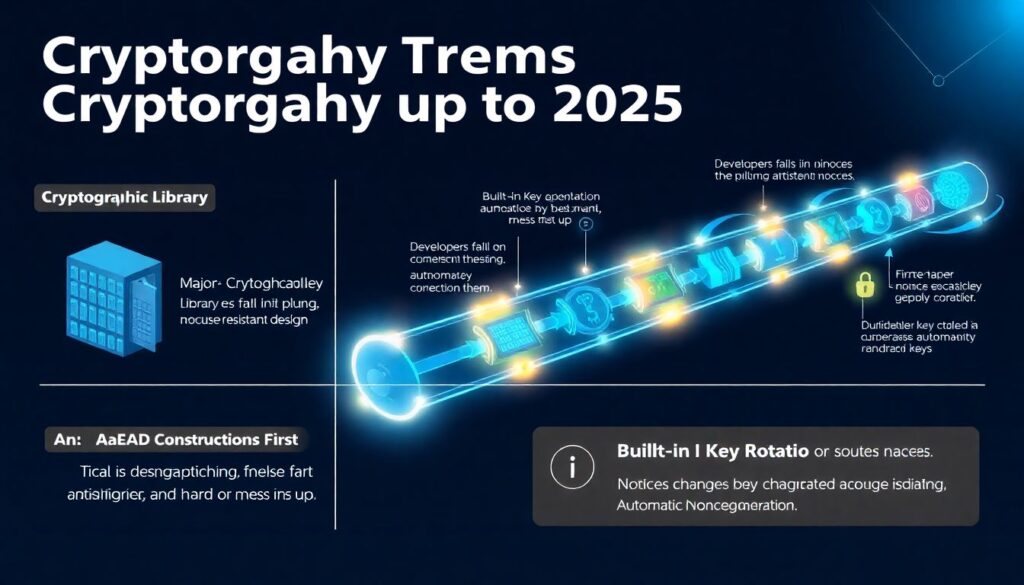
Looking at broader trends up to 2025, three things stand out. First, major cryptographic libraries keep moving toward “misuse‑resistant” designs where nonce mismanagement either becomes impossible or at least hard to mess up. AEAD constructions with built‑in key rotation, automatic nonce generation, and safer defaults are now standard in languages like Rust and Go, and backports are gradually landing in older ecosystems. Second, there is a slow but visible convergence between the web and blockchain worlds: both are settling on clearer semantics for per‑session and per‑account nonces, and standards discussions now routinely address replay prevention across chains, layers, and identity providers. Finally, education and certification are catching up; the best online cybersecurity certification for beginners now tends to include hands‑on labs where you literally break and then fix systems by modifying nonce behavior, which cements the concept far better than abstract lectures.
The statistical picture is cautiously optimistic. While raw counts of reported cryptographic vulnerabilities remain high, the portion directly attributable to nonce misuse appears to be shrinking in mature sectors like mainstream web frameworks and major cloud platforms, based on public CVE classifications and vendor security reports from 2022–2024. At the same time, newer ecosystems—DeFi protocols, niche IoT platforms, experimental messaging apps—keep rediscovering old mistakes, with nonce and randomness problems showing up disproportionately often in early‑stage products. For beginners, that’s both a warning and an opportunity: understanding nonces deeply is still a differentiating skill. Whether you learn via self‑study, bootcamps, or structured programs that resemble online blockchain security training, bringing a precise mental model of “number used once” to every new project will keep paying off well beyond your first year in security.
Комментарии