
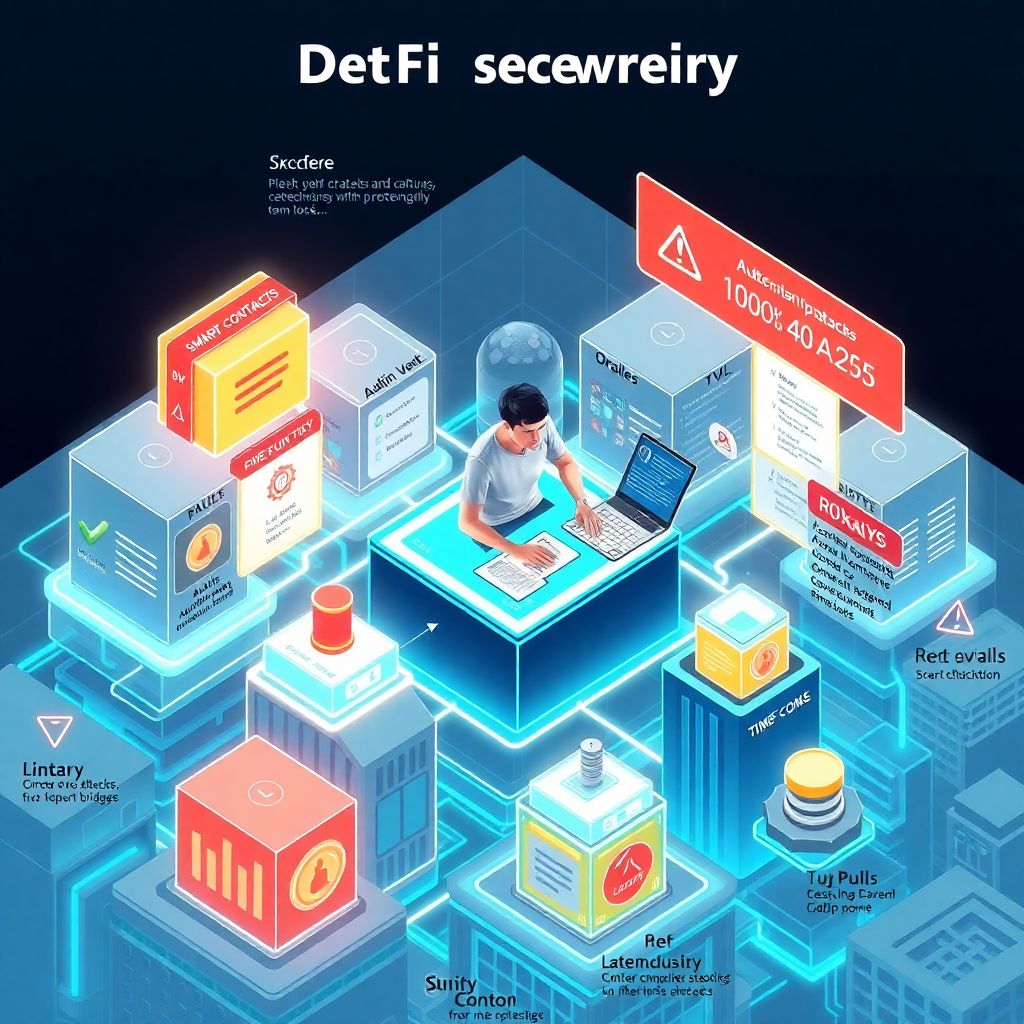
Why DeFi security should be your first concern, not an afterthought
If you’re just starting with DeFi, it’s tempting to focus on juicy APYs, colorful dashboards and “passive income” promises. But by 2025, the story of decentralized finance is also a story of hacks, rug pulls and painful lessons. Billions of dollars have been lost because people, teams and even big funds underestimated security. This guide is meant to walk you through how to evaluate DeFi protocol safety in a practical, beginner‑friendly way, so you can at least recognize red flags and avoid the most obvious traps, even if you’re not a Solidity wizard or a full‑time security researcher.
Historical background: how we got from experiments to billion‑dollar hacks
Back in 2017–2018, DeFi wasn’t even called “DeFi”. There were just a few early experiments on Ethereum like MakerDAO providing over‑collateralized loans, and some basic decentralized exchanges fighting with clunky interfaces and high slippage. The amounts of money in those smart contracts were relatively small, and most people considered them niche toys for hardcore crypto geeks rather than serious financial infrastructure. Security was discussed, but not yet treated as a life‑or‑death requirement for the average user.
Everything changed in 2020 with the so‑called “DeFi summer”. Protocols like Compound, Aave, Uniswap, Yearn and others turned yield farming into a craze. Incentive tokens and liquidity mining pulled billions into smart contracts. Along with the growth came a new wave of DeFi exploits: flash‑loan attacks, Oracle manipulations, re‑entrancy bugs and logic errors. By 2022–2024, cross‑chain bridges, algorithmic stablecoins and complex derivatives added even more attack surface. Some of the most talked‑about incidents wiped out entire projects overnight, making people realize that DeFi smart contract audit for beginners is not just a nerdy topic but a survival skill for anyone touching on‑chain finance.
By 2025, auditors, white‑hat hackers and specialized firms offering DeFi security audit services have become a normal part of the ecosystem. Battle‑tested protocols have learned hard lessons, and better tooling has appeared. Still, new chains and faster‑moving projects keep introducing fresh vulnerabilities. The history of DeFi security so far teaches one simple rule: the moment you think “this is safe enough, I don’t need to check”, you’re setting yourself up for trouble.
Basic security principles every DeFi beginner should know
Before you dive into specific platforms, it helps to understand a few foundational ideas. You don’t need deep math or coding skills, but you should grasp where the main risks come from. A DeFi protocol is basically a mix of smart contracts, governance, tokenomics and external dependencies like price oracles and bridges. If any of these parts is fragile, the whole thing can break, and your funds are the ones at risk, not the project’s marketing budget.
At a minimum, always think about three big buckets of risk: smart contract bugs, economic design flaws and human factors. Smart contract bugs are what most people imagine when they hear “hack”: coding errors that let attackers drain funds or bypass rules. Economic flaws are more subtle: the code works as written, but the game theory or incentives are broken, so an attacker can profit by manipulating prices, liquidity or governance. Human factors include admin keys, centralized servers, multisigs with too few signers and opaque decision‑making, all of which can turn into a slow‑motion rug pull or a sudden shutdown.
If you feel overwhelmed, that’s normal at the start. The trick is not to become a security expert overnight but to learn a repeatable checklist you can apply before putting real money into any new protocol. Even simple questions like “Who can upgrade this contract?” or “What happens if this Oracle fails?” will already put you ahead of many users who just chase yield and hope for the best.
Core questions to ask before using any DeFi protocol

When you look at a new platform, adopt the mindset of a cautious lender, not an excited gambler. Don’t just ask “How much can I earn?” but “What has to go wrong for me to lose everything?” You can’t eliminate risk completely, but you can avoid obvious landmines. And the more money you plan to deposit, the more strict you should be with your personal checklist and tolerance for uncertainty.
Here are some simple but powerful questions you can ask as a beginner:
– Has the protocol been audited, and by whom?
– How long has it been live on mainnet without major incidents?
– Who controls admin rights, upgrades and emergency switches (pause/kill functions)?
– Is the team public and accountable, or completely anonymous with no track record?
– Does the protocol depend on oracles, bridges or other external systems that have their own risks?
Just going through these points will already weed out many fragile, rushed or downright shady projects. Over time, you can deepen each question, learning to read audit reports (or at least their summaries), understand the basics of time‑locks and multisigs, and compare similar projects to see which ones treat security as a core feature rather than a marketing bullet point.
Smart contracts and audits: what they really tell you

“Smart contract audited” became a buzzword fast. A lot of landing pages proudly display logos of audit firms, but as a user you need to understand what that actually implies. An audit is a professional review of the codebase to find vulnerabilities, logic errors and design issues. However, an audit is not a magic shield; it’s closer to a technical health check. Quality varies wildly between providers, and a rushed or superficial review can miss serious problems.
When you look at an audit report, even as a beginner, you can extract useful information. Check how many issues were found, how severe they were rated (critical, high, medium, low), and whether they were fixed or simply acknowledged. A project proudly linking only a two‑page “review” from an unknown brand is very different from a mature protocol with multiple, detailed audits from respected firms and ongoing bug bounty programs. That’s where DeFi security audit services come into play: the best teams treat audits as an ongoing process, not a one‑time compliance sticker.
If you want to level up, practice by opening a few public audit reports from large, reputable protocols. You don’t need to understand all the technical details. Focus on the structure: what kinds of issues appeared, how they were mitigated, and how the team responded. This will help you judge new projects by analogy: if their code has never seen any serious external review, you should assume more risk, lower position sizes and be ready for things to break.
Economic and protocol design: more than just code
Even perfectly written code can secure a badly designed system. In DeFi, economic incentives and game theory matter just as much as Solidity correctness. For example, an over‑leveraged lending protocol might let users borrow too much against volatile collateral. The code can execute flawlessly, but during a sharp market crash, cascade liquidations can push prices down further, hurting honest users and allowing attackers to profit from manipulated conditions.
As a beginner, you can’t simulate complex attack scenarios on your own, but you can still spot some obvious questions. Does the protocol promise extremely high, “guaranteed” yields with no explanation of where the revenue comes from? Are you being paid mostly in a freshly minted native token, with no strong demand other than more people joining? Does the protocol rely on thin, illiquid markets that are easy to move with relatively small capital? These are strong clues that the design may be fragile, regardless of how clean the code looks on paper.
To get practical, try comparing two lending platforms or two yield aggregators. Read their docs and ask: How do they generate yield exactly? What are the default risks? Do they use insurance funds, safety modules or circuit breakers for extreme events? Over time, you’ll develop a sense for which systems are thought through and which ones are mostly pump‑and‑dump schemes wrapped in cool branding.
Best tools and resources beginners can actually use
The good news for newcomers in 2025 is that you no longer have to inspect bytecode manually or follow obscure GitHub threads to stay safe. A growing ecosystem of scanners, dashboards and analytic sites help users see basic risk indicators at a glance. The challenge is picking the best DeFi security tools for beginners that don’t overwhelm you with dense technical jargon or misleading “scores” that hide nuances.
Some tools track known exploits, admin privileges, upgradeability and protocol dependencies, giving you a quick overview of the attack surface. Others focus on economic risk, such as collateral quality, liquidity depth or potential insolvency scenarios. Then there are on‑chain explorers and portfolio dashboards that show where your funds are actually sitting and which contracts they’re exposed to. Using even two or three of these consistently can drastically improve your decision‑making compared to relying solely on Twitter threads or Discord hype.
To make this concrete, many beginners follow a simple routine: before depositing, they check whether a protocol appears on major dashboards, whether any security warnings or past incidents are listed, and whether multiple independent sources consider it non‑malicious. This isn’t perfect—new attack types are invented all the time—but it helps filter out projects with obvious red flags, suspicious admin control or histories of “soft rugs” hidden in fine print.
Simple step‑by‑step process for evaluating a new protocol
You don’t need a PhD to create a basic personal checklist. The goal is not to be perfect, but to be consistently cautious. Break the evaluation into a few easy steps and stick to them every time, especially when something looks “too good to be true” or you feel FOMO kicking in.
A practical beginner flow might look like this:
– Step 1: Basic identity check
– Who is the team? Do they have a track record?
– Is the code open‑source and verifiable on the blockchain?
– Step 2: Security review
– Are there any publicly available audits? From which firms?
– Are there active bug bounties or security partnerships?
– Step 3: Economic sanity
– Where does the yield come from, specifically?
– What happens in extreme market conditions or large withdrawals?
– Step 4: Operational and governance risk
– Who holds admin keys and how are upgrades managed?
– Is governance well‑distributed or easily captured by a few big holders?
Following this routine will slow you down, and that’s actually a good thing. Rushed decisions are the enemy of security. If a protocol can’t pass even these simple checks or gives evasive, hand‑wavy answers to basic questions, consider that an answer in itself and keep your funds away.
Real‑world examples: what safer DeFi can look like
Let’s look at some patterns that show up in relatively mature, robust platforms. No protocol is “risk‑free”, but some clearly take security more seriously than others. When you hear people talk about top secure DeFi platforms for yield farming, they usually mean protocols with long mainnet history, multiple audits, conservative risk parameters and a transparent governance process that doesn’t rely on a single hero developer.
Long‑running lending markets, for example, usually start with limited asset support and conservative collateral factors. They tend to avoid exotic tokens with thin liquidity and instead focus on blue‑chip assets that are harder to manipulate. Similarly, yield aggregators that prioritize safety will explain clearly which strategies they use, what the underlying risks are, and how they handle sudden market shocks. They typically cap exposure to newer, unproven platforms and adapt their allocations over time based on security developments.
On the flip side, you often see newer protocols clone the code of a reputable platform but remove or weaken safety mechanisms to advertise higher yields. They might drop insurance reserves, loosen collateral requirements or add leverage on top of leverage. These changes are sometimes pitched as “innovations”, but from a user’s point of view, they usually mean taking on more hidden risk for returns that may not justify the danger.
What “secure behavior” looks like for DeFi users
Security is not only about the protocol; it’s also about your own habits. Even the safest contracts won’t help if you sign random transactions blindly or connect your wallet to phishing sites. Good operational hygiene is like wearing a seatbelt—it doesn’t prevent accidents completely, but it massively increases your chances of walking away when something goes wrong.
Practical habits to build:
– Start small: treat new protocols like beta software; test with tiny amounts first
– Use separate wallets: one for experiments, another for long‑term holdings
– Double‑check URLs: bookmark official sites and avoid links from DMs
– Review permissions: periodically revoke unnecessary token approvals
– Take profits: don’t leave everything in one farm just because it’s working today
Over time, these behaviors become automatic. You’ll feel weird depositing a large sum into an unaudited, anonymous protocol, the same way you’d feel uneasy handing over your bank PIN to a stranger. That instinct is what you want to cultivate—not paranoia, but a healthy, practiced skepticism.
Common myths and misconceptions about DeFi security
A lot of beginners step into DeFi with assumptions that sounded reasonable at first glance but turn out to be dangerously wrong. Marketing, memes and half‑understood technical jargon don’t help. Clearing up these myths early can save you from some very expensive “lessons” that many others have already paid for the hard way.
One of the big myths is: “If it’s on the blockchain, it must be secure.” In reality, blockchains provide transparency and immutability, not automatic correctness. A smart contract will faithfully execute bad logic just as reliably as good logic. Another common belief: “The bigger the TVL, the safer it is.” A high total value locked can be a sign of trust, but it can also just mean a lot of people piled into the same unexamined risk. History has shown several large protocols that looked solid right up until the moment they broke.
A third misconception is that an audit equals a guarantee. Even a strong DeFi smart contract audit for beginners and advanced users alike is still a snapshot in time. Code can change after audits; new attack vectors can appear; integrations with other protocols can introduce new vulnerabilities. Treat audits as one important data point, not a seal of invincibility.
What beginners often get wrong when checking security

Apart from general myths, there are some specific patterns of thinking that trip newcomers up. Most of them come from over‑confidence in surface‑level signals or from misunderstanding what certain words imply. Being aware of these traps helps you slow down and ask deeper questions instead of being satisfied with quick, comforting answers.
Common beginner mistakes:
– Trusting logos over substance: seeing a big audit firm’s logo on the homepage but never reading the actual report or checking its date
– Confusing decentralization with safety: assuming that just because there’s a token and “governance”, admin control is automatically well distributed
– Ignoring composability risk: forgetting that a “safe” protocol can still be hurt if one of its dependencies (like a bridge, Oracle or lending market) fails
– Over‑relying on influencers: taking YouTube or Twitter recommendations as due diligence instead of doing even 10–15 minutes of your own checks
To counter these errors, make it a personal rule: if you can’t explain in simple words why you think a protocol is reasonably safe, beyond “X said so” or “everyone uses it”, you’re probably flying blind. It’s fine not to know everything, but it’s not fine to pretend that you do while risking money you can’t afford to lose.
When to consider professional audits and deeper reviews
If you ever move from being just a user to launching or helping launch a protocol, your responsibilities multiply. At that point, relying purely on intuition and basic tools is not enough. You should be thinking seriously about hiring professional auditors, running testnets and incentivizing white‑hat hackers through bug bounty programs. Skipping these steps to “go faster” often ends with much more time and money lost dealing with exploits, user backlash and potential legal headaches.
Professional DeFi security audit services usually combine manual code review, automated analysis, economic modeling and sometimes formal verification of critical components. They can also highlight design trade‑offs you might not notice, such as how an emergency pause function can itself become a centralization risk. Even as a non‑developer, if you’re involved in a project, you can push for multiple, staggered audits, a clear disclosure policy for vulnerabilities and transparent communication with the community.
For serious investors or DAO treasuries allocating large amounts of capital, independent reviews can also make sense. Some funds now commission their own risk assessments before committing to new protocols, going beyond public docs and marketing claims. This trend is likely to grow as DeFi matures and institutional capital becomes more sensitive to reputational and regulatory risk.
Putting it all together: a realistic mindset for DeFi in 2025
In 2025, DeFi is no longer just a playground for a small group of crypto natives; it’s a sprawling ecosystem touching lending, trading, derivatives, real‑world assets and more. With that growth comes both opportunity and danger. Learning how to evaluate DeFi protocol safety is less about memorizing every possible exploit, and more about adopting a habit of structured skepticism, using available tools and asking better questions before you click “Confirm” in your wallet.
As a beginner, your edge is not in outsmarting hackers or discovering some secret “safe” protocol. Your edge is in avoiding obvious mistakes: not chasing unsustainable yields, not blindly trusting shiny interfaces, not ignoring admin risks, and not over‑exposing yourself to untested experiments. Start with small amounts, treat every new protocol like a beta product, and keep updating your personal checklist as you gain experience and see what works—and what breaks—for others.
If you remember nothing else, remember this: in DeFi, security is not a one‑time box you tick, but an ongoing process. Even the top secure DeFi platforms for yield farming today can face new threats tomorrow, and even the best DeFi security tools for beginners will miss something eventually. Stay curious, stay cautious, and treat every new opportunity as a puzzle to be understood, not a lottery ticket to be scratched.
Комментарии