
A quick origin story: where token capture risk came from
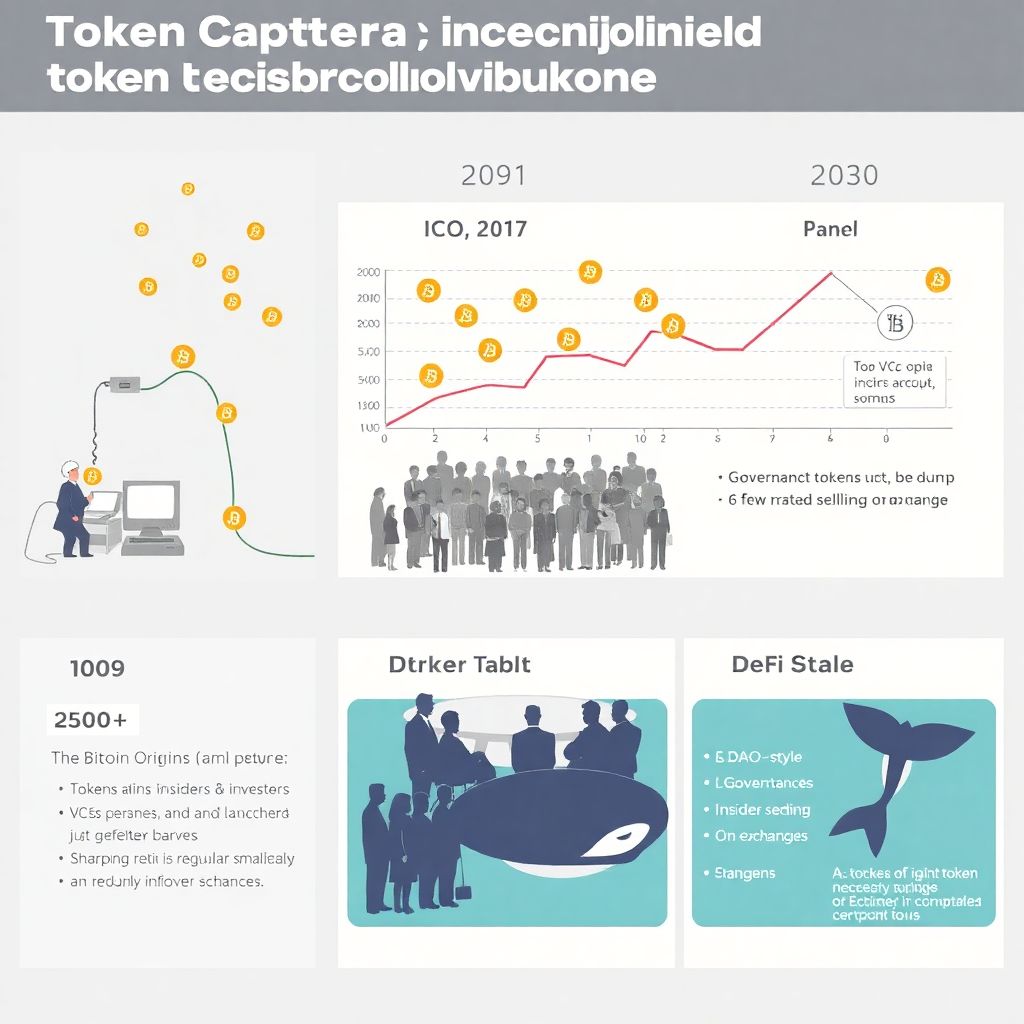
When Bitcoin launched in 2009, nobody seriously discussed “token capture”. There was no VC allocation, no presale, no team tokens — just miners, cypherpunks and early nerds running nodes. Distribution was clumsy but surprisingly organic: people who cared and showed up early got coins.
Problems started once projects began selling tokens *before* launch. ICOs in 2017 made it painfully obvious: a handful of insiders could buy massive chunks of supply, then dump on retail once the token hit exchanges. That’s when people first started to talk about crypto token distribution risks — often in hindsight, after they had already been burned.
DeFi in 2020 added a new twist. Protocol tokens were now used for governance, not just speculation. In theory, this meant communities could run protocols. In practice, big funds and whales quietly accumulated governance tokens and pushed votes their way. A few years, a couple of forks and several “governance attacks” later, the term “token capture” became standard jargon, not just a niche worry.
By 2025, any serious founder, investor or crypto governance token advisor must understand that token capture and distribution risk is not an edge-case; it’s a core design problem that can make or break a project.
—
What “token capture” actually means (in plain English)
Token capture happens when a small group ends up with enough tokens to control key decisions, value flow, or both. Think of it as a stealthy takeover, sometimes legal and “by the rules”, but still against the spirit of decentralisation.
It’s not only about owning 51% of supply. Capture can show up as:
– A venture fund quietly coordinating votes with two other funds
– A founding team holding most of the tokens behind a long but flexible vesting schedule
– An airdrop that looked large, but in practice went to a small group of well‑capitalised farmers using thousands of wallets
The result is similar: decisions serve the concentrated few, not the broader ecosystem, and regular users realise they don’t really have a voice. At that point, the token is “alive” on-chain but socially dead.
—
Basic principles of token distribution risk (the mental model)
At a high level, you’re juggling three forces: power, incentives and time. A simple way to think about how to prevent token capture in crypto projects is to ask three questions before you even write your first smart contract:
1. Who will hold which tokens?
– Founders, investors, team, community, partners, ecosystem funds, market makers, etc.
– Are you okay with one group being able to block or force any proposal?
2. When will they get access?
– Instant unlock vs. vesting vs. cliffs vs. streaming.
– Will anyone be able to dump or dominate voting early on?
3. How much do they care?
– Are these holders long‑term aligned (builders, power users) or short‑term (pure yield farmers, token flippers)?
– Do they have a reason to stick around once they’re in profit?
If you ignore any one of these, you end up with fragile tokenomics: maybe the numbers look balanced, but time-based unlocks break governance, or incentives push power into the hands of people who don’t even use the product. That’s exactly the space where tokenomics design service for new tokens has emerged as a specialised niche: getting these moving pieces right up front is much cheaper than trying to patch them later.
—
A simple framework for spotting distribution red flags
Here’s a straightforward checklist you can use when evaluating any token, either as a builder or as an investor.
1. Check immediate concentration
– Explore the top 10–20 wallets. Are they all exchanges and known entities, or anonymous fresh wallets?
– Look for signs of many “different” wallets funded from the same source — that’s often a sybil pattern.
2. Read the vesting schedules (for real)
– When do team and investor tokens unlock, and how quickly?
– Are unlocks heavily front‑loaded into the first year, when the project is still weak?
3. Map power, not just supply
– Which tokens actually vote? All of them, or only staked / escrowed ones?
– Is voting power capped or quadratic, or purely linear with no safeguards?
4. Stress-test worst cases
– Imagine a coordinated group that buys 10–20% of the float. Can they bribe, buy or borrow the rest they need to control votes?
– What if a major early investor gets angry or impatient and votes maliciously — can they still break the system?
5. Look for exit doors
– Are there on-chain kill switches, admin keys, or “emergency” powers that allow a tiny group to override governance?
– If yes, are those properly disclosed and time‑locked?
Do this consistently and your instincts about crypto token distribution risks will sharpen faster than you expect. After a while, you’ll “feel” when a design is safe or obviously skewed.
—
Real‑world patterns: how token capture shows up in practice
The most common form of capture is silent accumulation. A token launches fairly, liquidity is deep and everyone’s cheering. But a few sophisticated entities relentlessly buy or borrow governance tokens. They’re patient. Over months, they get just enough voting power to:
– Redirect emissions and rewards to pools they benefit from
– Approve treasury grants to their own shell entities
– Block proposals that would dilute their influence
Users notice only when it’s already entrenched. The protocol still “works”, but the culture feels off: risky proposals pass easily, community ideas stall, and governance forums read like theatre.
Another pattern is insider overhang. Token allocations look reasonable on paper: “only 20% to team, 15% to early investors, long vesting, don’t worry”. But if the free float is tiny at launch, those insiders effectively control the market and governance the moment their tokens unlock. Even 10–15% of unlocked supply can dominate if everyone else is passive or scattered.
Lastly, you have airdrop illusions. Massive airdrops are announced with 50%+ supply “for the community”. In reality, it goes mostly to:
– Heavy DeFi users already wealthy
– Professional “airdrop farmers”
– A cluster of high‑volume wallets that colluded to farm the drop
Small holders end up with dust; whales with thousands of addresses accumulate real voting power. The distribution *looks* wide, but control stays narrow.
—
Why “fair launches” aren’t automatically fair
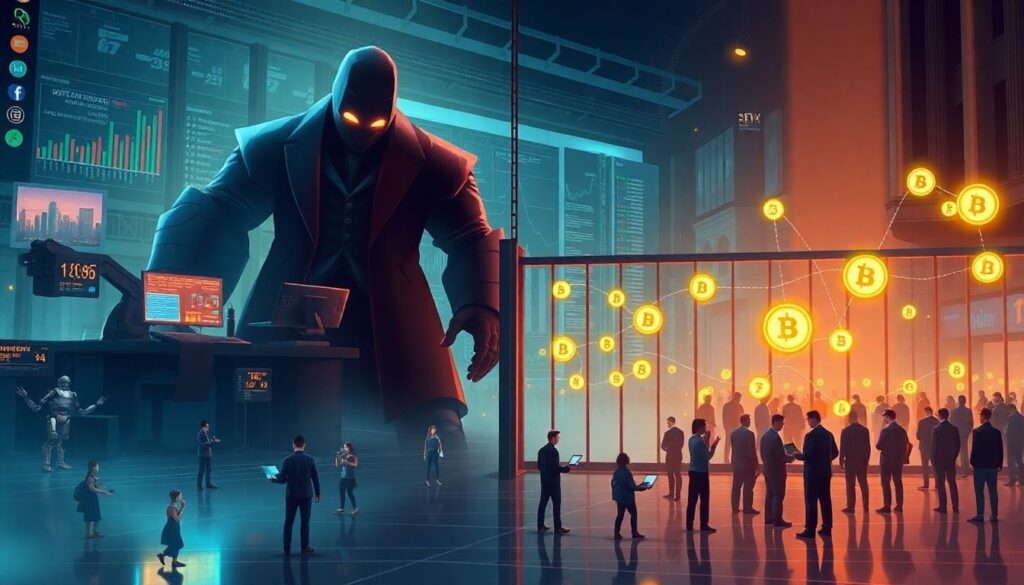
It’s tempting to assume that if everyone can buy or farm a token from day one, the distribution must be fair. Unfortunately, open access isn’t the same as equal opportunity.
Large players have tools that small users don’t: capital, automation, sophisticated order flow, MEV strategies. They can robotically buy dips, front‑run news, and deploy complex farming setups. So a “fair” or “community” launch can quickly tilt toward those who are already rich or highly technical.
That doesn’t mean fair launches are bad; it means you must pair them with guardrails: caps per wallet, sybil resistance, and distribution mechanisms that reward depth of participation (time, contribution, reputation) rather than just raw capital.
—
Design tools to reduce capture risk from day one
To bring this down to earth, here are some concrete design levers builders can pull:
1. Vesting that mirrors real contribution
– Team tokens should unlock in sync with shipping milestones and user growth, not on arbitrary dates.
– Investor vesting should be long enough that they win only if the protocol becomes genuinely useful.
2. Progressive decentralisation
– Start with a small, clearly defined group in control for safety.
– Over pre‑set, transparent milestones, hand more authority to the DAO, and eventually to non‑core community members.
3. Voting power with friction
– Require locking or staking tokens for governance rights, so voting isn’t free to flip.
– Use long‑term locks or “voting escrow” so short‑term speculators have less influence than committed holders.
4. Participation‑based distribution
– Airdrops and incentives that reward helpful actions: providing real liquidity, building tools, contributing code, moderating, educating.
– Use reputation or soulbound badges to differentiate real users from fly‑by‑night farmers.
If this sounds complex, that’s exactly why token launch consulting for fair distribution has become its own micro‑industry. Founders now routinely bring in outside experts to sanity‑check token allocations, vesting curves and governance mechanics before going live.
—
Common myths beginners should drop quickly
Let’s quickly bust some frequent misunderstandings that keep people naive.
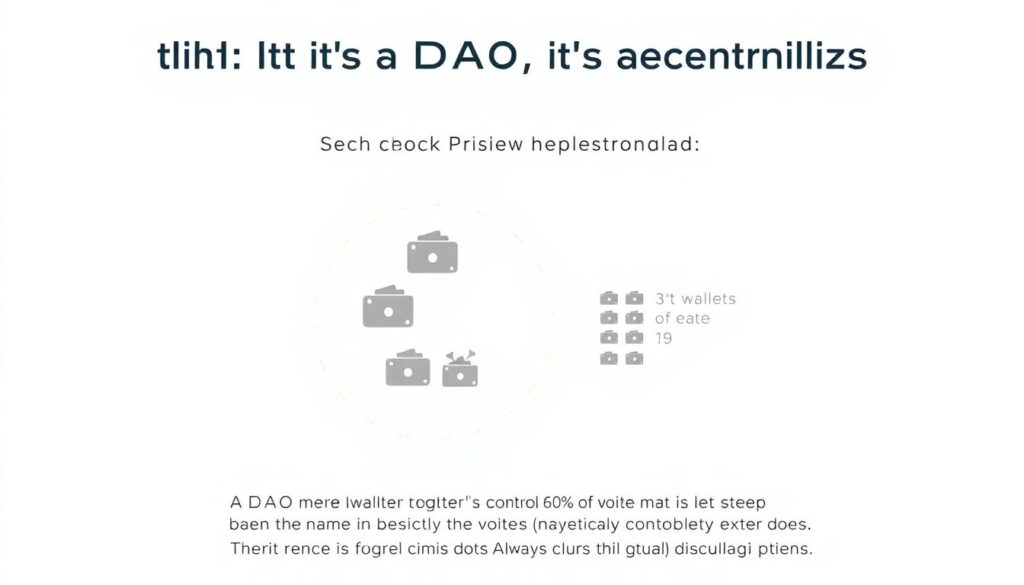
Myth 1: “If it’s a DAO, it’s automatically decentralised.”
A DAO where 3 wallets control 60% of votes is functionally a company with an extra step. The name doesn’t matter; voting power does. Always check the actual distribution and voting history.
Myth 2: “Many token holders means no capture risk.”
You can have 100,000 holders and still be captured if the top 50 wallets coordinate. Holder count is a vanity metric if you don’t examine concentration.
Myth 3: “On-chain transparency is enough protection.”
Yes, blockchains are transparent. No, most people don’t have time or skills to monitor flows 24/7. Without analytics, monitoring and social oversight, bad actors can still exploit complexity and user apathy.
Myth 4: “Good intentions from founders are sufficient.”
Even honest teams face pressure from investors, market conditions, and personal liquidity needs. Strong rules and incentives beat promises every single time.
—
The human factor: social capture vs. technical capture
Not all capture is about wallets. Sometimes, control is more subtle: narrative capture.
A charismatic founder, a large influencer or a respected fund can dominate *discourse* so completely that nobody dares to oppose them. Governance proposals are pre‑decided on private calls and social channels, and token voting just rubber‑stamps what’s already been agreed off‑chain.
Healthy communities fight this by:
– Encouraging dissent and constructive criticism
– Publishing clear conflict‑of‑interest disclosures
– Rotating leadership roles and committee members
– Making back‑room deals socially costly
You won’t fix token capture if the culture itself is captured by a hierarchy that nobody questions.
—
The role of advisors and external reviewers
By 2025, serious projects rarely ship tokens without external review. It’s common to see:
– Legal counsel checking compliance and investor protections
– Security auditors reviewing smart contracts
– Tokenomics specialists stress‑testing distribution and governance
In that context, a crypto governance token advisor is as much a social designer as an economic one. Their job isn’t just spreadsheets; it’s also mapping out likely power blocs, game‑theoretic attacks and community dynamics. If you’re launching a protocol with any ambition, treat this as core infrastructure, not a luxury.
—
Where this is going by 2030: a realistic forecast
Standing in 2025, a few trajectories are already visible. Barring black swans, here’s what you can reasonably expect over the next 5 years:
1. Regulated governance for systemically important protocols
– As DeFi and on‑chain markets scale, some governance tokens will be treated closer to public utilities.
– Expect specific rules around disclosures, concentration limits, and even “fit and proper” tests for major governance participants.
2. Standardised “distribution risk scores”
– Just like credit scores, protocols will likely have widely used risk metrics that quantify concentration, unlock schedules, and governance attack surfaces.
– Rating agencies and dashboards will compete to offer the most predictive models, making “hidden” capture much easier to spot.
3. Rise of contribution‑weighted ownership
– Projects will lean harder into identity, reputation systems and SBT‑like primitives to reward long‑term contribution, not capital alone.
– Farming purely with money and bots will still exist, but premium access, governance clout and meaningful upside will go to proven contributors.
4. Composable governance protections
– New primitives will emerge: delegate caps, circuit‑breakers, veto tokens, veto‑delay mechanisms and slashing for malicious governance behaviour.
– These will be plug‑and‑play modules other projects can import, much like standard token contracts today.
5. Professionalisation of token design
– Founders won’t casually improvise token allocations on a whiteboard.
– Specialised firms offering tokenomics design service for new tokens will become standard partners, and investors will insist on their involvement before committing capital.
In short, token capture will not disappear; attackers get smarter too. But the default level of defence — both technical and cultural — should improve meaningfully. Projects that ignore this evolution will stand out as obviously risky.
—
How a beginner can start building good instincts today
You don’t need to be a quant or protocol lawyer to get serious about distribution risk. Here’s a lean, practical starter plan:
1. Pick 3–5 live projects and study their tokenomics docs and governance history.
2. Use block explorers and analytics dashboards to inspect top wallets and historical unlocks.
3. Compare what the project promised (“fair launch”, “community first”) with how power actually looks now.
4. Follow a few independent analysts who regularly dissect tokenomics and governance incidents.
5. Optional but powerful: participate in one DAO, even with a tiny stake, and observe who really drives decisions.
Do that for a few months and you’ll be able to smell unhealthy designs early. You’ll also be much better prepared if you ever decide to found a project yourself or hire specialists for token launch consulting for fair distribution.
—
Closing thoughts
Tokens are not just numbers on a screen; they’re programmable ownership and power. Mis‑distributing that power is like building a skyscraper on sand — it may stand for a while, but the cracks are inevitable.
If you remember nothing else, keep this framing:
– Token capture is a *design failure*, not an accident.
– Distribution risk can be measured, managed and reduced, but not eliminated.
– Culture and incentives are as important as vesting curves and smart contracts.
The earlier you internalise that, the better decisions you’ll make — as a user, investor, or builder — in the next wave of crypto.