
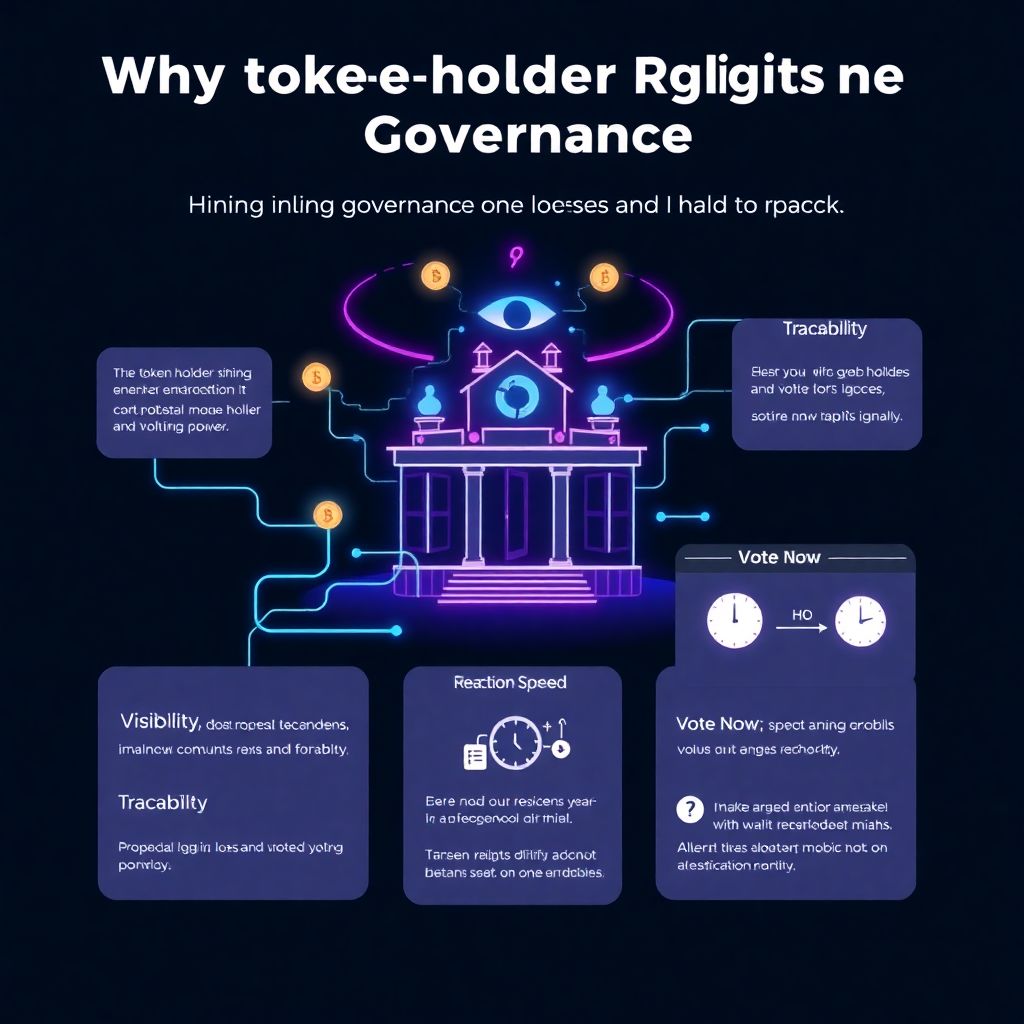
Why token holder rights in governance are so easy to lose (and hard to get back)
If you hold tokens in any protocol with voting, you technically have rights. In practice, those rights can quietly evaporate: you miss proposals, whales coordinate off-chain, or upgrades change rules while you sleep. A solid token holder rights governance framework is less about fancy legal talk and more about three boring things: visibility, traceability, and reaction speed. If you cannot see what’s going on, cannot verify what actually happened, and cannot react in time, your “governance power” is just a line in a whitepaper, not a real protection of your capital or your voice in the protocol’s future.
Real cases: what actually goes wrong in token governance
Case 1: The silent quorum trap

Imagine a DAO where proposals pass with a low quorum. Most holders assume “someone else is watching governance” and don’t bother. A group of active voters coordinates on a private Discord and pushes through a treasury allocation to a partner project where they have stakes. Everything is technically “on-chain and legit”, but most token holders are blindsided. This is a classic example of how to protect investor rights in crypto token governance by *not* relying on good intentions: you need automated alerts, clear quorum rules, and a culture of active monitoring. Without those, even a small but organized minority can repeatedly tilt the protocol in their favor.
Case 2: Delegation gone wrong
Delegation seems like an easy win: “I’m too busy, I’ll just delegate to a trusted address.” Then your delegate joins the core team, starts backing controversial proposals, and you wake up to discover your voting power helped approve a risky leverage strategy for the treasury. You can’t say you weren’t involved: your tokens literally signed those decisions. This is why any decentralized governance platform for token holders that supports delegation must make delegation status, history, and performance radically transparent. Otherwise, delegation turns from convenience into a hidden governance risk vector.
Case 3: Governance by interface, not by rules
Another real pattern: the smart contracts allow many things, but the front-end hides some of them. For example, maybe technically you can submit a proposal with a small stake, but the web interface requires a higher minimum. Most users never read the contracts; they simply assume “if the UI doesn’t show it, it doesn’t exist”. In practice, this creates a shadow elite of technically savvy users who can interact directly with the contract and bypass the soft constraints of the interface. Monitoring rights in this context means watching both the contract layer and the UI layer, and calling out any mismatch between written rules and actual, live behavior of the protocol.
Key principles: monitoring before complaining
At a high level, monitoring and enforcing token holder rights boils down to a few non-negotiables. First, you need event-level visibility: every proposal, every vote, every parameter change should be trackable via on-chain logs and readable dashboards. Second, you need identity context: who proposed what, who voted, who delegates to whom, and how those patterns evolve over time. Third, you need alerting with realistic thresholds so you don’t miss critical events but also don’t drown in noise. Only after these basics are in place does it make sense to talk about influence strategies, activist campaigns, or legal escalation. In other words, if you don’t even know what’s being voted on this week, arguments about fairness or power distribution are premature.
Concrete setup: building your monitoring stack
1. Start with a minimal “observer rig”

For individual investors or small funds, you don’t need a massive setup. Begin with a wallet you dedicate solely to governance interaction, linked to email, Telegram, or Slack alerts from whichever governance tracking tools your DAO uses. From there, make a list of the best tools to monitor DAO governance voting for that specific ecosystem. In Ethereum-based DAOs, that might be platforms like Tally or Snapshot dashboards plus a block explorer with good API support. The goal isn’t to collect every metric; it’s to guarantee you see new proposals, key parameter changes, and large delegate moves within hours, not weeks.
2. Build your own “governance feed” instead of browsing randomly
Instead of occasionally checking random dashboards, aggregate everything into one personal newsfeed. Subscribe to proposal RSS feeds, governance forum updates, and bot alerts into a single location: a Discord channel, a Telegram group, or even a private Notion page. Treat it like a Bloomberg terminal for governance. This is where a token governance rights management service—whether third-party or in-house—earns its keep: consolidating raw on-chain data, forum context, and social chatter into a timeline you can actually act on. The key is to reduce the friction from “something changed in governance” to “I know exactly what changed and what my options are”.
3. Track patterns, not just individual proposals
One-off votes can look harmless; patterns are where power shows up. Monitor recurring themes: the same wallets proposing fund transfers, the same cluster of addresses consistently forming a voting bloc, or a single entity’s delegates growing rapidly. Over a few months, this analysis can reveal whether the protocol is drifting toward capture by a fund, a team, or a small clique. Even a lightweight spreadsheet or a simple script that logs major voters and proposals can tell you more about the real power structure than any glossy governance manifesto.
Non-obvious solutions that actually work
Shadow simulations before real votes
One underused tactic is running “shadow votes” off-chain in your own environment before the real thing happens. For example, a fund can simulate how a proposal will pass or fail under different delegation and turnout scenarios, using public token distribution data. This allows you to see whether your own stake matters or if the outcome is effectively predetermined by whales or the core team. When a proposal is mathematically unstoppable, you might focus on public communication and future rule changes rather than wasting time on a symbolic “no” vote. Conversely, tight votes are where mobilisation and coalition-building actually have leverage.
Tagging addresses with human context
Raw addresses are not helpful; “0xABC…” doesn’t tell you why they vote the way they do. A subtle but powerful move is building a private “governance CRM”: a list where you tag addresses with human-level context like “core dev”, “market maker”, “long-term investor”, “activist critic”, or “new delegate’. Over time, this network map helps you interpret voting patterns. When you see a proposal backed by addresses historically tagged as “short-term yield hunters”, you treat it differently than one backed by long-term ecosystem builders. This also makes outreach and coalition-building more targeted and respectful.
Monitoring the *absence* of votes
Another non-obvious signal: who suddenly stops voting. If a large delegate or a key institution goes silent, that’s sometimes more meaningful than a yes or no. It can indicate internal conflict, legal concerns, or loss of confidence. A governance monitoring routine that flags “top 20 voters who have gone inactive for N proposals” can reveal shifting alliances before they fully show up in on-chain results. For activists and long-term holders, these absences are perfect moments to offer delegation services or to ask for feedback on why they stepped back.
Alternative methods beyond standard DAOs
Multi-layer governance (on-chain + social + legal)
Not every protocol should rely on pure token voting. In some ecosystems, especially those holding real-world assets, token holder rights are reinforced by a legal wrapper or foundation charter. In those cases, a token holder rights governance framework might combine on-chain actions with off-chain rights, such as the ability to challenge a decision in a foundation council or initiate an independent audit. Monitoring, here, includes reading foundation minutes, legal disclosures, and regulator-facing updates, not just scanning the chain. If you ignore the legal layer, you might be missing your strongest lever for contesting abusive decisions.
Representative councils and veto mechanisms
An alternative to pure one-token-one-vote is to elect a small council or committee with explicit veto or review powers. This can be effective for complex protocols where most token holders don’t have time to read every technical detail. Still, it raises monitoring questions: how do you ensure the council remains accountable? The answer is to treat their votes as proposals themselves: track attendance, voting history, conflicts of interest, and transparency commitments. Even if you delegate power, you don’t delegate oversight. Regular performance reports and open town-hall calls are simple but effective tools to keep such councils in check.
Soft power: media, researchers, and watchdogs
Sometimes, you don’t win by voting; you win by raising the cost of bad behavior. Independent researchers, newsletters, and governance watchdogs act as a soft alternative governance layer. They cannot veto a proposal, but they can shine enough light on abuses that whales think twice. Supporting such actors—funding audits, sponsoring write-ups, or giving them early access to drafts—is an effective, indirect way to protect your own rights. If governance feels captured, consider whether a well-documented public case might be more impactful than grinding through a rigged vote.
Pro tips and “expert mode” hacks
1. Run your own light indexing node
If you manage serious capital, relying solely on public explorers is a risk. Running a light indexing stack (for example, using The Graph or custom scripts) gives you faster and more flexible access to on-chain governance data. You can query, for instance, “all proposals that touched parameter X in the last year” or “all voters whose voting power increased by more than 10% in a week”. This level of granularity turns you from a passive observer into a serious player who can forecast and pre-empt governance shifts.
2. Use risk-based attention allocation
Not all DAOs deserve equal attention. Classify your holdings by impact: which protocols are systemically important to your portfolio, which ones hold high-risk assets, which ones are particularly prone to capture? Allocate your monitoring time accordingly. Set stricter alerts and closer watch on protocols where a single rushed vote could wipe out a big portion of your capital. For lower-impact tokens, you might rely more heavily on delegated monitoring via a token governance rights management service or a trusted research partner.
3. Bake rights into the code, not just the docs
The most robust way to secure token holder rights is to embed them in immutable or hard-to-change smart contract logic. For example, you can insist on governance rules that enforce minimum notice periods, quorum thresholds, and timelocks on major treasury moves. Once those are encoded, no one can “forget” them in a rushed upgrade. As an investor or delegate, explicitly pushing for such constraints in early governance proposals is one of the highest-leverage moves you can make; it saves you from future firefighting by making certain classes of abuse structurally impossible or at least very expensive.
Step-by-step checklist to keep your rights intact
1. Map your exposure: list all protocols where you hold governance-enabled tokens, plus their voting mechanisms and main interfaces.
2. Set up alerts: connect your wallets to governance monitoring tools, subscribe to proposal feeds, and route everything to a single “governance inbox”.
3. Analyze history: review the last 6–12 months of proposals and major voters to understand who really drives decisions.
4. Decide your stance: choose where you vote directly, where you delegate, and where you simply observe due to low impact.
5. Push for structural safeguards: support proposals that codify strong governance rules, even if they slow things down slightly.
Bringing it all together
Monitoring and ensuring token holder rights is not magic; it’s a mix of habits, tools, and a bit of skepticism. You don’t have to transform into a full-time on-chain activist, but you do need a clear process for watching proposals, understanding power dynamics, and reacting when something threatens your stake. A thoughtful token holder rights governance framework plus the right mix of on-chain dashboards, off-chain research, and social pressure can turn you from a passive speculator into an informed participant. Over time, that shift doesn’t just protect your own portfolio; it increases the odds that the protocols you rely on remain fair, resilient, and actually aligned with the people who fund them.