

Why your crypto research workflow is probably broken (and how to fix it)
Most beginners “do research” the same way: scroll X/Telegram, watch a couple of YouTube videos, ape into something that “everyone” is talking about, then wonder what went wrong.
The problem isn’t that you’re stupid or unlucky. The problem is that you don’t have a workflow — you have a stream of noise.
A robust crypto research workflow turns that noise into a repeatable process: how you discover projects, filter them, dig deeper, track positions, and learn from mistakes. Let’s walk through how to build that, compare a few common approaches, and look at non‑obvious tricks that pros actually use.
—
Three typical research styles (and why only one scales)
1. The “influencer echo chamber” approach
This is where most people start.
You follow big accounts, get hyped on new coins, maybe glance at CoinGecko, and jump in. Your “research” is mostly:
> “This guy has 500k followers, he must know what he’s talking about.”
What works here:
– You get exposed to lots of ideas quickly.
– You can catch narrative shifts early (AI coins, restaking, LRTs, etc.).
What fails badly:
– Zero independent verification.
– You mistake confidence for accuracy.
– You chase trends late and exit even later.
This approach is fast but completely dependent on others. It’s fine as a discovery channel, but suicidal as a full workflow.
—
2. The “spreadsheet warrior” approach
Next level: you start comparing tokens, making notes, tracking entries/exits in spreadsheets. You might add some simple metrics: FDV, market cap, token unlock dates, maybe a few valuation ratios.
You’re starting to act like a real analyst — but it’s still noisy.
Strengths:
– You’re forced to write down why you enter a trade.
– You can look back and see patterns in your wins and losses.
– You’re slightly less vulnerable to hype.
Weaknesses:
– Data collection is slow and manual.
– You probably cherry-pick metrics that confirm your bias.
– Without visualizations or alerts, you still react late to market changes.
This approach is much better, but without tools and structure, it quickly becomes overwhelming.
—
3. The “tool‑powered workflow” approach
This is where pros live.
They still consume narratives and sentiment, but they run everything through a fixed pipeline: on‑chain data, fundamentals, tokenomics, price structure, and risk.
They combine crypto research tools for beginners (simple dashboards, screeners, alerts) with more advanced crypto market analysis software for traders (order flow, derivatives data, L2 order books) — but the key isn’t the tools. It’s the order they’re used in.
We’ll build this kind of workflow now, but with a beginner‑friendly setup that you can actually maintain.
—
Step 1: Limit your information firehose
Your first problem isn’t “not enough alpha.” It’s drowning in random opinions.
Goal of this step: define *where* ideas come from and *how* they enter your process.
Practical setup
1. Pick 3–5 primary info sources
– One or two curated newsletters (macro + crypto).
– A handful of X accounts (devs, analysts, not meme‑lords).
– One or two data‑driven YouTube channels.
2. Create a separate “research” inbox / feed
– Use a dedicated email or filter.
– Mute 90% of your Telegram shill groups.
– Use lists on X so trading content doesn’t mix with memes and drama.
3. Turn “interesting noise” into a backlog
– When you see a project mentioned more than twice from *independent* sources, add it to a “to research” list.
– Do not FOMO buy anything directly from a feed. Everything must go through your workflow.
Non‑obvious trick:
Treat your feeds like a *lead generator*, not a trading signal. This single mental shift instantly makes you calmer and more systematic.
—
Step 2: Build a simple project screening layer
Before you deep dive, you need a fast way to kill 80% of bad ideas.
What you screen for in under 10 minutes
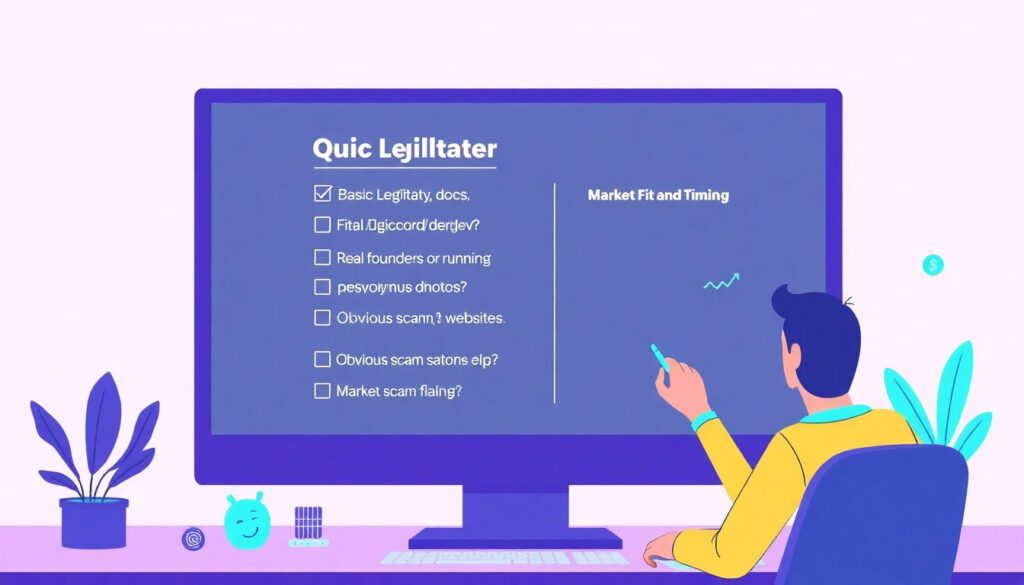
Your quick filter might be:
1. Basic legitimacy
– Is there a website, docs, GitHub/Discord/Telegram?
– Can you find founders or at least long‑running pseudonymous devs?
– Any obvious scam flags: copied website, fake team photos, aggressive “guaranteed APY” claims?
2. Market fit and timing
– Is this project aligned with any current narrative or structural need?
– Example: liquid restaking protocols gained traction when EigenLayer narrative exploded.
3. Rough token economics
– Total supply vs circulating supply.
– Upcoming unlocks and vesting.
– Does it look like insiders will constantly dump on you?
If a project fails any of these, you archive it. No attachment, no regrets.
—
Case study: avoiding a pretty obvious landmine
A beginner sees a new DeFi project on some small chain promising 1,000% APY. Big influencer shills it. The beginner usual path: “Looks fire, I’ll throw in $500.”
With a basic screening workflow:
– You check token supply and see 8% circulating, 92% locked for team and investors.
– Unlock schedule shows massive cliffs starting in two months.
– On‑chain, you spot that dev wallets are tied to a previous rug.
That entire process takes 15 minutes, saves you $500, and boosts your confidence in your system.
—
Step 3: Use tools the smart way (without drowning in dashboards)
Many articles throw a laundry list of apps at you and call it “a workflow.” That’s not helpful.
You need a minimal but complete tool stack that covers:
– Price and market structure
– Portfolio tracking and PnL
– On‑chain data and flows
– Alerts and checklists
1. Market and price structure
You can start with a mainstream charting platform and a data aggregator, nothing fancy.
Your goal is to see:
– Long‑term trend (daily/weekly).
– Key support/resistance levels.
– Volume spikes and liquidity zones.
This is where crypto market analysis software for traders really matters later — but as a beginner, don’t get lost in order book heatmaps and delta metrics. Start with clean charts, a few moving averages, and price structure.
—
2. Portfolio tracking and analytics
If you’re using 3+ chains and 2+ centralized exchanges, tracking your positions manually is asking for disaster. You’ll misjudge risk. Always.
This is where you look for the best crypto portfolio trackers and analytics that:
– Aggregate wallets and CEX accounts.
– Show PnL per asset and per trade.
– Offer basic tagging: strategy, narrative, time frame.
Pro tip:
Tag every position with a thesis label (e.g., “L2 infra mid‑term,” “memes short‑term”). Later, you’ll quickly see which thesis types work for you and which ones consistently lose money.
—
3. On‑chain research
On‑chain data is how you verify if a narrative is real or just social‑media smoke. The best platforms for crypto on-chain research let you:
– See active addresses and transaction counts over time.
– Track token holders: are whales accumulating or distributing?
– Inspect smart contracts for basic safety and past exploits.
Real‑world example:
You’re told “Project X has insane adoption.” On‑chain, you see:
– Daily active users peaked three months ago and are down 70%.
– Most volume is wash trading between a few addresses.
– Protocol fees are almost zero.
Suddenly, that “insane adoption” looks a lot like a ghost town.
—
Step 4: Build your research checklist (your personal playbook)
Tools are useless without a consistent set of questions. Your checklist is the core of a robust workflow.
Beginner‑friendly checklist (non‑technical)
For each project you consider, answer:
1. What real problem is it solving?
2. Who are the users, and how do they discover the project?
3. How does the token actually capture value?
4. Who owns most of the supply, and when can they sell?
5. What are the key on‑chain metrics I need to monitor?
6. What events can kill this thesis? (regulation, tech, competition)
7. What’s my maximum loss if I’m wrong?
You can keep this in Notion, Obsidian, Google Docs — whatever is easy for you to update.
Non‑obvious twist:
Write two versions of your thesis:
– The bullish case (why it could work really well).
– The bearish case (how it could fail catastrophically).
Forcing yourself to argue against your own idea dramatically improves decision quality.
—
Step 5: Connect research to actual trades
If you stop at “good research,” you’ve built a library, not a workflow. You need a clear bridge between analysis and execution.
This is where many beginners ask: *“How to build a crypto trading strategy step by step from this mess of data?”*
A simple step‑by‑step bridge
1. Define your time frame per idea
– Narrative trades: weeks to a few months.
– Tech/fundamental bets: months to years.
– High‑volatility plays: hours to days.
2. Translate research into a specific plan
– Entry zone (based on price structure, not vibes).
– Invalidations (at what price or metric do you admit you were wrong?).
– Position size (fixed % of total capital, not “feels right”).
3. Pre‑commit your exit logic
– For narrative trades: exit when on‑chain activity stalls or social interest collapses.
– For longer‑term bets: exit or reduce when project fails key milestones or when tokenomics change against you.
4. Log each trade as an experiment
– What hypothesis were you testing?
– What data did you rely on?
– Did you follow your plan or improvise under pressure?
—
Case study: structured vs impulsive trade
Two traders, same token.
– Impulsive trader:
– Sees token pump 40% in a day.
– Buys at local top because “this could be the next SOL.”
– No clear invalidation; sells after 50% drawdown out of pure frustration.
– Structured trader (using workflow):
– Adds token to backlog weeks earlier after noticing multiple mentions.
– Checks on‑chain: user growth and fees are steadily rising.
– Waits for pullback into a defined support zone.
– Sets stop just below invalidation level based on both price and user activity.
– Logs the trade: thesis = “L2 infra growth, 3–6 month time frame.”
Even if both lose money on this particular trade, the second trader walks away with *data* about what worked and what didn’t. The first trader walks away with only pain.
—
Step 6: Alternative approaches and when they make sense
There is no single “right” way to do crypto research. Different personalities gravitate to different styles.
Approach A: Quant‑leaning (data‑first)
You rely heavily on metrics: volatility, liquidity, funding rates, open interest, on‑chain flows. You treat narratives mostly as noise.
Pros:
– Clear rules, easier to backtest.
– Less emotional; you trust the numbers.
Cons:
– Can miss early narrative shifts that aren’t yet visible in data.
– Requires more tooling and some coding/statistical literacy.
Best for people who enjoy spreadsheets, data, and structure.
—
Approach B: Narrative‑driven (story‑first)
You focus on *why* a narrative might grow: macro themes, regulation, tech breakthroughs, social trends.
Pros:
– You can enter themes early and ride big moves.
– Great for spotting long‑term winners in new sectors.
Cons:
– Easy to get attached to a story and ignore bad data.
– Harder to define clear invalidation points.
Best for people who like reading, big‑picture thinking, and talking to founders/communities.
—
Approach C: Hybrid (what most pros eventually do)
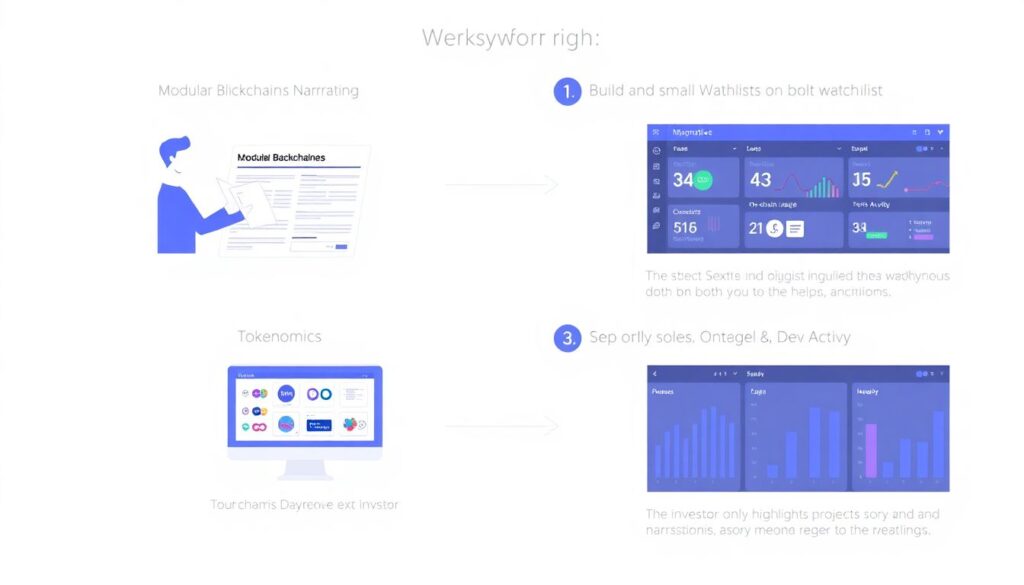
You use narratives to discover opportunities, then use data to size and time them.
Example workflow:
1. Hear about “modular blockchains” narrative.
2. Build a mini‑watchlist of key projects.
3. For each one, check: tokenomics, on‑chain usage, dev activity.
4. Only take positions where both story and data line up.
This hybrid approach is usually the most robust over a full cycle.
—
Non‑obvious tricks and pro‑level lifehacks
Let’s talk about the stuff most guides quietly skip.
1. Pre‑mortem instead of post‑mortem
Before entering a position, write:
> “In six months, this trade was a disaster because…”
List the 3–5 most likely reasons you’ll lose money (unlock dump, exploit, regulatory shock, narrative rotation, etc.). This “pre‑mortem” forces you to think about real risks up front, not when you’re already down 60%.
—
2. Use time‑boxed deep dives
Set a timer: 60–90 minutes per new project.
– 20 minutes: general overview and docs.
– 20 minutes: tokenomics and on‑chain.
– 20 minutes: competitors and past cycles.
– 10–30 minutes: write your notes and preliminary thesis.
If after that time you still feel “meh,” archive it. If you feel curious, schedule a second, deeper session.
This keeps you from spending 6 hours on a project you’ll never buy.
—
3. Build a “no‑go” list
Over time, you’ll notice recurring red flags that almost always lead to losses for *you*. Not for everyone — for you.
Examples:
– Projects where team is anonymous *and* handling user funds directly.
– Anything heavily dependent on mercenary liquidity incentives.
– Tokens with >90% supply unlocking in the next 12 months.
Write these down. When a new project triggers 2+ of your personal no‑go criteria, you skip instantly. No FOMO, no debate.
—
4. Separate “casino capital” and “serious capital”
Not everything needs a PhD‑level thesis. It’s okay to have degen plays — just don’t mix them with your researched positions.
1. Decide a fixed % of your stack as “casino” (e.g., 5–10%).
2. Everything else follows your full research workflow.
3. Never top‑up casino money from serious capital after a loss.
This protects your long‑term growth while still giving you room to experiment and learn.
—
Putting it all together: your beginner‑friendly workflow
To make this concrete, here’s how your day‑to‑day might look once you’ve set things up.
Daily routine (30–45 minutes)
1. Scan curated feeds for new mentions and add interesting tickers to backlog.
2. Check your portfolio tracker for major PnL swings and risk imbalances.
3. Review any active alerts (price, on‑chain metrics, funding, etc.).
4. Journal in one sentence: *“What changed in the market today that affects my theses?”*
—
Weekly routine (1–3 hours)
1. Do 2–3 time‑boxed deep dives from your backlog.
2. Update theses and checklists for existing holdings.
3. Trim positions that no longer match your original reasoning.
4. Review your trade log: which thesis types are working, which aren’t?
Keep it boring. A robust crypto research workflow should feel repetitive and predictable, not like swinging between panic and euphoria every other day.
—
Final thoughts: your edge is the process, not the prediction
As a beginner, you will be wrong a lot. Everyone is — including professionals with expensive crypto market analysis software for traders and decade‑long track records.
Your real edge is not “calling the top” or “finding the next 100x.” It’s having a repeatable workflow that:
– Filters noise into a clear backlog.
– Uses a small, coherent set of crypto research tools for beginners plus a few advanced ones as you grow.
– Connects research directly to position sizing, entries, exits, and reviews.
– Keeps you calm enough to survive long enough to actually improve.
Start small. Track everything. Iterate.
Over time, the combination of the right tools, a structured process, and honest self‑review will do more for your results than any secret signal group or “alpha” channel ever could.