
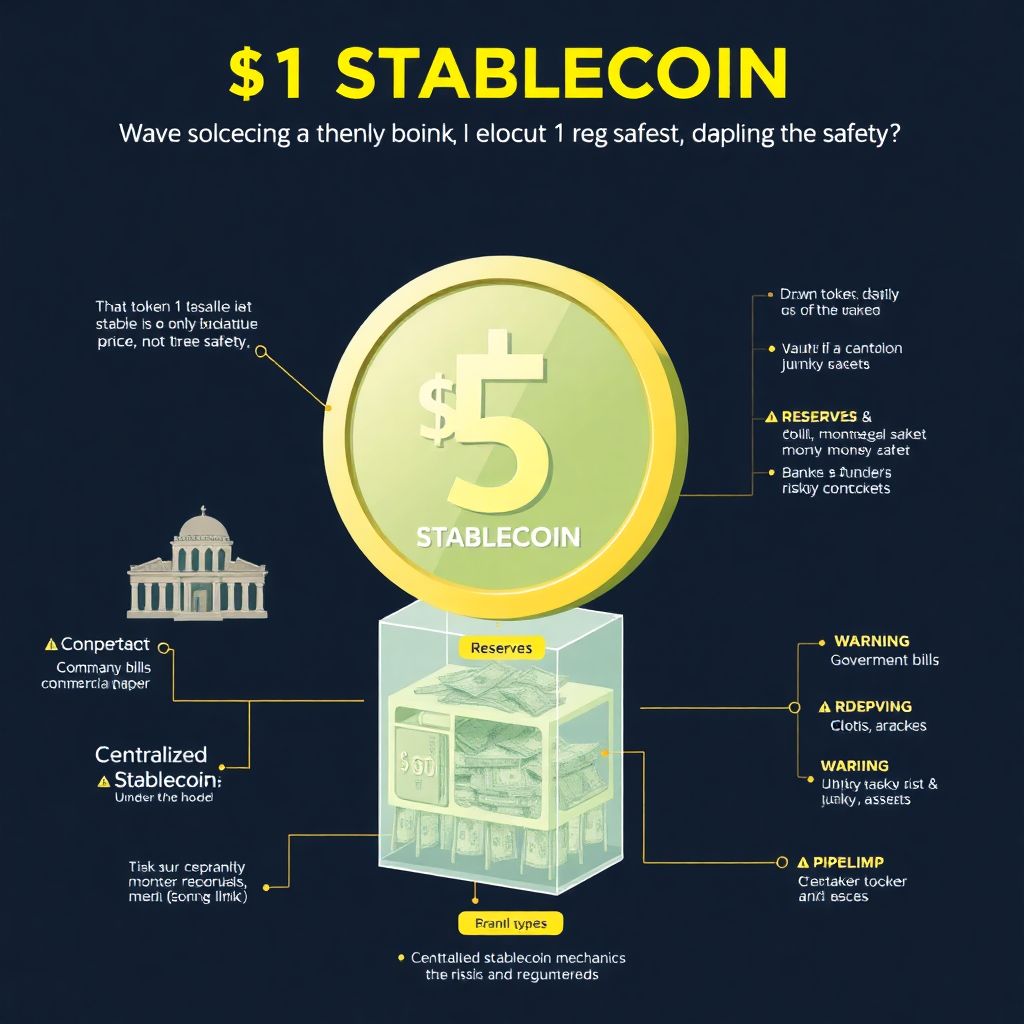
Why stablecoins feel “safe” — and why that’s only half the story
Stablecoins look simple: 1 token ≈ 1 dollar. For a beginner, they often feel like a safe parking lot for crypto capital. But once you dig a bit deeper, you realise *stable* refers to price, not necessarily to *risk*. That’s the essence of stablecoin risks for beginners: the number on the screen can stay at $1 right up until the moment the system itself breaks.
In 2025, stablecoins sit at the core of DeFi, trading, and on‑chain payments. If they malfunction, everything around them shakes. So instead of asking only “What APY can I get?”, you also need to ask: are stablecoins safe to invest in at all, and under what conditions?
Let’s unpack this without sugarcoating, but in a way that’s still human-readable, not just lawyer-talk.
What a centralized stablecoin actually is (under the hood)
Most big-name fiat-backed stablecoins share a common structure:
– A centralized issuer (company, foundation, sometimes a consortium)
– A reserve portfolio (cash, T‑bills, commercial paper, money market funds, sometimes riskier debt)
– A redemption mechanism (usually only for KYC’d institutional clients)
– A smart contract on-chain that represents a promise: 1 token = claim on $1 off‑chain
From a systems-design view, you don’t “own dollars”. You own:
> a token → that is a claim → on a company → that says it will give $1 → if regulators, counterparties, and liquidity all play nice.
That long chain is exactly where stablecoin regulation and centralized issuer risks live. Every arrow is a potential failure point.
Real case #1: When “fully backed” didn’t mean “fully safe”
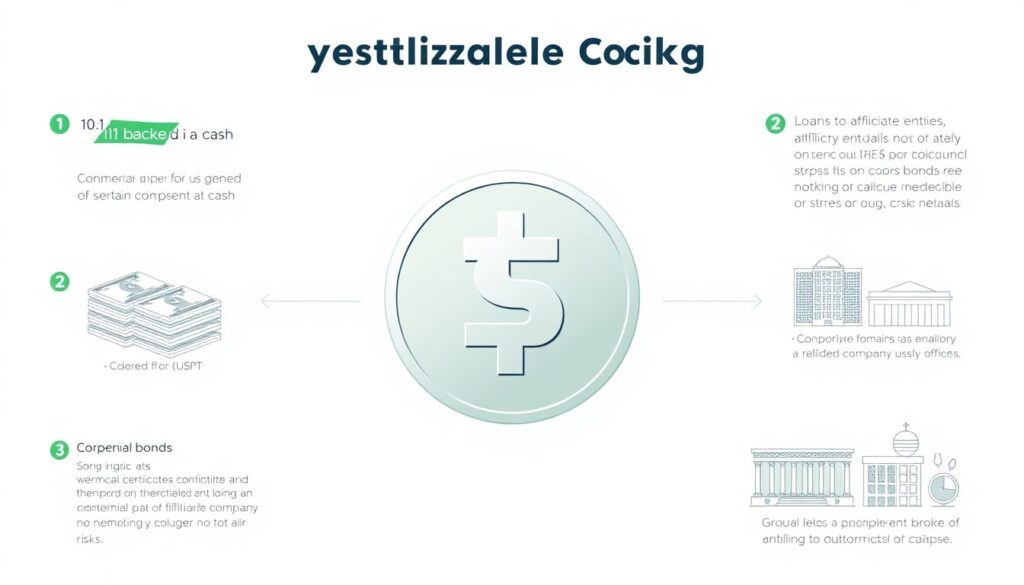
A classic example is Tether (USDT). For years it was marketed as 1:1 backed by cash. Later disclosures and settlements showed a mix of:
– Commercial paper of uncertain quality
– Corporate bonds
– Loans to affiliated entities
Each line item was a source of credit and liquidity risk.
Nothing “broke” catastrophically, but several events created serious stress:
– Regulatory probes into whether reserves were accurately represented
– Short-selling campaigns and fear of a “Tether bank run”
– Periodic depegs on some exchanges during market panics
This is a perfect illustration of why best stablecoins with lowest risk is *not* a simple ranking by market cap. The lesson: “fully backed” can mean “backed by risky assets that will be illiquid exactly when you need liquidity most.”
Real case #2: Terra/UST — when “decentralized” still meant “fragile”
Terra’s UST (an algorithmic stablecoin) imploded in 2022, wiping out tens of billions. It’s a different design from fiat-backed stablecoins, but it’s crucial for understanding stablecoin risks for beginners.
UST was backed not by dollars, but by a reflexive loop with LUNA. When confidence cracked, redemptions spiked, LUNA hyperinflated, and the peg died. Price went to cents.
Key takeaway even for centralized coins:
Stable value depends on *confidence* and *redemption credibility*. Once the market believes the peg may break, it often becomes a self-fulfilling prophecy.
The three main risk clusters of centralized issuers
If you hold USDT, USDC, or another centrally-issued asset, your risk profile is usually dominated by three vectors.
1. Issuer risk
– Fraud or mismanagement
– Poor reserve composition (too much duration, credit risk, junk assets)
– Operational failures (bad custody, bad accounting, internal security issues)
2. Regulatory and legal risk
– Sanctions lists (e.g., OFAC) making specific addresses toxic
– Freezes of assets at the banking or fund level
– Government forcing redemptions to pause or reserves to be ring‑fenced
3. Technical and smart contract risk
– Blacklisting functions in the token contract
– Admin keys being compromised or abused
– Bugs in mint/burn logic or bridge contracts
Once you view centralized stablecoins as regulated financial products wrapped in a token, the question “are stablecoins safe to invest in” turns into: “Do I trust this company, its regulators, and its tech stack more than my alternatives?”
How to choose a safe stablecoin: a practical checklist
You can’t eliminate risk, but you can make it legible. When thinking about how to choose a safe stablecoin, walk through these dimensions like a professional risk manager, even if you’re a beginner.
Look for at least:
– Reserve transparency
– Do they publish frequent, detailed reports?
– Are there third‑party attestations or full audits?
– Asset quality
– Majority in short-term government securities and cash?
– Minimal exposure to corporate debt, repo with weak collateral, or related‑party lending?
– Redemption mechanics
– Who can redeem? Only whales and institutions, or also smaller players via partners?
– What happened during past stress events (e.g., bank failures, market crashes)?
– On-chain controls
– Can the issuer freeze, seize, or blacklist tokens? Under what circumstances?
– Is the contract upgradeable? Who holds the admin keys?
If the official website and docs don’t answer these questions in plain language, that’s your first soft red flag.
Non-obvious risks that most beginners overlook
New users often check the peg and maybe the market cap — then stop. But some of the more subtle threats are structural, not price-based.
1. Jurisdictional clustering
– If the issuer, the banks, and the custodian are all in the same country, you’re overexposed to that legal regime. One sweeping policy change can affect everything.
2. Concentration in a handful of banks
– A “fully backed” stablecoin parked in a small number of banks can inherit all of those banks’ fragilities. The 2023 banking mini-crisis around Silicon Valley Bank hit USDC’s peg *without* any on-chain failure.
3. Regulatory time lag
– Stablecoin regulation and centralized issuer risks evolve slower than technology. Being “legal today” doesn’t mean the same rules will hold if your stablecoin becomes systemically important tomorrow. Retroactive enforcement is real.
4. Secondary exposure through DeFi
– Even if your chosen coin is strong, the protocol you’re using it in might rehypothecate or pool it with weaker assets. A failure elsewhere can contaminate your position via liquidity pools and lending markets.
Alternative methods: stable value without a single centralized issuer
If you care about stability but don’t want to be all‑in on centralized issuers, there are several architectural alternatives. None are perfect, but combining them can reduce correlated risks.
1. Overcollateralized crypto-backed stablecoins
– Example archetype: MakerDAO’s DAI (as originally designed).
– Backed by excess collateral (ETH, tokenized treasuries, sometimes other assets).
– Risk shifts from issuer risk to on-chain collateral risk, liquidation mechanics, and oracle integrity.
2. Synthetic dollar exposure
– Perpetual futures: you can hold BTC/ETH and short a perp to approximate a dollar position.
– Option-based structures: option spreads that hedge volatility into a pseudo-stable payoff.
– This is capital-inefficient and requires active management, but can dodge some centralized failures.
3. Tokenized money market funds / T‑bill tokens
– Tokens backed by segregated short-term government paper.
– Closer to regulated securities than to typical stablecoins.
– Offer yield from T‑bills, but come with KYC, lockups, and jurisdiction-specific rules.
These alternative methods don’t remove risk; they move it. You’re trading counterparty and regulator risk for market, oracle, leverage, or legal-structure risk. The trick is to avoid having *all* your exposure tied to a single point of failure.
Non-obvious solutions: structuring your own “stablecoin basket”
Instead of searching for a mythical “zero-risk coin”, think in portfolio terms. One of the most non-obvious solutions is to build your own basket, even as a retail user.
For example, for a $10,000 on-chain “cash” allocation, you might:
– 40% in a large, highly liquid centralized USD stablecoin
– 25% in a regulated tokenized treasury product
– 20% in an overcollateralized crypto-backed stable
– 15% in native fiat (in a bank / off-chain) as a true backstop
That way, you’re not betting everything on a single issuer, regulator, or smart contract. None of this guarantees safety, but it dramatically cuts tail-risk from a single catastrophic blowup.
As liquidity and products mature, community-built indices of “best stablecoins with lowest risk” will likely emerge, but you can approximate that logic manually right now.
Pro tips and lifehacks for advanced users (still beginner-friendly)

You don’t need to be a quant to use a few professional habits when dealing with stablecoins. These лайфхаки для профессионалов scale down nicely for individuals.
– Track implied risk via market signals
– Watch stablecoin prices not only vs. USD, but across exchanges and chains. Persistent discounts or premiums signal stress.
– Check borrowing rates: if a stablecoin suddenly becomes very expensive to borrow, market participants may be shorting it or fleeing.
– Separate “transaction stablecoins” from “savings stablecoins”
– Use one type purely for payments and bridging (you can tolerate more censorship risk here).
– Use a stricter, more conservative set for long-term holding of value.
– Read legal docs at least once
– Skim the terms of service and risk disclosures. Look for: can they gate withdrawals? under what conditions can they freeze or confiscate?
– Boring, yes. But this is where real power lies, not in marketing decks.
– Stress-test your own system
– Ask: “If this coin depegs 10–20% overnight, what happens to me?”
– Simulate a few scenarios on paper: forced liquidations, bridge failures, or a jurisdictional ban.
These habits turn “are stablecoins safe to invest in” into a dynamic question you revisit periodically, not a one-time decision.
How regulators are changing the game in 2025
By 2025, regulators in the US, EU, UK, and parts of Asia treat large stablecoins as quasi-banking institutions or payment system operators. That has consequences:
– Capital and liquidity requirements
– Issuers may face rules similar to money market funds or narrow banks.
– More of the reserves must sit in ultra-safe, short-dated government assets. Good for safety, bad for yield.
– Stricter KYC/AML and blacklist pressure
– More aggressive address blacklisting, transaction monitoring, and cooperation with law enforcement.
– Coins with strong censorship controls at the contract level are favored by regulators but less aligned with cypherpunk values.
– Licensing and supervision
– Some jurisdictions require stablecoin issuers to obtain e‑money, payment institution, or even banking licenses.
– Failure to comply can trigger service shutdowns, forced redemptions, or geofencing.
Net effect:
– Individual holders might be safer from insolvency and reserve fraud.
– But they’re more exposed to freezes, surveillance, and policy-driven disruptions.
This is the core of stablecoin regulation and centralized issuer risks in 2025: regulators are making insolvency less likely, while simultaneously making confiscation and censorship more operationally feasible.
Forecast: where stablecoin risk is heading (2025–2030)
Looking forward from 2025, a few trends are already visible:
1. Convergence of stablecoins and tokenized bank deposits
– Expect more bank-issued tokens that are effectively digitized deposits.
– Risk shifts from “shadow banking” issuers to fully regulated banks, but also moves you closer to traditional finance control rails.
2. Rise of multi-issuer and multi-asset stablecoins
– Baskets backed by multiple currencies and issuers will likely grow.
– This spreads regulatory and FX risk, but can introduce complexity and make pegs harder to interpret (1 token might not always mean 1 USD exactly).
3. Smarter on-chain risk metrics
– Protocols will integrate real-time risk scoring based on reserves, legal news, and on-chain behavior.
– You might see DeFi protocols auto-adjust collateral factors when a coin’s risk profile worsens.
4. Growth of non-USD stable units
– More EUR, JPY, and emerging-market-pegged tokens as countries push back on dollar dominance.
– This diversifies currency risk but introduces political risk from more jurisdictions.
5. Algorithmic revival — but with guardrails
– Not the Terra-style casino, but structured, overcollateralized, and regulator-aware algorithmic designs.
– These may still fail, but with better-designed failure modes (soft depegs, redemptions with haircuts) rather than instant collapse.
In other words, stablecoin risks for beginners don’t vanish; they become more *modular* and *transparent*. The tools to visualize and price those risks will get better, but so will the complexity of the systems you’re interacting with.
Putting it all together: a practical mindset for 2025
Instead of searching for the one “perfect” coin, adopt a working method:
– Treat each stablecoin as a bundle of risks (issuer + legal + market + technical).
– Use diversification and segmentation: different coins and setups for different purposes.
– Revisit the question “how to choose a safe stablecoin” periodically as regulation, reserve quality, and market sentiment change.
– Accept that $1 on your screen is a promise, not a law of nature. Manage around that assumption.
If you can hold that mental model, you’re already thinking more clearly than most retail participants. In a market where “stable” is often a branding decision, clear thinking is your real safest asset.