

Why security culture and incident readiness matter more than another cool feature
Imagine two startups. Оne spends months polishing a fancy dashboard and leaves security “for later”. The second one quietly builds a healthy security culture, does regular incident rehearsals, and documents boring runbooks. On demo day, they look similar. Six months later, the first startup is fire‑fighting a data leak on Twitter, while the second calmly handles a phishing attack, informs clients, and keeps shipping features.
This is the gap between “we have security tools” and “we live security every day”. Security culture and incident response readiness are not about fear or paranoia; they are about making sure your project survives success. When real users’ data, money, or trust are on the line, you either have a security backbone — or you’re learning the hard way, in public.
If you’re a beginner trying to evaluate a project’s security culture and incident response readiness, the good news is: you don’t need to be a world‑class hacker or compliance guru. You can start with a structured, common‑sense look at how your team behaves, learns, and reacts when things go wrong. This guide will walk you through that, with real‑world style examples, frequent rookie mistakes, and concrete next steps you can take this week.
—
Step 1. Look at behavior, not just documents
Most beginners start by hunting for policies: “Do we have an information security policy? Great, we’re safe.” Unfortunately, a PDF sitting in a dusty folder doesn’t stop attackers. To evaluate a project’s security culture, watch what people actually do in their daily work. Do they lock their screens? Do they report weird emails? Do they push back on risky shortcuts, even under deadline pressure? Culture is what happens when nobody with “Security” in their job title is in the room.
Questions to ask when you’re just starting
Instead of jumping straight into tools and acronyms, grab a notepad and talk to people. Ask them, in a casual way, how they handle security‑related situations. You’re not running an interrogation; you’re trying to see the real habits behind the official story. For a beginner, simple, human‑level questions can reveal more than a thick policy binder.
1. How do you share sensitive data with teammates or partners?
2. What do you do if you click on a suspicious link by mistake?
3. Who do you tell if you think there’s been a security incident?
4. When was the last time you changed your passwords or checked access rights?
5. How does onboarding teach new folks about security expectations?
If the answers are a lot of “I don’t know”, “We never really talked about it”, or “We just use whatever feels easiest”, that’s a signal: the security culture is mostly accidental. You’re not judging people; you’re identifying where culture is driven by convenience, not by conscious design.
—
Common beginner mistakes when evaluating security culture
Mistake 1: Equating tools with culture
A classic rookie error is thinking that having a firewall, VPN, or shiny SaaS platform equals “mature security culture”. Tools are like gym equipment: owning a treadmill doesn’t mean you’re in shape. If you want a realistic picture, ask how those tools are configured, who maintains them, and how often people review logs or alerts. Many beginners overlook this and happily declare victory after seeing a list of products and subscriptions. Real culture shows up in routines and habits, not logos on a slide.
Mistake 2: Ignoring non‑technical people
Another trap is focusing only on engineers and admins. In reality, attackers often target finance, HR, support, or even the founder who’s always on the road and quickly approving documents on a phone. When you evaluate security culture, talk to support agents, product managers, and marketing folks. If they say things like “Security is the devs’ problem, I just do my job”, you’ve just found a gap. A strong culture makes security everyone’s business, not just the IT department’s side quest.
Mistake 3: Asking yes/no questions
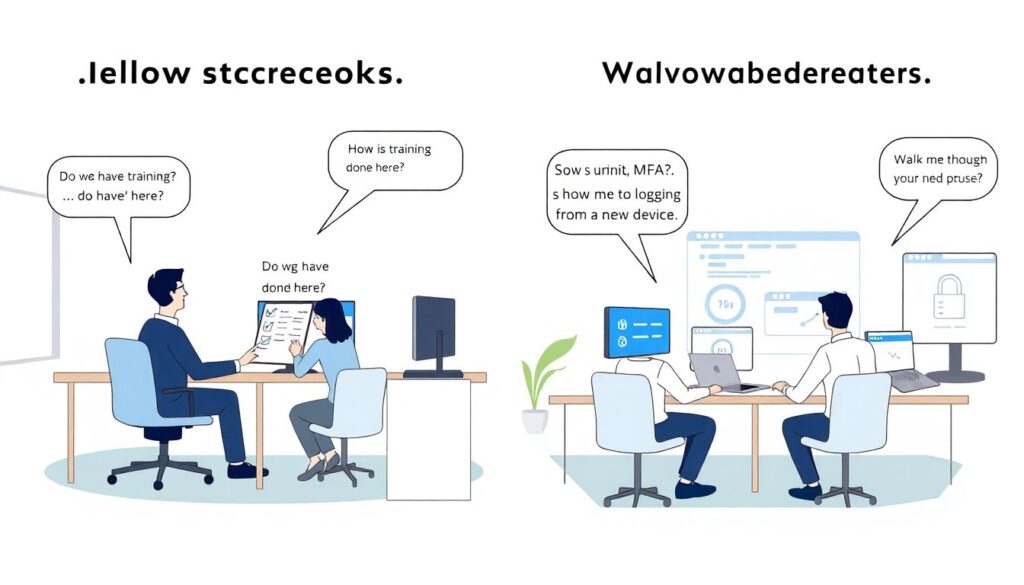
Beginners often ask, “Do we have training?”, “Do we have backups?”, “Do we have MFA?”. People say “yes”, the box gets ticked, and you move on. Better questions are open‑ended: “How is training done here?”, “Show me how you’d restore from backup”, “Walk me through logging in from a new device.” Vague or confused answers tell you much more than a confident “Yes, we have that somewhere”.
—
Step 2. Evaluating incident response readiness without being an expert
You don’t need to lead a red‑team exercise to sense whether a project is ready for trouble. Incident response readiness is really about three basics: Can we detect issues? Do we know what to do when we see them? And can we recover without chaos? Many teams buy a managed incident response service or monitoring platform, then never rehearse what happens when an alert goes off. That’s like buying a fire extinguisher and never reading the label.
What a beginner‑friendly readiness check looks like
When you hear about an “incident response readiness assessment”, it might sound like a giant consulting engagement. At a project level, you can do a lightweight version yourself. Ask simple questions and try to follow the thread:
– How would we notice something strange is happening?
– Who is the very first person to act, and what do they do in the first 15 minutes?
– Where are incident runbooks or checklists stored, and can people actually find them?
– Who can make the call to shut down or isolate a system in an emergency?
– How do we inform customers and partners, and who writes those messages?
If every answer starts with, “Hmm, we’d probably…” or “I guess we’d try…”, your project is relying on improvisation, not readiness. That doesn’t mean you’re doomed; it means you’ve discovered the fastest path to improvement: write down the “probablies” and turn them into a basic plan.
—
Frequent mistakes in incident readiness for new teams
Mistake 4: Confusing monitoring with response
Many teams proudly show dashboards, alerts, and logs, then fall silent when you ask, “And what happens next?” A monitoring tool doesn’t respond to an incident; people do. If alerts go to an unmonitored mailbox or a single engineer’s phone at 2 a.m., you don’t have incident readiness, you have wishful thinking. A beginner often fails to trace the full chain: detection → triage → decisions → communication → follow‑up.
Mistake 5: No dry‑runs or simulations
Reading a runbook once is not the same as practicing it. Teams sometimes fear simulations because they “don’t have time” or worry about looking unprepared. Ironically, a one‑hour tabletop exercise saves days of panic later. For a beginner, even a short role‑play around a fictional breach — “We just discovered a leaked API key on GitHub, what do we do?” — can expose missing steps, unclear ownership, and unrealistic expectations.
Mistake 6: Forgetting about people and communications
Newcomers often obsess over technical details — log retention, forensics, backups — but forget that incidents are social events. Someone has to decide what to tell users, regulators, investors, and the press. If your only plan is “We’ll figure out messaging if it happens”, you’re setting yourself up for rushed statements, conflicting versions, and reputational damage. Evaluating readiness means checking whether comms and leadership are part of the plan, not just engineering.
—
Inspiring examples: What “good” looks like, even on a small budget

Let’s look at two realistic case‑style examples to make this less abstract. These aren’t fairy tales; they’re composites of what happens in many organizations that take security culture seriously without endless budgets.
Case 1: The startup that turned a scare into a security upgrade
A small SaaS team of eight people once received a phishing email that looked exactly like a code‑review notification. One developer clicked, entered their credentials, and realized the mistake seconds later. Instead of hiding it, they told the team lead immediately. Within minutes, the lead locked the account, rotated keys, and reviewed recent changes. After a tense but controlled few hours, no damage was found.
Here’s the important part: they used the incident as a learning moment, not a blame game. They introduced simple security culture training for employees — short, monthly micro‑sessions with real examples and “spot the phishing” games. They also wrote a lightweight incident checklist and did a brief simulation once a quarter. No big consultancy, no massive tools. A year later, when a similar phishing wave hit, nobody fell for it, and the team detected and blocked attempts in under five minutes.
Case 2: Mid‑size company embracing external guidance
Another project, inside a 200‑person company, had some security basics but no clear view of where they stood. They worked with a partner providing cyber security maturity assessment services to map their strengths and weaknesses. At first, the team was nervous: “They’ll tell us everything is bad.” Instead, the assessment highlighted a few high‑impact fixes, like clarifying incident ownership and formalizing escalation paths.
They combined this with targeted cybersecurity risk and compliance consulting to tie security work to future certifications they cared about. Over the next six months, they introduced clear roles during incidents, refined their logging, and ran cross‑department simulations. When they later faced a real credential‑stuffing attack, they activated their plan calmly, informed affected users quickly, and even shared a transparent post‑mortem. Internally, people started seeing security as a shared value, not a random audit checkbox.
—
Practical recommendations for developing security culture
You don’t have to rebuild your entire organization to start moving the needle. Focus on small, repeatable actions that signal: “Security matters here, every day.” These actions are especially useful when you’re new and trying to influence culture from the inside.
Bring security into everyday conversations
Talk about security like you talk about testing or uptime. Add a quick “Any security concerns?” question to design reviews and sprint planning. When someone spots and reports a risky issue — a misconfigured bucket, a suspicious login, a dodgy integration — thank them publicly. This normalizes security discussions instead of making them feel like a special, scary topic reserved for emergencies.
Make training short, relevant, and ongoing
Huge, boring annual trainings don’t build culture; they build resentment. Instead, think in smaller, relevant chunks. A 15‑minute session on “How attackers target engineers”, “Secure handling of customer data”, or “Safe use of third‑party tools” goes much further if it’s tied to people’s real work. If your project grows, you can later bring in structured security culture training for employees from external partners, but you don’t have to wait for that to start sharing knowledge internally.
You can also lean on reputable online platforms for practical courses, then adapt what you learn into internal mini‑workshops. The key is to make security feel like skill‑building, not punishment.
—
Growing your incident response capability over time
Incident readiness is not a binary switch; it’s a capability you build stage by stage. The trick is to avoid trying to perfect everything at once. Focus first on clarity: who does what, when something breaks. Then upgrade detection, analysis, and communication step by step.
Start with a simple, written plan
Even a one‑page document is better than “We’ll just ping each other on chat”. Define who is the incident lead, who handles communication, and which systems are critical. Add a checklist for the first 30 minutes of any serious issue: gather info, contain, document, escalate if needed. Put this where everyone can find it during stress — not buried in a forgotten wiki section.
Level up with tools and external partners
As your project matures, you might decide to work with a managed incident response service, especially if you don’t have senior security folks in‑house. The value here isn’t just “someone to call” during a crisis, but also guidance on building better playbooks, tuning alerts, and learning from incidents. Likewise, a more formal incident response readiness assessment with an external advisor can validate your internal view and point out blind spots you missed because “this is how we’ve always done it”.
—
Resources for learning and growing as a beginner
You don’t have to reinvent best practices from scratch. There’s a lot of solid, free guidance out there. The challenge is to pick a few core resources instead of drowning in endless PDFs and webinars.
Where to deepen your knowledge without getting lost
Look for materials that emphasize real scenarios and checklists rather than just theory. For example, incident‑handling guides from established security organizations, community talks on how teams handled real breaches, and blogs that share honest post‑mortems can be extremely educational. Pair those with practical courses in secure coding, cloud security basics, and modern authentication. Over time, you’ll build intuition: you’ll recognize patterns and know which questions to ask, even if you’re not the one configuring firewalls.
If your project aims at regulated markets, consider engaging light‑weight cybersecurity risk and compliance consulting early, not just right before an audit. You’ll learn how to align your security culture and incident processes with future certifications, instead of bolting on paperwork at the last minute. Think of it as coaching for your long‑term security habits rather than a one‑off exam cram.
—
Bringing it all together: your next concrete steps
You don’t become a “security project” by accident; you become one by asking better questions and acting on the answers. As a beginner, your superpower is curiosity: you’re allowed to say “I’m not sure, let’s map this out.” If you want to start evaluating your project’s security culture and incident response readiness this week, keep it simple and focused:
1. Talk to at least three people from different roles about how they handle security day to day.
2. Try a mini tabletop exercise: invent a small incident and walk through who would do what.
3. Capture gaps you see — missing ownership, no clear runbook, unclear communications — in one shared document.
4. Pick one improvement you can actually deliver in the next two weeks (e.g., a one‑page incident plan or a short phishing awareness session).
5. Share what you learned with the team, not as accusations, but as a roadmap: “Here’s where we are today, here’s how we can be more resilient tomorrow.”
If your project keeps growing, you can gradually layer in more mature practices, occasional external assessments, and better tooling. Whether it’s basic internal drills, partnering for an incident response readiness assessment, or selectively using cyber security maturity assessment services to guide your roadmap, the point stays the same: security culture and readiness are living systems.
You don’t have to get everything perfect now. You just have to start, keep learning from real situations, and make sure that when the next surprise comes — and it will — your project responds with calm, clarity, and integrity instead of panic and guesswork.