
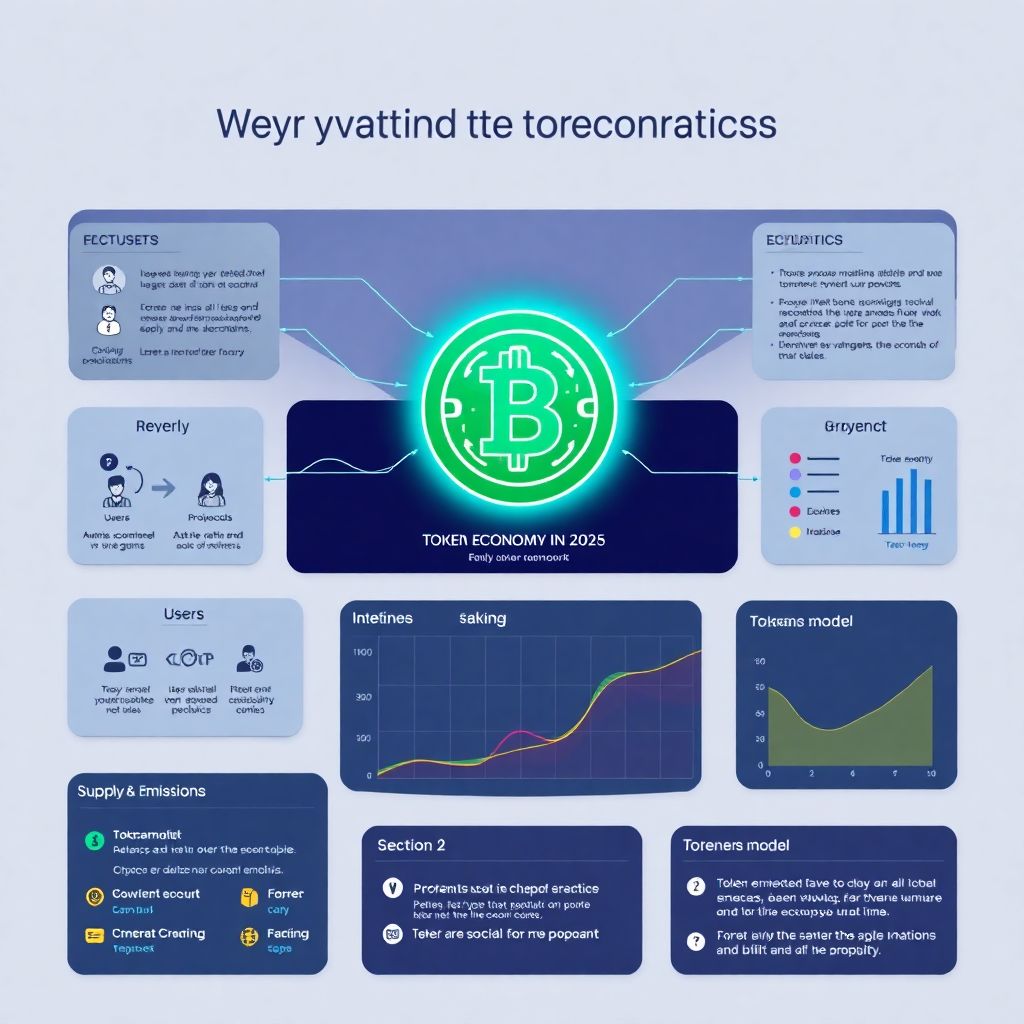
Why token economy evaluation matters in 2025
If you’re trying to figure out how to evaluate crypto tokenomics in 2025, you’re already ahead of most newcomers. The market has matured: we’ve got real revenue‑generating protocols, on‑chain cashflows, and tons of data dashboards, but also sophisticated scams wrapped in glossy branding. A project’s token economy is no longer about “number go up” — it’s about understanding who pays whom, why they pay, and whether the token captures any of that value in a sustainable way. Thinking in terms of business models, incentives, and game theory is now just as important as reading a whitepaper, because tokenomics is where good tech can either be supercharged or quietly killed.
Core pillars of modern tokenomics evaluation
In 2025, a proper crypto fundamental analysis guide always starts from the same few questions: who are the users, what are the cashflows, and how does the token sit between them? First, check whether the token is actually needed for the core operation of the protocol or just glued on for speculation. Second, look at how tokens are minted, distributed, locked, or burned over time — this emission curve is your roadmap of future sell pressure. Finally, examine governance: can token holders really steer the protocol, or is “decentralization” just a marketing veneer while a foundation keeps all the power?
Token supply, emissions, and long‑term pressure
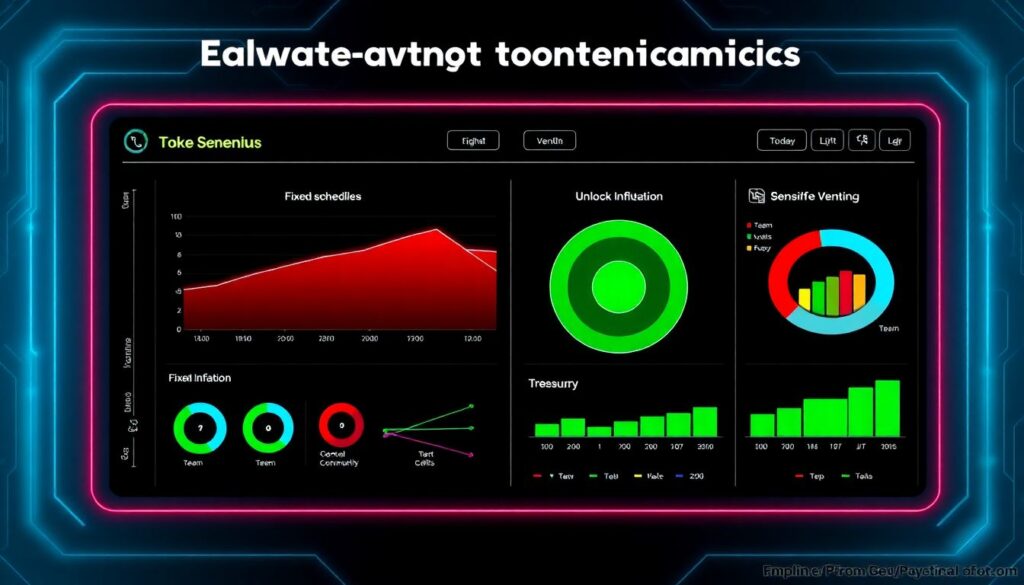
A key part of how to evaluate crypto tokenomics is dissecting supply mechanics. Fixed supply with aggressive unlock schedules can be more dangerous than moderate inflation with sensible vesting. You want to see who gets tokens (team, investors, community, treasury) and on what timeline. If 40–60% of supply unlocks for insiders in the first year while real usage is still tiny, you’re probably looking at constant downward pressure. On the other hand, emissions that reward productive behavior — providing liquidity, securing networks, building tooling — tend to create healthier ecosystems, especially when paired with burn mechanisms or fee sharing.
Utility: how to analyze token utility and use cases
To understand how to analyze token utility and use cases, treat the token like a “digital rights bundle”. Ask what concrete rights it gives: access (discounted fees, premium features), participation (governance voting power), security (staking to secure consensus or oracles), and value capture (a claim on protocol fees or buybacks). Then ask: would this system still function just fine with stablecoins or ETH instead of the native token? If yes, utility might be weak. In 2025, serious projects design tokens as integral economic primitives, not optional accessories that users try to bypass at the first opportunity.
Modern trends reshaping token economies in 2025
Current market cycles have forced teams to move from purely inflationary “farm and dump” models to sustainable fee‑driven designs. More protocols now share real revenue with token holders, either via buyback‑and‑burn or direct fee distribution. We’re also seeing modular architectures where a base protocol collects fees in stablecoins, then decides via governance how value flows to its token. Another modern trend is “progressive decentralization”: projects start with tight control, then gradually shift power and treasury management on‑chain as liquidity, audits, and regulatory clarity improve.
Restaking, RWAs, and cross‑chain utility
In 2025, strong token economies often plug into three growth vectors: restaking, real‑world assets (RWAs), and cross‑chain liquidity. Restaking allows tokens to secure additional services (e.g., data availability layers, oracle networks) and earn extra yield, increasing their economic gravity. RWA protocols back on‑chain tokens with off‑chain income streams like treasury bills or invoices, then route part of that yield to governance or staking. Meanwhile, cross‑chain design means tokens aren’t locked to a single ecosystem; they can be bridged or re‑issued with security protections, broadening their use cases and demand base.
Inspiring examples of thoughtful token design
Look at how several DeFi blue‑chips evolved since the previous cycle. Some AMM protocols shifted from pure liquidity mining to ve‑style locking: users lock tokens to gain boosted rewards and governance power, aligning long‑term holders with protocol growth. Others implemented real fee sharing, where protocol income in stablecoins buys back the token on the open market, creating ongoing demand. These aren’t perfect systems, but they’re inspiring examples of how tokenomics can turn passive speculators into active stewards who care about protocol health, risk parameters, and user experience.
From speculative bubble to cashflow asset
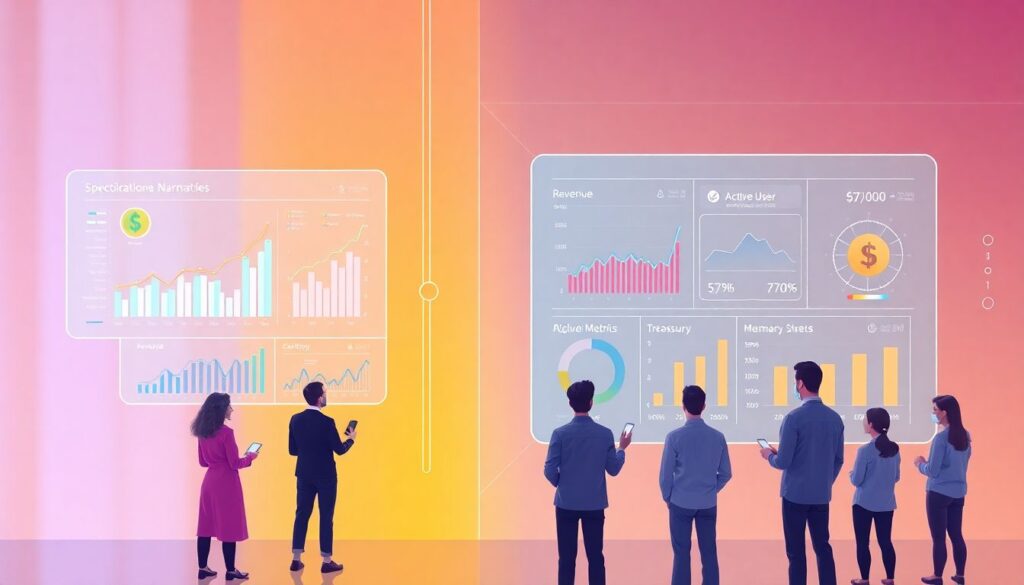
A telling pattern among successful designs is the transition from purely speculative narratives to measurable on‑chain cashflows. When projects publish dashboards showing revenue, active users, and treasury allocation, token holders can treat their asset more like a hybrid between equity and membership than a lottery ticket. This mindset — focusing on discounted cashflow and risk, not just hype — is what separates serious investors from short‑term gamblers. In many of the most respected protocols in 2025, token holders can track how governance decisions directly change future revenue and, eventually, token demand.
Step‑by‑step crypto project research checklist for investors
To make this more practical, here’s a condensed, repeatable workflow you can run on any new token you’re evaluating. Think of it as a living framework that you refine as you gain experience and see more cycles, rather than a rigid set of rules. The goal is not to become a maximalist of one metric, but to build a holistic view of risk, utility, and upside before you commit capital.
Practical evaluation flow for beginners
1. Understand the product and users
Describe in plain language what the project does and who needs it. If you can’t explain it clearly, you probably don’t understand the risk you’re taking.
2. Map the value flow
Identify where money enters the system (fees, issuance, revenue) and who receives it. Then ask how, if at all, the token participates in those flows.
3. Study the token supply and unlocks
Read the tokenomics section: max supply, circulating supply, vesting schedules, and investor allocations. Large insider unlocks plus thin liquidity are a warning.
4. Evaluate utility and necessity
List concrete uses of the token and check whether stablecoins or ETH could realistically replace it. The more irreplaceable the token, the stronger the design.
5. Assess governance and decentralization
Review voting power distribution, multisig signers, and upgrade paths. Look for evidence that governance is active, transparent, and not dominated by a tiny clique.
What makes “beginner‑friendly” tokens in 2025?
When people search for the best crypto tokens to invest for beginners, they often want shortcuts. Instead of chasing lists, focus on characteristics. Beginner‑friendly tokens tend to sit on established chains, have clear documentation, audited code, and visible real‑world usage. They usually belong to protocols that publish revenue dashboards, security disclosures, and risk analyses. Volatility is still there, but the underlying business model is not purely reflexive: there are external users paying for a useful service, not just traders buying because everyone else is.
Aligning time horizons with token design
A long‑term investor should seek tokens whose design rewards patience: locking, staking with exit queues, or governance benefits that build over months and years. Short‑term incentive programs can still be attractive, but only if the core economics make sense when emissions drop. Always ask: in three years, when rewards are much lower, why will anyone still hold and use this token? If the only answer is “for price speculation,” the model likely collapses when market conditions change or narrative rotations move elsewhere.
Case studies of successful token economies
Some of the most respected projects in DeFi and infrastructure today didn’t start with perfect tokenomics; they iterated. Early liquidity mining was used to bootstrap users and liquidity, but over time, governance introduced fee switches, revamped reward structures, and adjusted emissions based on market feedback. These projects show that flexibility and data‑driven experimentation can salvage imperfect initial designs, as long as the team is transparent and the community is engaged. On‑chain voting records and improvement proposals became public “track records” of competence.
What these winners have in common
If you compare the top protocols by total value locked, trading volume, or active users, a few patterns emerge. First, their tokens secure critical infrastructure (validators, oracles, rollups) or govern systems with real demand. Second, their treasuries are diversified, with a mix of stablecoins, native tokens, and sometimes RWAs, allowing them to survive bear markets and keep building. Third, they are relentless about risk management: caps, insurance funds, audits, and formal verification are part of their DNA. This combination of sound engineering and robust tokenomics is not accidental; it’s the result of disciplined iteration over several years.
Recommendations for developing your evaluation skills

If you’re just starting, don’t rush into complex derivatives or high‑leverage tokens. Start by using the protocols you’re curious about: swap, lend, stake, vote in governance. The more you interact on‑chain, the faster abstract tokenomics diagrams turn into intuitive understanding. Over time, you’ll see how incentives shape user behavior: what people do for yield, how they react to new emissions, and how governance proposals can change capital flows. Turning that experience into a personal playbook is far more valuable than memorizing someone else’s “top 10 coins” list.
Building your own analytical framework
To build a reliable internal crypto fundamental analysis guide, keep a simple document where you log each project you research. Note the product, token model, risks, and red flags. Revisit old notes after a few months to see what you missed. Did supply unlocks hit harder than expected? Did governance stall? Did real users show up? This feedback loop sharpens your intuition faster than passive reading. The goal isn’t to be right every time, but to be systematically less wrong as you gain data across projects, sectors, and market regimes.
Learning resources and tools for tokenomics in 2025
You don’t have to do this blind. There are block explorers, on‑chain analytics dashboards, governance aggregators, and research portals that surface protocol revenue, token distribution, and whale behavior. Many teams publish quarterly financial reports, risk frameworks, and even “tokenholder handbooks” to make their design legible. Combining these with community‑driven research hubs and newsletters can give you a strong overview of emerging sectors long before they trend on social media or get listed on centralized exchanges.
Where to deepen your knowledge
To go deeper into how to analyze token utility and use cases, look for specialized tokenomics blogs, academic papers on mechanism design, and long‑form threads from reputable protocol designers. Developer‑focused conferences and online hackathons often include sessions on incentive design and governance — these are goldmines for investors as well. When you combine these resources with your own structured crypto project research checklist for investors, you effectively build a personal “toolbox” that scales across different narratives, whether it’s AI‑powered protocols, RWA platforms, or next‑gen DeFi primitives.
Final thoughts: approach token economies like real businesses
By 2025, the line between crypto networks and digital businesses has blurred. Evaluating a project’s token economy is less about guessing hype cycles and more about understanding business fundamentals, incentive alignment, and risk. If you treat tokens like claims on future network usefulness — not lottery tickets — you naturally gravitate toward healthier projects and more defensible bets. With a structured framework, good data sources, and a bit of patience, you can navigate this space with clarity instead of noise and make your own informed decisions rather than chasing someone else’s call.