
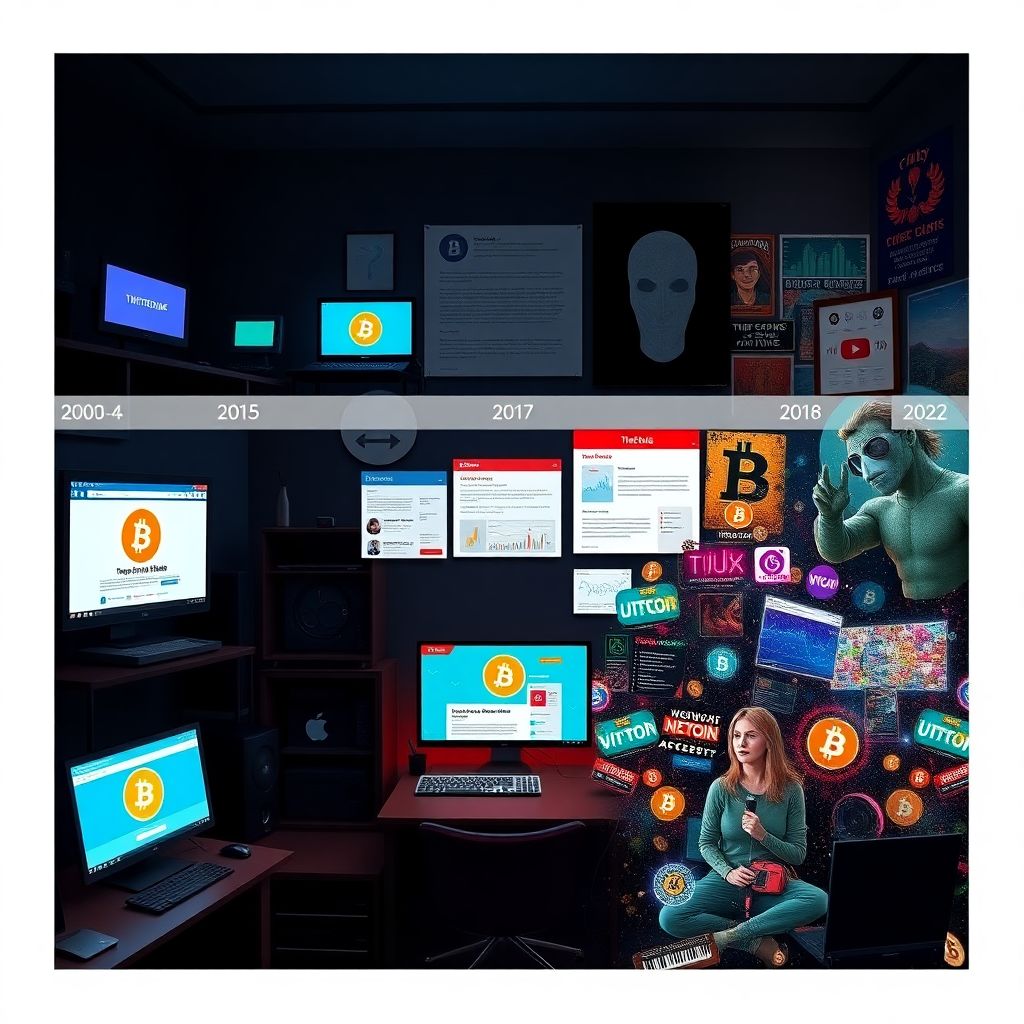
Crypto went from cypherpunk hobby to Super Bowl commercials in one wild decade. In 2025 it’s no longer “that weird internet money” — it’s regulation, ETFs, on‑chain games, AI agents trading for you, memecoins flying and crashing in days. That chaos creates one big opportunity: people are desperate for guides they can trust.
That’s where your crypto blog or vlog comes in.
Below is a grounded, step‑by‑step look at how to start a crypto blog or vlog for beginners, how it actually makes money, and what matters in 2025 (not 2017).
—
From BitcoinTalk to TikTok: a tiny bit of history
Crypto content started long before influencers and thumbnails with laser eyes.
– 2010–2014 – Forums and long reads.
Early Bitcoin adopters lived on Bitcointalk, Reddit, niche blogs. Zero SEO, just hardcore discussions about mining, block sizes and libertarian dreams.
– 2015–2017 – Blog era and ICO boom.
Medium and Steemit exploded, “top 10 altcoins to buy now” posts multiplied, and affiliate links to shady exchanges hid everywhere. Many people learned crypto through half‑baked “guides” during the ICO mania.
– 2018–2020 – Crash, then quiet growth.
After the 2018 bear market wiped out a lot of hype, more serious research blogs and YouTube channels appeared. People began asking, “What is actually being built?”
– 2020–2022 – DeFi, NFTs, and influencer industrial complex.
Yield farming, OpenSea, dog coins, sudden millionaires, then sudden zeroes. Crypto YouTubers and TikTokers turned into mini‑media‑companies with sponsors, merch and paid groups. Some educated; many just shilled.
– 2023–2025 – Regulation, AI and “on‑chain everything”.
Spot Bitcoin and ETH ETFs in the US, MiCA in Europe, and AI tools for on‑chain analysis. Audiences are more skeptical now: they want signals, not hype. That’s good news if you want to build a serious blog or channel.
Understanding this arc helps you avoid two classic traps: copying outdated 2017 tactics and repeating 2021‑style pump‑and‑dump behavior that can now get you legally in trouble.
—
Blog or vlog: what’s the real difference in 2025?
Both a crypto blog and a vlog aim to do three things: explain, simplify, and build trust. The format you choose shapes how you do it.
Blogging in crypto: words, charts, and search traffic
A blog is still the most reliable base if you’re thinking long term.
Плюсы:
– Search engines can send you traffic for years.
– Easier to fact‑check and edit (you can quietly fix mistakes).
– Perfect for deep dives, tutorials, code snippets, charts.
– Great foundation for email lists, newsletters, and paid courses.
Минусы:
– Growth is usually slower in the beginning.
– Writing clear, engaging text is work; AI drafts still need human editing.
– You won’t capture people who spend all their time on YouTube or TikTok.
In 2025, written content pairs well with AI: you can generate first drafts, outlines or summaries, then refine them with your own research and voice.
Vlogging in crypto: video, personality, and fast trust
A crypto vlog (YouTube, Shorts, TikTok, Reels) is your face + your take.
Плюсы:
– Faster trust building — people see your reactions and tone.
– Better for market updates, reactions to news, interviews.
– Short‑form clips can go viral and push your main channel.
Минусы:
– Video editing, sound, lighting — you’ll need at least basic skills.
– Harder to correct mistakes after publishing.
– Platform rules: demonetization, copyright strikes, regulation on “financial advice”.
If you’re wondering how to start a crypto youtube channel today, the reality is that “turn on webcam and rant about Bitcoin” doesn’t cut it anymore. You’re competing with polished, semi‑professional studios — but you win by being more honest, more specific, and more niche.
—
Which approach suits you? Simple self‑diagnosis
You don’t need to choose forever, but starting with one clear focus helps a lot.
Ask yourself:
– Do I think more easily in written form or by talking out loud?
– Am I okay with being on camera — or at least using voice‑over?
– Do I enjoy editing text more or editing video timelines?
If you:
– like researching, structuring arguments, and quietly polishing your thoughts → start with a blog, then repurpose posts into scripts or threads.
– speak easily, gesture a lot, and can riff on topics without a full script → begin with a vlog, then add a simple website later.
– are unsure → record 3–4 test videos and write 3–4 test articles in a week. Publish none of them. Which process felt less like torture? Start there.
The best creators in 2025 are multi‑format, but they rarely start that way.
—
Core technologies: what you really need (and don’t)
Let’s separate essentials from shiny distractions.
For a crypto blog
At minimum you need:
– A platform
– A simple, fast design
– Basic analytics
Many guides on how to start a crypto blog and make money overcomplicate this part. You don’t need custom blockchains or “Web3 native publishing” on day one.
The classic route (still strong in 2025):
– Domain + hosting + WordPress (or another CMS)
– A clean theme, no heavy sliders
– A few must‑have plugins: SEO, caching, backups, newsletter signup
This still counts among the best crypto blog platforms to earn money because you fully control your content, domains, and monetization.
The “hosted” route (easier start):
– Substack, Ghost(Pro), Medium (with your own domain), or Beehiiv
– Built‑in email newsletter, subscription buttons, analytics
Hosted platforms reduce technical friction; the trade‑off is less control and greater platform risk.
For a crypto vlog
For video, you mainly need:
– A camera (modern smartphone is enough at first)
– Decent microphone (audio matters more than 4K)
– Basic editing software (DaVinci Resolve, CapCut, Final Cut, etc.)
No need for a studio from day one. Start with:
– natural light near a window,
– neutral background,
– no distracting noise.
Later you can add a softbox, better lens, branded overlay, and multi‑angle shots if you enjoy the craft.
—
Pros and cons of blogging vs vlogging in crypto
Where blogs shine
1. Searchability and depth
Long guides like “crypto blogging for beginners step by step” can rank in search and keep attracting newcomers. You can include screenshots, code samples, on‑chain charts and nuance that is hard to display in a 60‑second Short.
2. Multi‑language and translation
It’s easier to translate and localize text than video. In 2025, multi‑lingual crypto content (English + local language) is a big growth lever.
3. Lower production cost
A laptop, some time, and discipline — that’s mostly it.
Where vlogs shine
1. Speed and reaction
Big news — ETF approvals, protocol hacks, new regulations — spreads visually. A quick breakdown video can ride the wave of interest.
2. Emotional connection
People stay not just for “crypto alpha” but because they like your vibe. That’s hard to fake and hard to copy.
3. Native ad formats
Sponsors love pre‑rolls, mid‑rolls, integrated segments, and product demos. When you think about how to make money from a crypto vlog, most of the serious income tends to come from sponsors and your own products, not just YouTube ads.
—
Step‑by‑step plan: from zero to your first 50 pieces of content
Let’s merge blogging and vlogging into one actionable roadmap.
Step 1. Choose your angle, not “all of crypto”
“Crypto” is too big. In 2025 it includes:
– L1/L2 ecosystems (Bitcoin, Ethereum, Solana, modular chains)
– DeFi, NFTs, GameFi
– Stablecoins, real‑world assets (RWA)
– Regulation, tax, security, on‑chain analytics, AI + crypto
Pick a narrow lane where you’re slightly ahead of absolute beginners:
– “Crypto security and avoiding scams for non‑tech people”
– “How to use DeFi on Ethereum and L2s safely”
– “Bitcoin only, for long‑term investors”
– “On‑chain analysis basics for new traders”
– “Crypto for freelancers and online creators: getting paid, taxes”
You can expand later. Depth beats breadth early on.
Step 2. Define your “beginner”
The word “beginner” is vague. Clarify:
– Are they totally new to investing?
– Do they already own Bitcoin on an exchange?
– Are they under 20 or over 40?
– What country or legal environment are they in?
A post titled “First week in crypto if you’re 35+, have a day job and zero time” is more useful than “Crypto for beginners” because it speaks to a specific life situation.
—
Step 3. Minimum setup for a blog
Do this if you’re starting with text:
– Buy a clear domain (avoiding “moon”, “lambo”, “100x” clichés).
– Set up WordPress or a hosted platform.
– Create 3 basic pages: About, Disclaimer, Contact.
– Add a simple email signup (no fancy funnel, just “get new posts”).
Your first articles might be:
– “Why I started this blog and what I will and won’t do here”
– “Crypto security basics: 5 mistakes that cost people real money”
– “How to choose your first exchange and not get rekt by fees”
These early posts are your reference links for future content.
—
Step 4. Minimum setup for a vlog
If video is your starting point:
– Create a YouTube channel with a descriptive name.
– Write a channel description that clearly states who it’s for.
– Design a simple banner and profile pic (Canva works fine).
– Prepare a disclaimer you repeat in descriptions and occasionally in videos.
Your first 3–5 videos might cover:
– Who you are, your level of expertise, and your approach.
– How you personally manage risk and what you don’t talk about (no pumps, no secret signals, etc.).
– A slow, clear walkthrough: “setting up your first wallet”, “how to send a test transaction with $5”.
Make peace with the fact that the first 10–20 videos will look awkward. That’s normal.
—
Step 5. Consistency over optimization
In the beginning, your content schedule matters more than your logo, color scheme, or perfect SEO.
Aim for:
– 2–3 pieces of content per week (blog posts or videos).
– 50 pieces as a minimum before you judge your results.
You can repurpose:
– Turn each article into a video script.
– Turn each video into a short summary post.
– Cut 1–3 shorts or reels from each longer video.
This accelerates learning and spreads your voice across platforms.
—
Monetization: realistic paths in 2025

Everybody wants to know how this turns into income. That’s sensible — if you’re serious, you should think about money from day one, just not let it dictate every word.
Main monetization channels
– Affiliate links
Exchanges, wallets, tax software, VPNs, data providers. Use them transparently, explain why you chose them, and compare alternatives.
– Sponsorships
Protocols, analytics platforms, NFT marketplaces, sometimes even funds and brokers. Here ethics and legality matter: do due diligence, clearly label sponsored content, and refuse obvious scams.
– Own products
E‑books, video courses, consulting, private communities (Discord/Telegram), templates, checklists.
– Ad revenue
Display ads on a blog and YouTube AdSense. Nice as a baseline, rare as a main source unless you have large traffic.
When people talk about how to start a crypto blog and make money, they often jump straight to “best pay‑per‑signup affiliate program”. That’s short‑sighted. The durable way is:
1. Teach clearly.
2. Build trust.
3. Recommend tools you’d use yourself.
4. Launch your own simple product once you know what your audience actually struggles with.
For video, how to make money from a crypto vlog follows the same logic, just with stronger emphasis on sponsors and your own offers, because ad revenue is volatile and platform‑dependent.
—
2025 trends you can ride as a beginner
Understanding where attention is moving can help you pick themes that grow.
Trend 1. Regulation and tax clarity
More countries now have at least basic rules for:
– crypto taxation,
– KYC/AML for exchanges,
– stablecoins and tokenized securities.
Beginners are hungry for plain‑language explanations like, “What does MiCA mean for an average EU investor?” or “How are US crypto ETFs taxed if you’re not a pro trader?”
If you can read legal summaries and then translate them into normal speech, you’re valuable.
Trend 2. AI + on‑chain data

Tools that auto‑label wallets, detect unusual flows, and generate dashboards are becoming mainstream. People want to know:
– how to use these tools without getting lost,
– how to avoid “AI hallucinations” in financial decisions,
– how to combine human judgment with machine suggestions.
Content that calmly tests these tools and shows real workflows can stand out.
Trend 3. Real‑world assets and stable yield
Tokenized T‑bills, real estate, invoices, carbon credits — RWA projects are trying to bridge TradFi and DeFi. In a post‑2022 market, many beginners don’t want 100x; they want “something more interesting than a bank deposit but not casino level”.
Explaining risks and mechanisms here is a strong niche.
Trend 4. Short‑form “explainers” plus long‑form deep dives
Audiences often discover you via 30–90 second clips, then decide to trust you after watching or reading long‑form content. Smart creators pair:
– quick, punchy shorts on a single idea;
– detailed 15–30 minute breakdowns or 2000‑word guides.
You can apply this pattern whether you lean blog‑first or vlog‑first.
—
Risk, ethics, and trust: your actual competitive edge
Crypto has a reputation problem: scams, Ponzi schemes, anonymous promoters who disappear when things collapse.
As a beginner creator, you can differentiate yourself by being boringly honest:
– No secret signal groups.
– No guaranteed returns.
– Clear disclaimers: not financial advice, do your own research.
– Openly admitting what you don’t understand yet.
Over time, that honesty compounds. People remember creators who said “I don’t know” instead of confidently selling them the top.
—
Quick comparison and recommendations
To condense it all:
– Choose blog‑first if you:
– like writing and structure;
– want evergreen “how‑to” content to rank over time;
– are comfortable learning basic SEO and email marketing.
– Choose vlog‑first if you:
– express yourself better by speaking;
– enjoy visuals, pacing, and editing;
– are ready to show up on camera consistently.
– Combine both once:
– you’ve published ~30–50 pieces in your main format;
– you see what topics get the most feedback;
– you can sustainably add a second workflow.
The core idea doesn’t change: explain, simplify, be transparent about incentives.
—
Final thought: you don’t need to be an “expert”, just one chapter ahead
In 2013, “crypto expert” meant someone who had run a node and read the whitepaper. In 2017, it sometimes meant “bought a token before you”. In 2021, it sadly often meant “has more followers than you”.
In 2025, sustainable crypto creators are usually:
– one or two steps ahead of their audience,
– obsessive about learning,
– careful with claims,
– generous with explanations.
If you can stay curious, keep publishing, and treat your readers or viewers as partners rather than exit liquidity, your crypto blog or vlog has every chance to become not just a side hustle, but a serious personal media asset over the next cycle.